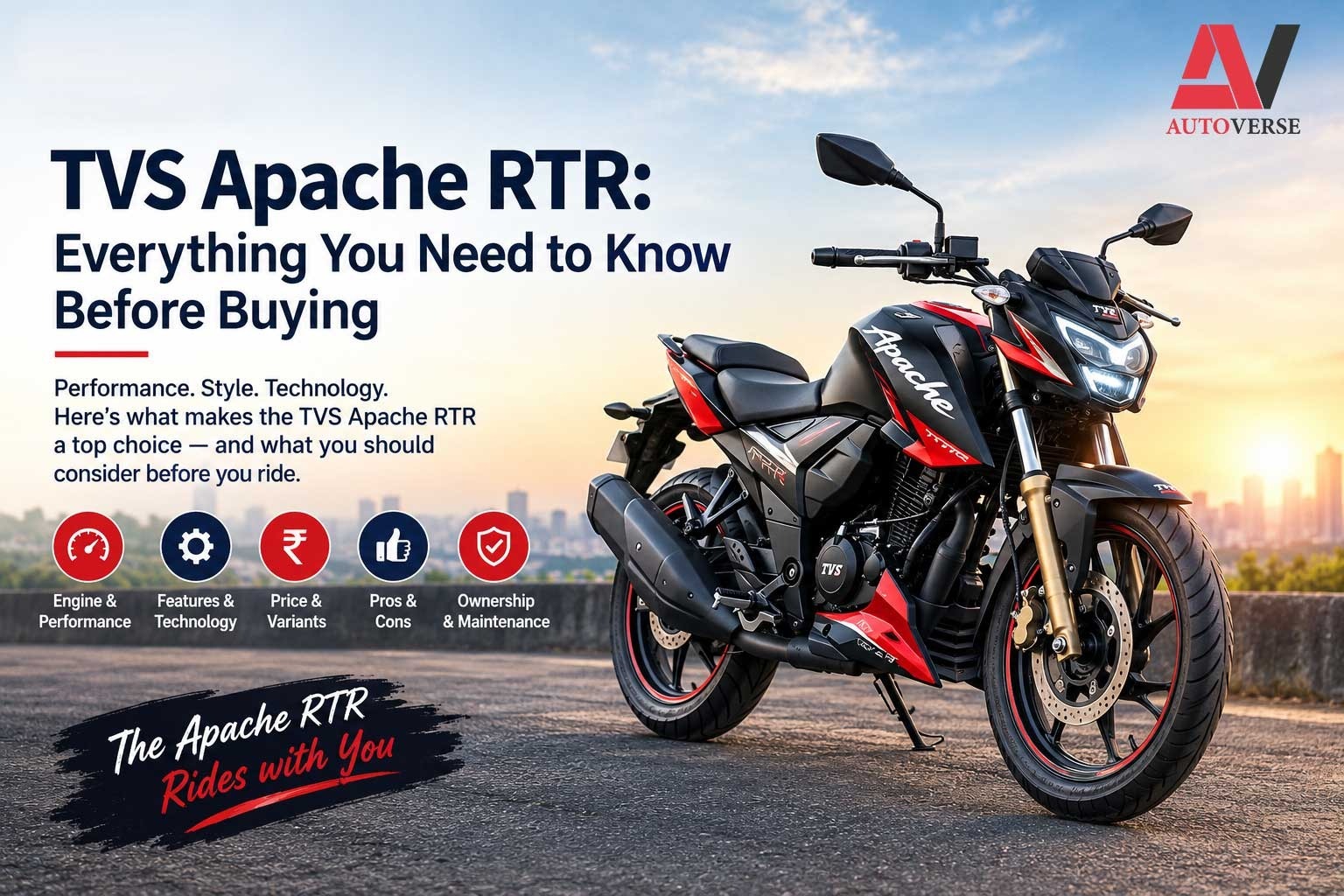
If you are looking at the TVS Apache RTR and wondering which version makes sense for you, the choice can be a little confusing. The Apache name now covers motorcycles with different engine capacities, performance levels, features and prices.
From the Apache RTR 160 2V and RTR 160 4V to the more powerful RTR 200 4V and RTR 310, there is an Apache for different types of riders. Among them, the Apache RTR 160 4V is particularly relevant for buyers who want a sporty motorcycle that can still handle everyday city riding.
But should you buy the entry-level version or spend more on the higher variants? Are the additional features actually useful? And how does the Apache fit into normal daily riding?
Here is a practical buyer’s guide to the TVS Apache RTR range, with a closer look at the Apache RTR 160 4V.
What Is the TVS Apache RTR?
RTR stands for Racing Throttle Response. The Apache RTR family has traditionally focused on combining sporty styling and performance with everyday usability.
The range includes motorcycles such as the Apache RTR 160 2V, Apache RTR 160 4V, Apache RTR 180, Apache RTR 200 4V and Apache RTR 310.
These motorcycles are not simply different versions of the same bike. They have different engine capacities, performance levels, equipment and price points.
For buyers shopping in the 160cc segment, the Apache RTR 160 4V is one of the most important models to consider because it combines a relatively compact motorcycle with performance-oriented hardware and modern features.
TVS Apache RTR 160 4V: At a Glance
| Key Detail | Apache RTR 160 4V |
|---|---|
| Engine | 159.7cc, single-cylinder, 4-valve |
| Maximum Power | 17.55 PS |
| Maximum Torque | 14.73 Nm |
| Gearbox | 5-speed |
| Fuel Tank | 12 litres |
| Seat Height | 800 mm |
| Ground Clearance | 180 mm |
| Kerb Weight | 143–146 kg, depending on variant |
| Riding Modes | Sport, Urban and Rain |
| ABS | Single-channel / dual-channel depending on variant |
| Front Suspension | Telescopic / USD depending on variant |
| Rear Suspension | Mono-shock |
| Front Brake | 270mm petal disc |
| Rear Brake | 240mm petal disc |
The exact equipment varies between variants, so buyers should check the specification of the particular version they are considering.
2026 TVS Apache RTR 160 4V: What’s New?
The 2026 Apache RTR 160 4V received an important equipment update.
TVS added a Class-D projector headlamp with signature DRLs and all-LED lighting, while Assist & Slipper Clutch technology was extended to additional variants.
The motorcycle also continues with three riding modes — Sport, Urban and Rain.
The top-spec version gets additional technology including a 5-inch TFT display and traction control.
This means the latest RTR 160 4V is not simply about engine performance. The motorcycle now offers a combination of mechanical and electronic features that can appeal to riders looking for a more feature-rich 160cc motorcycle.
Apache RTR 160 4V Engine and Performance
The Apache RTR 160 4V uses a 159.7cc, single-cylinder, four-valve engine with fuel injection and a five-speed gearbox.
In Sport mode, TVS lists the motorcycle’s maximum output at 17.55 PS at 9,250 rpm and 14.73 Nm at 7,500 rpm.
Urban and Rain modes provide different power and torque characteristics.
The important point for a buyer is that the Apache is designed to offer more than basic point-to-point commuting.
It has a performance-oriented character, but its compact dimensions and relatively manageable weight mean it can still be used for regular city travel.
If you are moving from a conventional commuter motorcycle to a more performance-focused machine, however, a test ride is important. Engine response, clutch feel and riding position can feel quite different from a typical commuter.
TVS Apache RTR 160 4V Price
The price of the Apache RTR 160 4V can vary by variant and location.
TVS’s current model information lists the motorcycle from around ₹1.25 lakh ex-showroom, while prices can change with variant updates and location.
For the 2026 launch, TVS announced the following Delhi ex-showroom prices:
| Variant | Ex-showroom Delhi Price |
|---|---|
| Single Channel ABS | ₹1,25,440 |
| Dual Channel ABS with USD | ₹1,30,690 |
| USD with TFT | ₹1,37,440 |
These figures are ex-showroom prices. The final on-road amount will be higher after registration, insurance and other applicable charges.
Because motorcycle prices can change, buyers should check the latest quotation from an authorised TVS dealer before booking.
Which Apache RTR 160 4V Variant Should You Consider?
This is one of the most important questions for a potential buyer.
The three variants are not simply different versions with different displays. There are differences in braking, suspension and electronic equipment.
Apache RTR 160 4V Single Channel ABS
The entry version is aimed at buyers who want the Apache’s engine, styling and core riding experience without paying for all the additional equipment.
It gets single-channel ABS and telescopic front suspension.
For someone primarily using the motorcycle for regular city commuting, this version may provide enough of what they actually need.
Apache RTR 160 4V Dual Channel ABS with USD
The next version adds dual-channel ABS and USD front suspension, along with additional equipment.
This can be particularly relevant to riders who regularly travel on faster roads or enjoy weekend riding.
The additional hardware is more meaningful than simply having a different appearance because braking and suspension are directly related to how the motorcycle behaves on the road.
Apache RTR 160 4V USD with TFT
The top variant adds the 5-inch TFT display and traction control, along with the higher-spec hardware.
It is aimed at buyers who want the complete equipment package.
However, the most expensive version is not automatically the right version for everyone.
If you mainly commute through city traffic and do not particularly value connected technology or additional electronics, the lower variants may be sufficient.
Apache RTR 160 4V vs Apache RTR 160 2V
Both motorcycles use a 159.7cc engine, but they are positioned differently.
| Feature | Apache RTR 160 2V | Apache RTR 160 4V |
|---|---|---|
| Engine | 159.7cc | 159.7cc |
| Valve configuration | 2-valve | 4-valve |
| Maximum Power | 16.04 PS | 17.55 PS |
| Character | Simpler | More performance-oriented |
| Equipment | Relatively straightforward | More electronics and hardware options |
| Suitable for | Everyday city use | Performance + everyday riding |
The RTR 160 2V can make sense for a buyer who wants an Apache motorcycle but does not need all the additional features of the 4V.
The RTR 160 4V, on the other hand, is aimed at buyers who want more performance and equipment.
The right choice therefore depends less on the Apache badge and more on how much performance and technology you actually want.
Three Riding Modes: Are They Really Useful?
The Apache RTR 160 4V offers Sport, Urban and Rain modes.
Sport mode is intended for a more performance-oriented response, while Urban and Rain modes are designed around different everyday riding conditions.
For someone who rides in varied conditions, this can be a useful feature.
However, riding modes should not be treated as a substitute for responsible riding. They change the motorcycle’s response; they do not eliminate the effects of poor road surfaces, wet conditions, excessive speed or sudden traffic situations.
For many buyers, the best way to understand the difference is to try the modes during a proper test ride.
Assist & Slipper Clutch: Who Really Needs It?
The Apache RTR 160 4V gets Assist & Slipper Clutch technology on relevant variants.
The assist function can make clutch operation easier, while the slipper mechanism is particularly useful during aggressive downshifts.
This feature is more noticeable to riders who enjoy spirited riding than to someone who spends most of the day crawling through traffic.
Still, even everyday riders can appreciate a lighter clutch operation.
Projector Headlamp and LED Lighting
The 2026 Apache RTR 160 4V gets a Class-D projector headlamp and LED lighting.
For riders who regularly travel after dark, lighting performance is an important practical consideration.
However, buyers should avoid judging a motorcycle’s night-time visibility only from photographs or specifications.
Road conditions, weather, riding speed and the condition of the road itself also affect visibility.
If possible, check the headlamp performance during a test ride or ask the dealer about a demonstration.
SmartXonnect and TFT Technology
Higher versions of the Apache RTR 160 4V get TVS’s connected technology, with the top variant featuring a 5-inch TFT display.
Features can include navigation and other connected information depending on the version and system functionality.
For riders who frequently use navigation or like having additional information available on the motorcycle’s display, this can be useful.
But this is also an area where personal preference matters.
If your priority is simply getting from home to work every day, a large connected display may not be as important as comfortable ergonomics, braking hardware or suspension.
Is the Apache RTR 160 4V Comfortable for Daily Use?
The Apache RTR 160 4V has a sporty character, but sporty styling does not automatically mean it is unsuitable for commuting.
The motorcycle has an 800mm seat height and weighs approximately 143–146kg depending on the variant.
Its relatively compact dimensions can be useful in crowded city traffic, particularly when moving through narrow spaces or parking.
However, comfort is subjective.
A rider who prefers a very relaxed and upright commuter riding position may find the Apache’s sporty character different from what they are used to.
This is why sitting on the motorcycle is important before buying.
Check whether you can comfortably place your feet on the ground, whether the handlebar position feels natural and whether the seat remains comfortable after spending some time on the motorcycle.
Is the Apache RTR 160 4V Good for City Traffic?
The Apache is still compact enough to work well as a city motorcycle.
The five-speed gearbox, fuel-injected engine and riding modes give it flexibility for different traffic conditions.
TVS also offers Glide Through Technology (GTT), which is designed to assist smooth low-speed movement under suitable conditions.
For riders who spend a significant amount of time in stop-and-go traffic, features such as clutch operation, low-speed response and manageable weight can be more important than maximum power.
This is one reason a test ride should include actual traffic rather than only a short ride around an empty dealership road.
What About Mileage?
Mileage is naturally an important consideration for Indian motorcycle buyers.
However, there is no single real-world mileage figure that applies to every Apache RTR 160 4V rider.
Fuel economy can change depending on:
- Traffic conditions
- Riding speed
- Acceleration habits
- Passenger load
- Tyre pressure
- Road conditions
- Motorcycle maintenance
- Use of the motorcycle in Sport mode
A motorcycle ridden gently on relatively open roads will generally have different fuel consumption from one used in heavy stop-and-go traffic.
Therefore, do not select the Apache—or any other motorcycle—based solely on one claimed mileage figure.
Instead, consider your annual running and typical riding conditions.
What About Safety?
Safety equipment is one of the areas where the Apache RTR 160 4V variants differ.
The higher versions offer dual-channel ABS, while the entry version uses single-channel ABS.
The higher-spec variants also receive additional hardware such as USD front suspension.
This makes it important to compare the exact variant rather than simply searching for the starting price of the Apache RTR 160 4V.
A difference in price can represent differences in braking equipment, suspension, electronics and display technology.
For riders who regularly travel at higher speeds or use the motorcycle for longer rides, these differences may deserve closer consideration.
Apache RTR 200 4V: Should You Move Up?
If you want more performance than the RTR 160 4V offers, the Apache RTR 200 4V is another option within the family.
Its 197.75cc engine produces up to 20.82 PS and 17.25 Nm in Sport mode, according to TVS.
It also gets a five-speed gearbox and slipper clutch.
The 200 4V therefore moves the Apache experience into a higher performance bracket.
The trade-off is simple: you are moving to a larger motorcycle and a higher price point.
For a buyer whose priority is primarily city commuting, the 160cc models may already provide enough performance. Someone who regularly enjoys open roads and wants stronger acceleration may want to consider the 200 4V as well.
Apache RTR 160 4V for City Riding vs Weekend Riding
Your riding pattern should influence the variant you choose.
If you mainly commute in the city
Pay attention to:
- Clutch operation
- Low-speed response
- Riding position
- Weight
- Seat comfort
- Fuel economy
- Ease of parking
In this situation, you may not need every available electronic feature.
If you combine city riding with weekend trips
The higher-spec variants become more interesting because equipment such as dual-channel ABS, USD suspension and additional electronics can become more relevant.
If you enjoy enthusiastic riding
Engine response, suspension, braking hardware, tyres, riding modes and slipper-clutch functionality deserve greater attention.
The important point is to match the motorcycle to your actual usage rather than buying a variant simply because it has the longest equipment list.
Apache RTR 160 4V: Things Buyers May Like
There are several reasons the motorcycle stands out in the 160cc category:
- Strong performance for its engine size
- Sporty styling
- Three riding modes
- Projector headlamp
- Assist & Slipper Clutch on relevant variants
- Dual-channel ABS available on higher variants
- USD front suspension on higher variants
- TFT display available on the top variant
- Traction control on the top variant
- 12-litre fuel tank
- Relatively manageable size for urban riding
Things to Consider Before Buying
The Apache RTR 160 4V is not designed to be everything to everyone.
Before buying, consider these points:
The sporty character may not suit everyone
If you prefer a very relaxed commuter-style motorcycle, take a longer test ride before deciding.
Variant selection matters
The entry and top variants differ significantly in equipment. Compare the exact specifications before paying a booking amount.
More features mean a higher price
A TFT display, traction control, USD suspension and dual-channel ABS can be useful, but not every rider needs every feature.
Mileage will depend on usage
Do not assume that another owner’s fuel economy will be identical to yours.
Seat height should be checked personally
At 800mm, the seat height may be comfortable for many riders, but shorter riders should sit on the motorcycle before making a decision.
What Will the Apache RTR 160 4V Cost to Own?
The purchase price is only one part of motorcycle ownership.
Before buying, consider:
- Fuel
- Insurance renewal
- Scheduled servicing
- Engine oil and consumables
- Tyres
- Brake pads
- Chain maintenance
- Registration and applicable charges
- Accessories, if required
Your annual ownership cost will depend heavily on how much you ride.
Someone covering a few thousand kilometres a year will have a very different running cost from a daily commuter covering several hundred kilometres every month.
It is therefore worth asking the dealer for the current service schedule and approximate routine-service costs before making your final decision.
Who Should Consider the Apache RTR 160 4V?
The Apache RTR 160 4V is particularly relevant for riders who want a combination of:
- Sporty styling
- Strong performance
- Everyday usability
- Modern electronics
- Multiple riding modes
- More sophisticated hardware on higher variants
It can work as a daily city motorcycle while also offering enough performance for occasional longer rides.
Who May Want to Consider Other Motorcycles?
The Apache RTR 160 4V may not be the natural choice for someone who:
- Wants the simplest possible commuter
- Prioritises relaxed ergonomics above sporty handling
- Does not care about performance-oriented features
- Wants the lowest possible purchase price
- Primarily rides very short distances at low speeds
That does not make the Apache unsuitable. It simply means the motorcycle should match the rider’s priorities.
What Should You Check During the Test Ride?
Before booking the Apache RTR 160 4V, don’t just ride around the dealership for two minutes.
Try to evaluate:
1. Riding position
Check the handlebar, footpeg position and seat comfort.
2. Clutch feel
Spend some time at low speeds and, if possible, in traffic.
3. Gearbox
See how easily you can shift through the gears during normal riding.
4. Suspension
Ride over a few speed breakers or uneven surfaces and observe how the motorcycle feels.
5. Braking
Test the brakes progressively and understand how the motorcycle responds.
6. Low-speed behaviour
This is especially important if the motorcycle will be used mainly in city traffic.
7. Variant-specific features
If you are considering a higher variant, actually try the TFT, riding modes and other available features instead of assuming you will use them regularly.
Final Takeaway
The TVS Apache RTR is not one motorcycle but a family of motorcycles designed around different levels of performance and equipment.
For buyers in the 160cc segment, the Apache RTR 160 4V stands out for combining a 159.7cc engine with sporty hardware, three riding modes and a wide range of technology depending on the variant.
The 2026 update adds further equipment, including a projector headlamp and all-LED lighting, while higher versions bring features such as dual-channel ABS, USD suspension, a TFT display and traction control.
However, buying the most expensive variant simply because it has the longest feature list may not make sense for every rider.
If your motorcycle will mainly be used for city commuting, focus on comfort, low-speed behaviour, clutch operation, braking and running costs. If you also enjoy weekend rides, the higher-spec variants may deserve closer attention.
Most importantly, take a proper test ride before booking the motorcycle. A few minutes on the road can tell you much more about the riding position, clutch, gearbox, suspension and overall character than a specification sheet can.
For more automobile news, buying guides and useful two-wheeler information, visit the AutoVerse homepage.