Volkswagen Group could be preparing for one of its biggest strategic shifts in India. After years of trying to strengthen its position largely through its own operations, the German automotive giant is now looking to JSW Group for local investment, manufacturing support and a faster route to growth.
The proposed partnership between Volkswagen Group and the Sajjan Jindal-led JSW Group could reshape how the company’s Indian passenger vehicle business operates. The focus is expected to extend beyond launching new cars, with deeper localisation, improved sourcing, manufacturing expansion and a stronger dealership network all forming part of the broader plan.
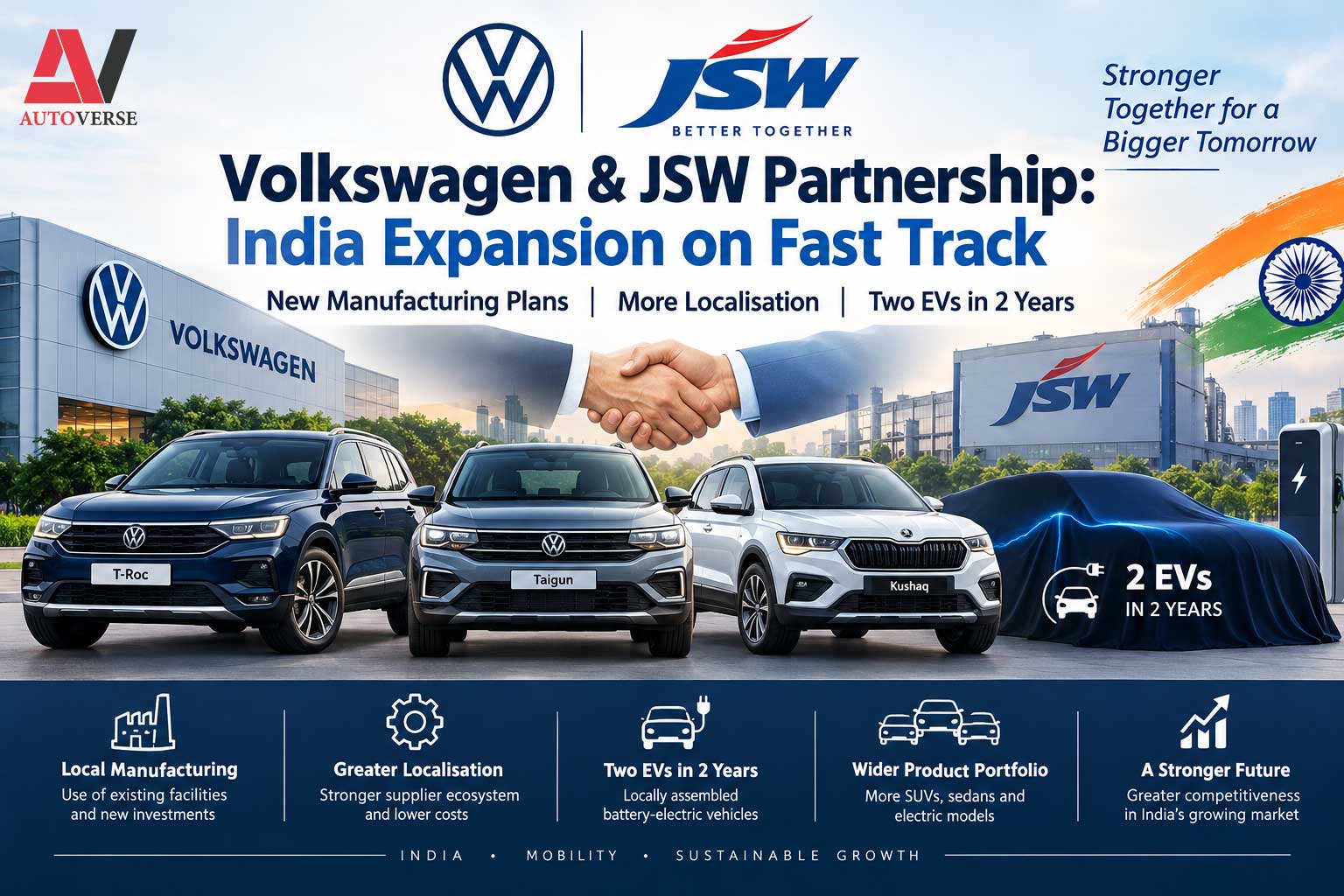
For Indian car buyers, the most interesting development is the reported plan to introduce two locally assembled battery-electric vehicles within two years. If the strategy moves ahead as planned, it could mark the beginning of a new phase for Volkswagen and Škoda in India.
But what exactly is changing, and why does Volkswagen need a partner like JSW?
Volkswagen and JSW Partnership: What We Know So Far
The proposed alliance took a significant step forward in September 2026, when JSW Group and Volkswagen Group’s Indian operations signed a non-binding memorandum of understanding (MoU) to begin exclusive negotiations.
Reports have described a proposed 51:49 ownership structure, with JSW expected to hold 51% and Volkswagen’s Indian operation holding 49%. The final agreement, including the precise investment, valuation and operational arrangements, remains subject to negotiations.
The proposed venture is expected to operate through a separate entity, distinct from JSW’s existing automotive partnership with China’s SAIC Motor, which sells MG-branded vehicles in India.
According to an October 7 report by The Economic Times, Skoda Auto acting CEO Holger Peters told employees that the partnership could help the group improve its competitiveness and expand more quickly. The report said the companies were targeting completion of the joint venture before mid-2027.
In simple terms, Volkswagen would gain a stronger local partner, while JSW would gain access to the German group’s automotive technology, platforms and engineering capabilities.
Why Does Volkswagen Need JSW in India?
Volkswagen and Škoda have been present in India for years, but their combined market position remains relatively small compared with domestic leaders.
The group has invested in local manufacturing, engineering and India-focused vehicles. Models such as the Volkswagen Taigun and Virtus, alongside the Škoda Kushaq and Slavia, have helped the brands establish a presence in the SUV and sedan segments.
However, India’s market is extremely price-sensitive. Manufacturers such as Maruti Suzuki, Tata Motors, Mahindra and Hyundai benefit from extensive local sourcing, broad product portfolios and large dealer networks.
Volkswagen’s challenge is not simply building good cars. It needs to produce and sell them at prices that Indian customers are willing to pay, while maintaining profitability.
Reuters reported in September that Volkswagen’s market share in India remained around 2%, despite more than two decades of operations. The proposed JSW partnership is intended to improve competitiveness through local sourcing, manufacturing and a wider product range.
This is where JSW could make a difference. Its experience in steel, manufacturing, energy and its existing automotive operations could help Volkswagen expand without relying exclusively on investments made by the German parent.
Two Locally Assembled Electric Cars Could Be the Biggest Development
One of the most important parts of Volkswagen’s reported India roadmap is its electric vehicle plan.
According to The Economic Times, Volkswagen intends to introduce two locally assembled battery-electric vehicles within two years, with profitability across its Indian operations targeted to improve by 2030. The report also said the companies were discussing how to use their existing manufacturing facilities for the upcoming electric cars.
Local assembly could be important for keeping prices competitive. Importing fully built electric vehicles can make them expensive because of duties, logistics and other costs. Producing or assembling them locally can create opportunities to reduce costs, subject to the level of localisation and the scale of production.
The proposed partnership could also help Volkswagen make use of JSW-linked manufacturing infrastructure rather than immediately investing in separate EV assembly lines.
However, the identities of the two electric vehicles, their prices, battery specifications and launch dates have not been officially confirmed in the reports. It would therefore be premature to assume that any particular Volkswagen or Škoda model is definitely coming to India under the new arrangement.
For buyers, the key development is that locally assembled EVs appear to be moving higher up the group’s India priorities.
Could Volkswagen Cars Become More Affordable?
This is the question many prospective buyers will be asking.
Volkswagen and Škoda have often attracted customers with their driving dynamics, solid build and European engineering. But their pricing and ownership costs can make them harder to recommend to buyers who prioritise maximum features and low running costs.
A deeper local supply chain could help reduce manufacturing costs and make future products more competitive. Shared components, higher volumes and improved procurement could also help the group achieve economies of scale.
The proposed partnership is expected to explore greater localisation and the sharing of vehicle platforms, although the exact arrangements remain under discussion.
That does not automatically mean existing cars will become cheaper overnight. Pricing depends on several factors, including input costs, equipment, taxes, exchange rates and the manufacturer’s margins.
The more realistic expectation is that the partnership could improve the economics of future models, particularly vehicles designed specifically for Indian buyers.
If Volkswagen and Škoda can combine their engineering strengths with competitive pricing and local manufacturing, they may be better positioned to challenge established brands.
Manufacturing and Localisation Will Be Crucial
The partnership is not just about bringing new models to showrooms. Manufacturing efficiency could be equally important.
Reports indicate that the companies are exploring ways to use existing facilities associated with the Volkswagen group and JSW for future electric vehicles. One possibility under discussion is contract manufacturing at JSW-linked facilities.
The final production arrangement has not been confirmed, but using existing infrastructure could potentially reduce the time and investment needed to establish new manufacturing capacity.
Local sourcing will also matter. A stronger Indian supplier base can help automakers reduce import dependence, manage costs and adapt vehicles to local requirements.
For the Indian automotive industry, the partnership could create opportunities for component suppliers and manufacturing partners if production volumes increase.
For Volkswagen, it could provide a more practical route to scaling its operations in a market where affordability and local relevance are critical.
What About Volkswagen and Škoda’s Existing Cars?
The proposed alliance is expected to focus on the group’s passenger vehicle operations, including its Volkswagen and Škoda brands.
That makes the future product strategy particularly important. Both brands already have vehicles tailored to India, but a broader portfolio could help them reach more customers and cover additional price segments.
A successful expansion could eventually mean more choices across SUVs, sedans and electric vehicles. However, no comprehensive new-model schedule has been officially confirmed as part of the final joint venture.
There is also an important distinction between the proposed partnership and an immediate change to the ownership of the brands themselves. The discussions concern the Indian passenger vehicle business and its operating structure; the reported agreement does not mean Volkswagen or Škoda is disappearing from India.
The brands’ long-term success will depend on the products they launch, their pricing, service experience and ability to build customer trust.
One Major Hurdle Remains: The Final Deal
Despite the momentum, the partnership is not yet a completed transaction.
The non-binding MoU allows the parties to negotiate the terms of the proposed alliance. Ownership, investment commitments, governance, technology sharing and the use of manufacturing facilities still need to be resolved.
A separate complication is Volkswagen’s ongoing tax dispute in India. A September 2026 report said JSW wanted Volkswagen to bear a reported $1.4 billion tax liability as part of the negotiations. Volkswagen has contested the tax demand, and the issue remains a potential complication for the deal.
The eventual outcome will depend on how the companies resolve these issues and reach a definitive agreement.
That is why the partnership should be viewed as a major strategic possibility rather than a completed change to India’s automotive landscape.
AutoVerse Take
Volkswagen’s proposed partnership with JSW could be a turning point for the German group in India.
For years, the challenge has been clear: Volkswagen and Škoda have engineering strengths and recognisable brands, but they need more scale, sharper localisation and products that fit India’s price-sensitive market.
JSW could help bridge that gap through local investment, manufacturing capabilities and a deeper understanding of the Indian business environment.
The reported plan for two locally assembled electric vehicles within two years is particularly significant. If it materialises, it could give the group a stronger entry into India’s increasingly competitive EV market while helping it improve manufacturing economics.
But the real test will come after the headlines. A successful partnership must translate into competitively priced cars, a broader product range, dependable after-sales support and a sustainable business model.
Volkswagen has the engineering. JSW could provide the local muscle. The big question is whether the partnership can turn that combination into cars Indian buyers genuinely want to purchase.