Honda has never been the biggest carmaker in India, but it has built something that is difficult to measure through sales numbers alone: a loyal group of buyers who value refinement, comfortable driving, petrol engines and long-term ownership.
However, the Indian car market of 2026 is very different from the market in which Honda established that reputation.
SUVs are now the preferred body style for many families. Buyers expect connected technology, large displays, advanced safety systems and increasingly efficient powertrains. Electric vehicles are also becoming a more serious alternative for urban car buyers.
That raises an important question:
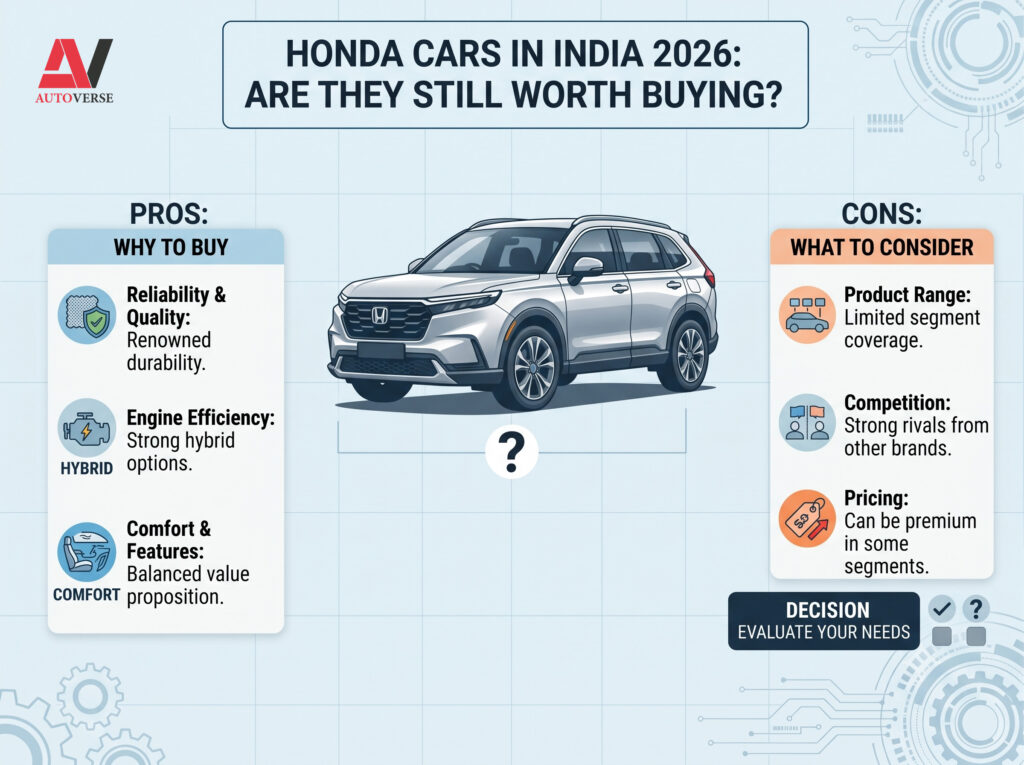
Are Honda cars still worth buying in India in 2026?
The short answer is yes, but not for everyone.
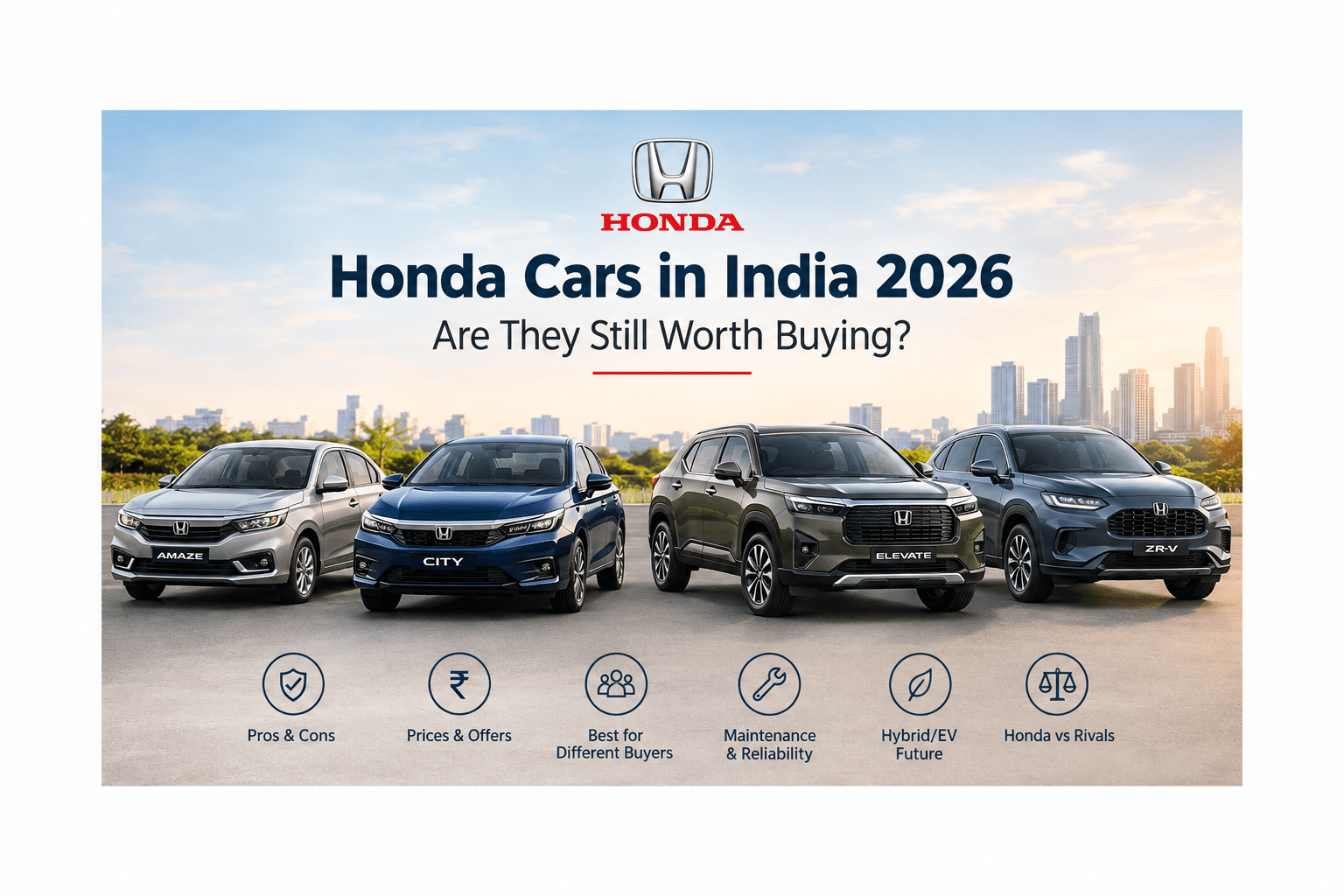
Honda’s current portfolio includes the Amaze, City, Elevate and the premium ZR-V e:HEV. Honda’s official website lists the new Amaze from ₹7.65 lakh, the new City from ₹11.99 lakh and the ZR-V at ₹47.99 lakh, with prices subject to the company’s applicable terms.
The more interesting question is not whether Honda makes good cars.
It is whether Honda’s strengths still match what Indian buyers want today.
Honda Cars in India in 2026: The Current Lineup
Honda’s Indian range is relatively small compared with manufacturers such as Maruti Suzuki and Hyundai.
But each model serves a fairly different buyer.
| Honda car | Type | Who should consider it? |
|---|---|---|
| Honda Amaze | Compact sedan | Family and city buyers |
| Honda City | Premium sedan | Sedan and highway buyers |
| Honda Elevate | Mid-size SUV | Family SUV buyers |
| Honda ZR-V e:HEV | Premium hybrid SUV | Premium hybrid buyers |
The ZR-V is particularly different from the rest of the range. Honda describes it as a premium sports hybrid SUV with a 2.0-litre e:HEV powertrain, e-CVT and Honda SENSING technology.
This means Honda’s portfolio now stretches from a relatively affordable family sedan to a nearly ₹48-lakh premium hybrid SUV.
But there is also an obvious gap.
Honda does not currently offer the same breadth of hatchbacks, compact SUVs and mass-market EVs available from some of its competitors.
And that is one of the biggest questions surrounding the brand.
Why Do People Still Buy Honda Cars?
Honda’s strongest selling points have not disappeared.
In fact, some have become more valuable as buyers increasingly look beyond specification sheets.
1. Refinement remains a Honda strength
A car can have a long equipment list and still feel ordinary to drive.
Honda has traditionally taken a different approach.
Its petrol engines are generally appreciated for their smoothness and predictable power delivery. For buyers who spend a lot of time behind the wheel, that character can be more important than having another electronic feature on the dashboard.
This is especially relevant to buyers who frequently travel between cities.
2. Honda still understands the sedan buyer
The Indian market has moved heavily towards SUVs, but that does not mean sedans have stopped making sense.
A sedan can still offer:
- Comfortable highway driving
- A relatively planted driving feel
- Good boot space
- Easy long-distance cruising
- A lower seating position for buyers who prefer it
The Honda City remains particularly relevant here.
It is not trying to be an SUV.
Instead, it appeals to buyers who genuinely enjoy the characteristics of a well-engineered sedan.
That distinction matters.
Honda City in 2026: Still Worth Buying?
The City remains one of the most recognisable Honda products in India.
Honda currently lists the new City from ₹11.99 lakh ex-showroom.
Its biggest advantage is not one individual specification.
It is the way the overall package comes together.
For a buyer who regularly drives on highways, the City can make a strong case because of its:
- Refined petrol powertrain
- Comfortable cabin
- Mature ride and handling balance
- Spacious passenger area
- Long-distance comfort
- Sedan driving dynamics
But there is a major caveat.
You need to actually want a sedan.
If your priority is a high seating position, SUV styling and easier entry and exit, a mid-size SUV may make more sense.
This is why the City should not simply be compared with another sedan.
A potential City buyer should also test-drive cars such as the Hyundai Verna, Volkswagen Virtus, Skoda Slavia and Honda’s own Elevate.
AutoVerse take
Buy the City if you enjoy sedans and drive long distances.
Don’t buy it simply because it has a good reputation.
Honda Elevate in 2026: The More Practical Honda?
The Elevate is arguably the most important Honda for buyers who have moved away from sedans.
It gives Honda a strong presence in the competitive mid-size SUV category while retaining the company’s petrol-focused character.
Honda currently positions the Elevate alongside the City and Amaze in its Indian portfolio.
For many families, the Elevate makes more practical sense than the City because it offers the SUV characteristics buyers increasingly want.
Why the Elevate makes sense
- Higher driving position
- SUV styling
- Family-friendly cabin
- Comfortable road manners
- Straightforward petrol powertrain
- Honda’s established ownership reputation
But the competition is extremely strong.
Buyers can choose from several established mid-size SUVs offering different combinations of features, powertrains, styling and pricing.
So the Elevate cannot win simply because it is a Honda.
It has to win the individual buyer’s priorities.
Honda Elevate September 2026 Offers: Should You Buy Now?
This is where the timing becomes interesting.
Honda is currently running promotional schemes on selected cars, including the Elevate, City and Amaze, with the company’s offer information subject to model, variant, location and applicable terms.
Independent reports have quoted headline benefits of up to ₹2.44 lakh on Honda cars in September 2026. However, that figure should not be treated as a universal cash discount for every Elevate buyer.
The final benefit can depend on factors such as:
- Variant
- Exchange eligibility
- Corporate eligibility
- Loyalty benefits
- Warranty-related benefits
- Dealer/location
- Applicable scheme dates
Our advice
Don’t ask the dealer only:
“How much discount are you giving?”
Instead ask for:
“Please give me the complete final on-road price after every applicable benefit.”
That number is much more useful.
Honda Amaze in 2026: The Underrated Choice
The Amaze does not attract the same attention as SUVs, but it continues to make sense for a particular type of buyer.
The latest Amaze starts at ₹7.65 lakh according to Honda’s current website.
It is aimed at buyers who want a compact family car without necessarily following the SUV trend.
The Amaze can make sense if you want:
- A manageable city car
- Family-friendly space
- A conventional petrol car
- Automatic transmission availability
- Sedan practicality
- Honda’s ownership proposition
Its biggest challenge is not necessarily the car itself.
It is the changing preferences of Indian buyers.
Many customers who previously bought compact sedans now consider compact SUVs instead.
Therefore, the Amaze is best viewed as a deliberate sedan choice, rather than an alternative for someone who really wants an SUV.
Honda ZR-V e:HEV: A Sign of What’s Coming?
The ZR-V is the most unusual product in Honda’s current Indian lineup.
With a price of ₹47.99 lakh and a 2.0-litre e:HEV hybrid system, it sits far above the Amaze, City and Elevate.
It is therefore unlikely to become a volume seller.
But its importance goes beyond sales numbers.
The ZR-V demonstrates Honda’s willingness to bring sophisticated hybrid technology to India.
Honda describes the ZR-V as a premium hybrid SUV featuring its e:HEV powertrain, e-CVT and Honda SENSING technology.
For AutoVerse, the important buyer takeaway is this:
Honda’s electrification story in India is currently more closely associated with hybrid technology than with an affordable mass-market EV.
That could change in the future, but buyers should evaluate Honda’s current range based on what is actually available rather than assuming an EV is coming at a particular time.
Where Honda Still Has an Advantage
Refinement
If you value smooth and relaxed driving, Honda remains attractive.
Driving experience
Honda’s cars tend to appeal to drivers who care about how a car feels rather than simply what equipment it carries.
Highway comfort
The City and Elevate can both appeal to buyers who spend considerable time travelling between cities.
Long-term ownership
Honda’s established reliability reputation remains an important reason some buyers stay with the brand.
Safety technology
Honda has increasingly incorporated active safety and driver-assistance technology into its newer products.
But safety should always be judged by the complete vehicle and its equipment level rather than by one feature or one marketing term.
Where Honda Needs to Improve
A useful Honda article should not only discuss its strengths.
There are several areas where the brand faces genuine challenges.
1. Limited choice
This is probably Honda’s biggest weakness.
Maruti Suzuki, Hyundai and Kia can offer buyers multiple body styles and price points.
Honda’s range is much narrower.
If the exact Honda model you want does not exist, there is nowhere else within the brand to go.
2. SUV competition is intense
The Elevate gives Honda a serious SUV product, but Indian buyers have an enormous number of alternatives.
A buyer can choose based on:
- Price
- Features
- Mileage
- Automatic options
- Turbo performance
- Hybrid technology
- Styling
- Rear-seat comfort
- Service network
Honda therefore has to compete on the complete ownership experience, not just its badge.
3. EV choices are limited
This is another important weakness.
Indian customers who specifically want an affordable EV have several choices outside Honda.
Honda’s hybrid direction is interesting, but hybrid and battery-electric vehicles solve different buyer requirements.
Someone with easy home charging may prefer an EV.
Someone who regularly travels long distances and does not want to plan around charging may find a hybrid or petrol vehicle more convenient.
Honda needs to address both kinds of customers over time.
Honda vs Maruti Suzuki vs Hyundai vs Kia
Instead of declaring one brand the winner, buyers should compare what each company does particularly well.
Honda
Best suited to: Buyers who value refinement, driving comfort and long-term ownership.
Maruti Suzuki
Best suited to: Buyers prioritising fuel efficiency, affordability and a huge service network.
Hyundai
Best suited to: Buyers who want technology, features and a broad product range.
Kia
Best suited to: Buyers who prioritise modern SUV design, premium interiors and feature-rich products.
This does not mean one brand is objectively better.
It means their strengths are different.
Which Honda Car Should You Buy in 2026?
Choose the Amaze if…
You want a practical family sedan for city and everyday use and do not particularly need an SUV.
Choose the City if…
You enjoy sedans and frequently travel on highways.
Choose the Elevate if…
You want an SUV but still prefer Honda’s petrol-focused driving experience.
Choose the ZR-V if…
You have a much larger budget and specifically want a premium hybrid SUV.
For most mainstream Honda buyers, the real decision is likely to be between the Amaze, City and Elevate.
Who Should Avoid Buying a Honda?
This may be the most useful part of the entire article.
You should look beyond Honda if your primary requirement is:
Maximum features for the lowest price
Some competitors may offer a longer equipment list.
A wide EV portfolio
Honda currently does not offer the same breadth of EV choices as some rivals.
A large choice of SUVs
Honda’s SUV range is comparatively limited.
The biggest possible service network
Maruti Suzuki has a major advantage here.
A small hatchback
Honda’s current Indian strategy does not target this segment.
Being honest about when not to buy a Honda makes this guide more useful than a conventional brand article.
Is Honda Expensive to Maintain?
There is no single maintenance cost that applies to every Honda.
Your ownership cost depends on:
- Annual kilometres
- Model
- Service centre
- Tyre replacement
- Brake wear
- Battery
- Driving conditions
- Insurance
- Age of the vehicle
A buyer should therefore avoid statements such as “Honda maintenance is cheap” or “Honda maintenance is expensive” without context.
A better approach is to ask the dealership for a scheduled maintenance estimate for the exact model and intended ownership period.
For example, if you plan to keep the car for seven years, calculate the expected scheduled maintenance over those seven years rather than looking only at the first service.
Is Honda Reliable in 2026?
Honda’s reliability reputation remains one of its strongest assets.
But reliability is not a guarantee.
Every car requires:
- Timely servicing
- Correct engine oil and fluids
- Proper tyre maintenance
- Brake inspection
- Battery checks
- Replacement of worn components
A well-maintained car from any established manufacturer can provide years of dependable service.
The Honda advantage is that its long-standing reputation gives buyers confidence in this area.
Honda’s 2026 Sales: Is the Brand Recovering?
Honda’s recent sales numbers provide an interesting context.
The company reported 6,014 domestic units in July 2026, representing growth of more than 48% year-on-year, while total sales including exports reached 8,284 units.
In August 2026, Honda reported 7,508 total units, including 2,123 units in domestic sales.
These numbers should not be interpreted as proof that Honda has suddenly become a market leader.
They do, however, show why the brand is worth watching.
The new City, updated Amaze, Elevate and ZR-V give Honda a different product mix going into the next phase of the Indian market.
What Should You Check Before Buying a Honda?
Before paying the booking amount, don’t limit your research to online reviews.
Use this checklist.
1. Take a proper test drive
Drive the car in city traffic and on an open road if possible.
2. Check rear-seat comfort
Don’t assume the rear seat is suitable for your family just because the car looks spacious.
3. Calculate the final on-road price
The ex-showroom price is only one part of the purchase cost.
4. Get the offer breakup
This is particularly important during September 2026 promotions.
5. Check the manufacturing month
Ask the dealer for the manufacturing date before accepting the vehicle.
6. Compare insurance
Dealer insurance is convenient, but compare the final premium and coverage.
7. Check service availability
A good product can still be frustrating if the local service experience is poor.
8. Compare at least two competitors
Never make the final decision after driving only one car.
So, Is Honda Still Worth Buying in India in 2026?
Yes — but Honda is now a choice based on priorities rather than a default recommendation.
If you want a refined petrol car, enjoy driving, frequently travel on highways and plan to keep your vehicle for several years, Honda remains highly relevant.
If you want an SUV, the Elevate deserves a serious look.
If you prefer sedans, the City remains one of Honda’s strongest products.
If you need a practical compact family car, the Amaze continues to make sense.
And if you are shopping in the premium segment and specifically want a hybrid SUV, the ZR-V offers something very different from Honda’s mainstream range.
The bigger challenge for Honda is not product quality.
It is breadth.
The brand needs to compete in a market where buyers increasingly want SUVs, EVs, technology and multiple choices at every price point.
AutoVerse Verdict
Honda is still worth buying in 2026 — if you buy for the right reasons.
Don’t buy a Honda merely because it is a Honda.
And don’t reject one because another car has more features.
Instead, look at the things that will affect your ownership every day:
How comfortable is it?
How does it drive?
Does the powertrain suit your usage?
Is the rear seat comfortable for your family?
Is the service centre convenient?
What is the final on-road price?
And can you see yourself keeping the car for several years?
For a buyer who values refinement, comfort, sensible engineering and a mature driving experience, Honda remains a credible choice in India in 2026.
For someone who wants maximum features, the widest SUV range or several affordable EV choices, other manufacturers may offer a better fit.
That is the real Honda story in 2026.
Honda may no longer be the choice for everyone. But for the right buyer, it can still be the right car.
Frequently Asked Questions
Which is the best Honda car in India in 2026?
There is no single best Honda for every buyer. The Amaze suits practical family buyers, the City is better suited to sedan and highway users, the Elevate is the mainstream SUV choice, while the ZR-V targets premium hybrid SUV buyers.
Is Honda City worth buying in 2026?
Yes, especially for buyers who prefer sedans, value refinement and regularly drive on highways. However, SUV buyers should also consider the Elevate and competing mid-size SUVs.
Is Honda Elevate worth buying?
The Elevate is worth considering if you want a mid-size SUV with Honda’s driving characteristics and ownership proposition. Its value should be judged against the final on-road price and current offers.
Is Honda Amaze a good family car?
Yes. The Amaze can make sense for buyers who want a compact family sedan, particularly for urban use and everyday commuting.
Does Honda have an SUV in India?
Yes. The Elevate is Honda’s mainstream mid-size SUV, while the ZR-V e:HEV occupies a much more premium position.
Is Honda reliable?
Honda has a strong long-term reliability reputation in India. However, reliability depends on proper servicing and maintenance, just as it does with other car brands.
Does Honda offer an EV in India?
Honda’s current Indian electrification strategy includes hybrid technology, with the ZR-V e:HEV representing its premium hybrid offering. Buyers looking specifically for a mass-market battery-electric Honda should check the company’s latest official portfolio before making a decision.
Should I buy a Honda in September 2026?
It can be a good time to negotiate because Honda is offering promotional benefits on selected models. However, benefits vary by model, variant, location and eligibility, so buyers should compare the final written on-road price rather than relying on a headline discount.