Buying a new car in India today is very different from buying one a decade ago.
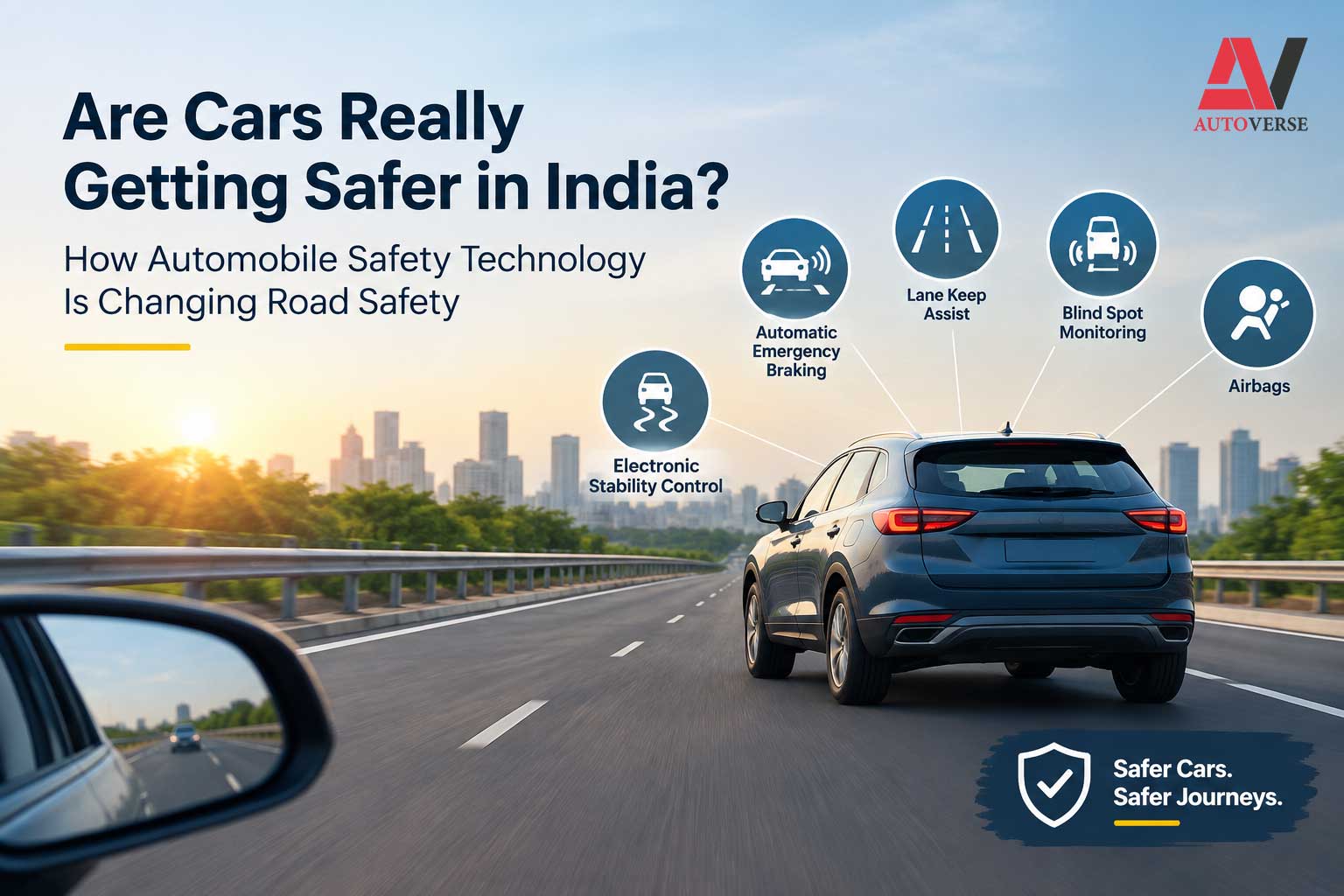
Airbags, ABS, electronic stability control, seat-belt reminders, rear parking sensors and stronger body structures have become increasingly common. More recently, technologies such as ADAS, automatic emergency braking, blind-spot monitoring and driver attention alerts are entering mainstream cars.
But there is one important question behind all this technology:
Are safer cars actually making Indian roads safer?
The answer is complicated.
The automobile industry has made significant progress in vehicle safety, but technology alone cannot solve India’s road-safety problem. The latest government data shows why. India recorded 4,80,583 road accidents and 1,72,890 fatalities in 2023. The number of deaths increased further to 1,77,175 in 2024, according to the latest MoRTH data reported after the release of the 2024 road-accident report.
So while cars are becoming safer, the environment in which they operate remains challenging.
Cars Have Come a Long Way
Modern cars are no longer just machines designed to move people from one place to another.
Manufacturers increasingly design them around three layers of safety:
Prevent the crash.
Protect occupants when a crash happens.
Help after the crash.
ABS is a good example of preventive safety. It helps prevent the wheels from locking during hard braking, allowing the driver to retain steering control.
Electronic Stability Control takes this further by helping the vehicle remain stable during sudden manoeuvres or loss of grip.
Then there are airbags and stronger passenger compartments designed to reduce injuries when a collision cannot be avoided.
The arrival of Bharat NCAP has added another important layer: consumer awareness.
India’s own crash-testing programme evaluates vehicles for adult occupant protection, child occupant protection and safety-assistance technologies. Its assessment includes crash tests as well as features such as electronic stability control, pedestrian protection and seat-belt reminders.
That means safety is increasingly becoming something consumers can compare rather than simply something manufacturers claim.
The Biggest Change: Safety Is Moving Beyond Airbags
Airbags are still extremely important, but the next generation of vehicle safety is increasingly about preventing the accident in the first place.
This is where ADAS comes in.
Depending on the vehicle, Advanced Driver Assistance Systems can include:
- Forward Collision Warning
- Automatic Emergency Braking
- Adaptive Cruise Control
- Lane Keeping Assist
- Blind Spot Monitoring
- Rear Cross-Traffic Alert
- Driver Attention Monitoring
These systems can warn the driver about an approaching hazard or, in certain situations, intervene.
But there is a catch.
ADAS is assistance, not autonomous driving.
As we have discussed earlier on The Auto Verse, India’s traffic conditions can make ADAS particularly challenging. Motorcycles appearing suddenly between lanes, pedestrians crossing unpredictably, inconsistent lane markings and temporary diversions can all affect how these systems perform.
So an ADAS-equipped car can provide another layer of protection, but it cannot replace an attentive driver.
Bharat NCAP Is Changing the Conversation
One of the more positive developments in India’s automobile industry is that vehicle safety is becoming easier for ordinary buyers to understand.
Instead of simply asking whether a car has two airbags or six airbags, buyers can now look at crash-test performance and safety-assistance equipment.
Bharat NCAP was launched in 2023 and opened to vehicle manufacturers from October that year. The programme assesses cars through crash tests and safety-assistance criteria and publishes star ratings intended to help consumers make informed choices.
This is important because safety should not be reduced to a feature-counting exercise.
A car having six airbags does not automatically make it safer than another car with fewer airbags. Structural integrity, restraint systems, electronic stability control, crash performance and the effectiveness of the complete safety package also matter.
Where the Industry Is Doing Well
There are several areas where the Indian automobile industry has clearly moved forward.
1. More Safety Equipment
Safety features that were once associated with expensive cars are increasingly appearing in mass-market vehicles.
Seat-belt reminders, airbags, ABS and electronic stability control are becoming much more widespread.
2. Better Crash Testing
Bharat NCAP has made crash-test performance more visible to consumers.
That creates an incentive for manufacturers to improve structural safety and safety-assistance systems.
3. ADAS Is Becoming More Accessible
ADAS is no longer restricted to luxury vehicles.
Several mainstream manufacturers are bringing collision warnings, lane assistance and adaptive cruise control into more affordable segments.
This could eventually make advanced preventive safety technology much more common on Indian roads.
4. Better Consumer Awareness
Perhaps the biggest change is happening inside the showroom.
Buyers are increasingly asking:
“How safe is this car?”
rather than simply:
“How many features does it have?”
That is a healthy change.
But There Are Some Problems Too
The industry’s safety journey is not perfect.
One problem is that safety equipment can still vary significantly between variants. A buyer may see a long list of safety features in a model’s brochure but discover that some technologies are available only on higher variants.
Another issue is marketing.
Terms such as “ADAS”, “six airbags” or “5-star safety” can sometimes become selling points without consumers fully understanding what they actually mean.
Even Bharat NCAP has guidelines around the appropriate use of its ratings in advertising and consumer communications, reflecting the importance of presenting safety information accurately.
There is also a larger problem: a safer car cannot compensate for unsafe behaviour.
If a driver is speeding, using a mobile phone, driving under the influence or refusing to wear a seat belt, even the most advanced vehicle cannot guarantee a safe outcome.
The Human Factor Still Matters Most
Imagine a family leaving Delhi for a weekend trip.
The car has six airbags, ABS, ESC and ADAS.
The children are sitting in the back. Everyone is comfortable. The vehicle is technically very safe.
But the driver is tired.
Or perhaps the driver is travelling too fast because the road is empty.
Maybe someone is checking a phone at a traffic signal and continues looking at it after the light turns green.
This is where technology meets reality.
The car can warn.
It can brake.
It can stabilise itself.
But the person behind the steering wheel still makes the most important safety decisions.
The World Health Organization says correctly worn seat belts can reduce the risk of death among vehicle occupants by up to 50%, while correct motorcycle helmet use can substantially reduce the risk of death and brain injury. WHO also identifies speed, alcohol, distraction, unsafe vehicles, infrastructure and weak enforcement among the major road-safety risks.
What India Needs Next
The automobile industry can continue improving cars, but road safety needs a much wider approach.
India needs safer vehicle design, safer roads, better enforcement, responsible driving and faster emergency response.
The government itself describes road safety through a multi-pronged approach involving Education, Engineering, Enforcement and Emergency Care.
There are already measures moving in that direction. The government has mandated safety technologies and strengthened vehicle fitness testing, while electronic enforcement is being expanded on high-risk corridors. Newer rules are also introducing additional safety requirements for certain vehicle categories.
The industry can contribute by making advanced safety features more widely available, improving India-specific ADAS calibration and communicating limitations honestly.
Consumers have a role too.
Choose a car based on its overall safety package rather than just its touchscreen, sunroof or number of airbags.
Wear the seat belt.
Use child restraints properly.
Do not drive under the influence.
Do not use your phone while driving.
And perhaps most importantly, slow down.
So, Are Cars Making Indian Roads Safer?
Yes, but only to a point.
Modern vehicles are undoubtedly equipped with far more safety technology than cars of the past. Bharat NCAP, better crash engineering, airbags, ESC, ABS and ADAS are all important steps forward.
But India’s road-fatality numbers show that vehicle technology alone has not been enough to reverse the larger road-safety challenge.
The future of road safety will therefore not be decided by one feature, one manufacturer or one government programme.
It will depend on how cars, roads, technology, enforcement and people work together.
Because at the end of every safety discussion is something far more important than a star rating or a feature list.
A person waiting at home for someone to return safely.
And that is ultimately what road safety is about.
Learn More About ADAS