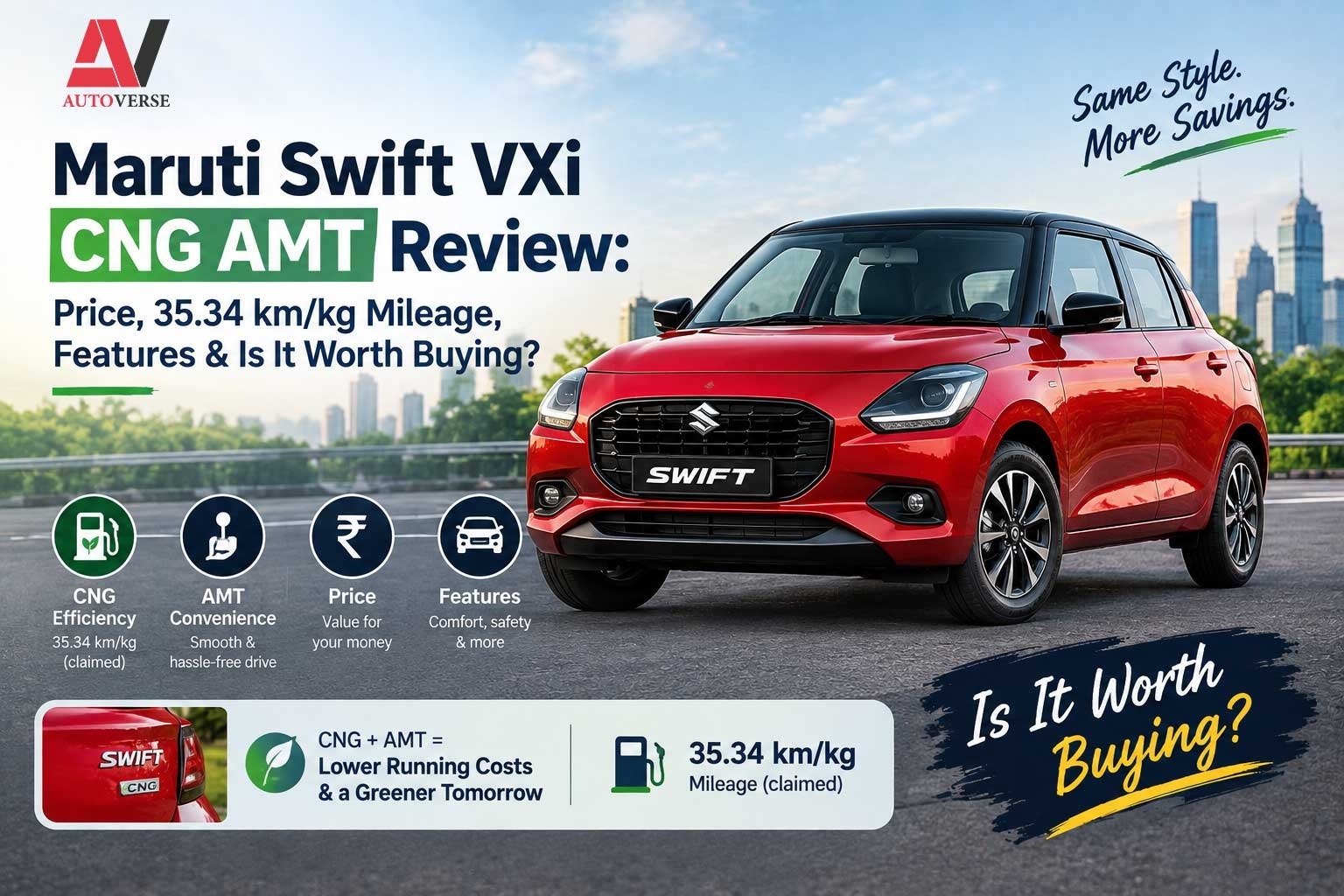
The Maruti Swift VXi CNG AMT brings together two features that many Indian city-car buyers have wanted for a long time: the lower running-cost potential of CNG and the convenience of an automatic transmission.
Maruti Suzuki has now introduced the Swift CNG with a 5-speed AMT, giving buyers an alternative to the traditional CNG manual. The Swift VXi CNG AMT is priced at ₹7.92 lakh ex-showroom as an introductory/festive-season price.
But is the automatic CNG Swift actually worth choosing over the manual?
That depends on how much you drive, how much time you spend in traffic and whether you are willing to pay extra for clutch-free driving.
Here is a practical look at the price, mileage, features, advantages, limitations and everyday buying considerations of the Swift VXi CNG AMT.
Maruti Swift VXi CNG AMT Price
The Swift VXi CNG AMT is priced at ₹7.92 lakh ex-showroom.
The new CNG AMT range is offered in VXi, VXi (O) and ZXi variants. The CNG AMT option costs around ₹35,000 more than the corresponding CNG manual version.
This price difference is important because the buyer is essentially paying extra for the convenience of the AMT.
The final on-road price will vary depending on the city, insurance, registration charges, accessories and applicable offers. Maruti also states that the price prevailing at the time of invoice/bill is applicable.
Swift VXi CNG AMT price at a glance
| Detail | Swift VXi CNG AMT |
|---|---|
| Fuel type | CNG |
| Transmission | 5-speed AMT |
| Ex-showroom price | ₹7.92 lakh* |
| Seating capacity | 5 |
| Engine | 1.2-litre, 3-cylinder |
| Claimed CNG mileage | 35.34 km/kg |
| CNG tank | 55-litre water-equivalent capacity |
*Introductory/festive-season price; confirm the applicable price and on-road cost before booking.
Swift CNG AMT Mileage: 35.34 km/kg Claimed
One of the biggest highlights of the new Swift CNG AMT is its claimed fuel efficiency.
Maruti Swift CNG AMT has a claimed mileage of 35.34 km/kg.
Interestingly, this figure is higher than the 32.85 km/kg claimed for the Swift CNG manual, giving the AMT version a 2.49 km/kg advantage in certified efficiency figures.
However, buyers should not assume that 35.34 km/kg will be the exact number displayed during everyday driving.
Actual mileage can vary because of:
- Traffic conditions
- Driving style
- Air-conditioner usage
- Passenger and luggage load
- Tyre pressure
- Road conditions
- CNG quality and filling conditions
So, the 35.34 km/kg figure is best treated as a certified benchmark, not a guaranteed real-world figure.
For someone covering a large number of kilometres every month, however, the CNG setup can make a meaningful difference to running expenses.
The same principle applies to electric cars, where claimed figures can also differ from everyday usage. Read our guide to [real-world range vs claimed range] to understand why official efficiency figures and actual driving results can differ.
What Makes the CNG AMT Different?
The most important change isn’t simply the CNG system.
It is the addition of the 5-speed AMT.
Until now, buyers choosing the Swift CNG had to accept a manual transmission. The new version gives them the option of driving without operating a clutch pedal.
That can be particularly useful in heavy urban traffic.
Think about a daily commute involving repeated stops, starts and slow-moving traffic. A manual transmission requires constant clutch operation. With the AMT, the car handles clutch operation and gear changes automatically.
This doesn’t mean the Swift CNG AMT will behave exactly like a more expensive automatic transmission.
An AMT is based on a manual gearbox with automated clutch and gear operation. Gear changes can therefore be more noticeable than in a conventional automatic or CVT.
For relaxed city driving, many buyers may find that acceptable.
But if smoothness is a high priority, a proper test drive should be part of the buying process.
Engine and Performance
The Swift CNG AMT continues to use Maruti Suzuki’s 1.2-litre, three-cylinder Z12E engine.
In CNG mode, it develops approximately 69.75 PS and 101.8 Nm, while petrol operation produces around 82.93 PS and 112.4 Nm, according to the latest launch information.
The important point for buyers is that the CNG version is designed more around efficiency and everyday usability than outright performance.
For normal city commuting, the powertrain should suit buyers who drive at a relaxed pace.
However, if your regular usage involves:
- Frequent highway overtaking
- Full passenger loads
- Steep roads
- Long-distance travel with luggage
then a test drive becomes even more important.
The Swift CNG AMT is better understood as an efficient urban car with automatic convenience, rather than a performance-oriented hatchback.
Features You Get
The Swift’s familiar cabin and equipment package continue with the CNG AMT, while the CNG versions receive some specific equipment and mechanical changes.
Depending on the variant, the Swift range offers features such as:
- SmartPlay Pro touchscreen infotainment
- Apple CarPlay and Android Auto
- Automatic climate control
- Rear AC vents
- Wireless charging
- Six speakers
- Rear USB ports
- Rear wiper and washer
- Height-adjustable driver seat
- Adjustable rear-seat headrests
- 60:40 split-folding rear seat
- LED lighting on applicable variants
- Six airbags
- Electronic stability-related safety equipment
The exact equipment depends on the variant, so buyers should check the VXi, VXi (O) and ZXi equipment lists before deciding which version offers the features they actually need. The current Maruti Swift listing confirms features such as the SmartPlay Pro touchscreen, side and curtain airbags and Hill Hold Assist in the range.
CNG Tank and Boot Space: The Major Practical Compromise
This is one area where buyers should look beyond the mileage figure.
The Swift CNG uses a 55-litre water-equivalent CNG tank positioned in the boot, while the car also retains a spare wheel.
That arrangement helps preserve the spare wheel but significantly reduces the usable luggage area.
For a buyer who mostly uses the Swift for:
office commuting + city driving + shopping + two or three occupants
this may be manageable.
But families that regularly travel with several passengers and large bags should physically inspect the boot before booking.
A specification sheet cannot tell you whether the remaining luggage space will work for your lifestyle.
Suspension and CNG-Specific Changes
The additional weight associated with the CNG system has also resulted in changes to the car’s setup.
The Swift CNG AMT gets retuned suspension, along with a CNG fuel-level indicator and a fuel-change switch.
These changes are intended to accommodate the additional CNG hardware while retaining the basic characteristics of the Swift.
Swift VXi CNG AMT Pros
1. CNG and automatic convenience together
This is the main reason to consider the car. Buyers no longer have to choose between CNG efficiency and a clutch-free city drive.
2. Strong claimed mileage
At 35.34 km/kg, the certified efficiency figure is one of the strongest reasons to consider the new variant.
3. ₹35,000 AMT premium
Compared with the corresponding CNG manual, the additional AMT cost is around ₹35,000, making the automatic option relatively accessible compared with moving to a different automatic car.
4. Compact city-friendly size
The Swift remains a relatively easy car to manoeuvre and park in busy urban areas.
5. Six-airbag setup
The Swift range includes six airbags, adding an important safety feature to the equipment package.
Swift VXi CNG AMT Cons
1. Boot space is limited
The 55-litre CNG tank occupies considerable space in the boot, making luggage practicality one of the major compromises.
2. AMT gear shifts may be noticeable
AMT convenience comes with its own driving characteristics. It should not be expected to feel exactly like a conventional automatic.
3. CNG performance is modest
The CNG engine prioritises efficiency rather than strong acceleration.
4. CNG availability affects convenience
The financial advantage of CNG becomes less useful if you don’t have convenient access to CNG stations along your regular routes.
5. Higher upfront price than the manual
The AMT carries a premium over the equivalent CNG manual. Buyers who don’t mind driving a manual should calculate whether the additional convenience is worth the extra amount.
Swift CNG AMT vs CNG Manual: Which Should You Consider?
This is perhaps the most important part of the buying decision.
The CNG manual is more straightforward if your priority is keeping the initial purchase price lower and you are comfortable using a clutch.
The CNG AMT, on the other hand, is aimed at buyers who want the same basic CNG proposition but don’t want to deal with a clutch during daily traffic.
| If your priority is… | Consider |
|---|---|
| Lower initial purchase price | CNG Manual |
| Frequent stop-and-go traffic | CNG AMT |
| High monthly running | CNG |
| Clutch-free driving | CNG AMT |
| Greater control over gear changes | CNG Manual |
| Maximum luggage practicality | Inspect both carefully |
| Occasional driving | Compare petrol options too |
There is no need to choose the AMT simply because it is automatic.
If your daily route is relatively open and you are comfortable with a manual gearbox, the cheaper CNG manual deserves consideration.
But if your everyday driving involves significant traffic, the additional AMT cost is essentially paying for daily convenience.
Who Should Buy the Swift VXi CNG AMT?
The Swift VXi CNG AMT could suit buyers who:
- Drive regularly in the city
- Spend considerable time in traffic
- Want to avoid clutch operation
- Have easy access to CNG stations
- Want to prioritise fuel economy
- Prefer a compact hatchback
- Don’t require a large luggage compartment
- Plan to keep the car for several years
It may require more thought if you:
- Drive very few kilometres every month
- Frequently travel with a full load of passengers and luggage
- Want strong highway performance
- Prefer extremely smooth automatic gear changes
- Don’t have convenient CNG availability
- Want the lowest possible purchase price
Is the Maruti Swift VXi CNG AMT Worth Buying?
The Swift VXi CNG AMT makes its strongest case for urban buyers who drive frequently and want to combine lower running-cost potential with automatic convenience.
The additional ₹35,000 over the comparable CNG manual is not simply paying for a badge or cosmetic upgrade. You are paying for a different everyday driving experience.
At the same time, buyers should not ignore the compromises.
The AMT has its own shift characteristics, the CNG tank takes up valuable boot space, and the CNG powertrain isn’t aimed at buyers seeking strong performance.
Therefore, the decision should come down to usage rather than just mileage.
If your daily commute involves heavy traffic and you value a clutch-free driving experience, the Swift CNG AMT deserves a place on your shortlist.
If you are comfortable driving a manual and want to minimise the upfront cost, compare the CNG manual carefully before spending the additional money.
AutoVerse Buyer Takeaway
The Maruti Swift VXi CNG AMT is an interesting new option because it solves a very specific problem: how to get the running-cost advantage of CNG without having to operate a clutch every day.
Its 35.34 km/kg claimed mileage, compact dimensions and automatic convenience make it particularly relevant for urban commuters.
But the right question isn’t simply, “Is the mileage good?”
The better question is:
“Will I use the automatic convenience enough to justify paying extra for it?”
For a heavy city commuter, the answer may come down to how much that everyday convenience matters. For a buyer who is comfortable with a manual gearbox, the CNG manual remains an important comparison.
Before booking, compare the final on-road prices, check CNG availability on your regular routes, inspect the boot personally and take the AMT for a proper test drive.
That will give you a much clearer picture of whether the Swift VXi CNG AMT fits your actual driving needs.
The Swift CNG AMT is also part of a broader period of activity for Maruti Suzuki. See our Maruti Suzuki September 2026 overview for more on the brand’s current lineup and market activity.
For more automobile news, reviews and buyer guides, visit our homepage.