When you start looking for a new car in India, the first price you usually notice is the ex-showroom price.
But that is not necessarily the amount you will finally pay.
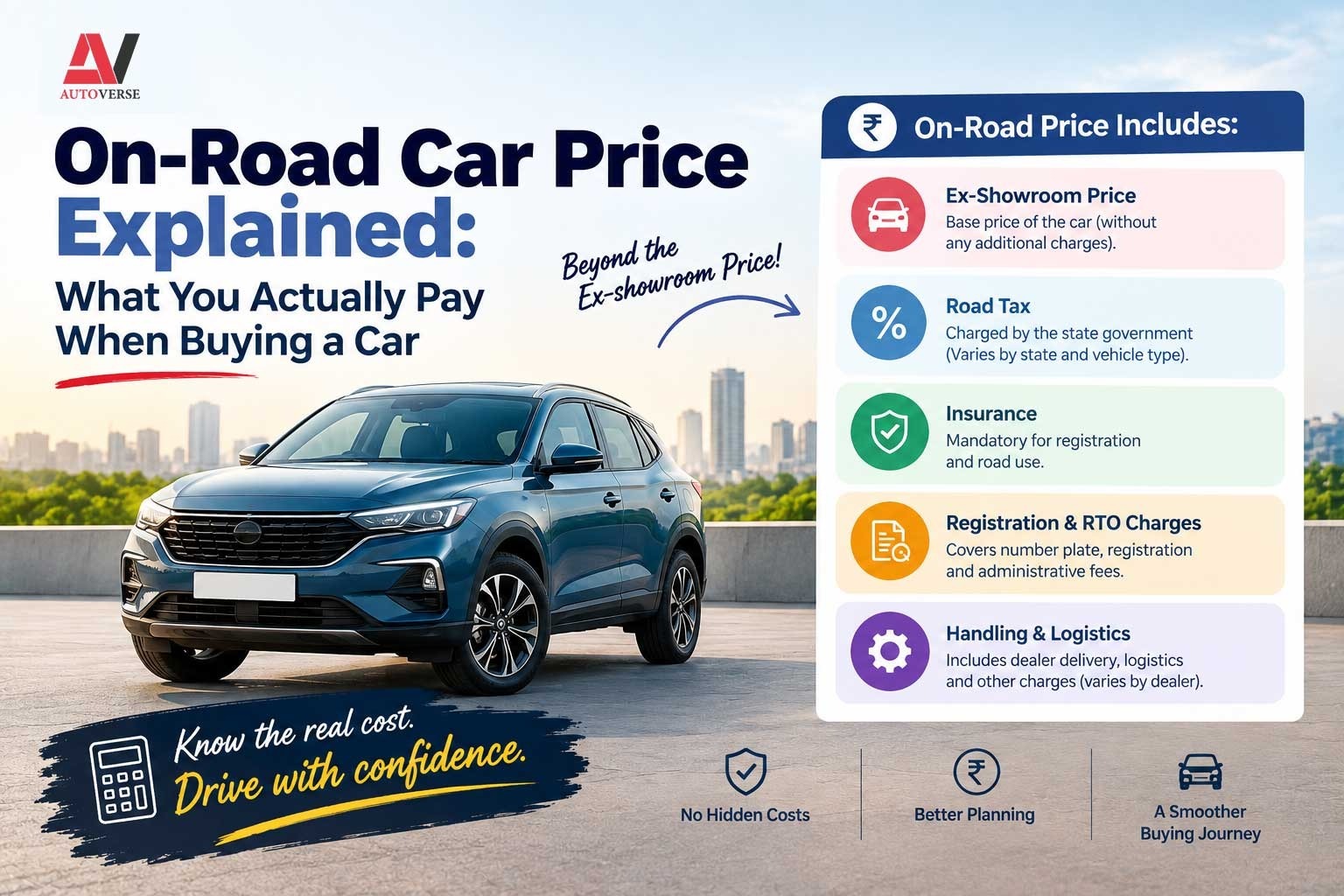
The amount you actually spend to buy, register and insure the car is generally referred to as the on-road price. It can be considerably higher than the advertised ex-showroom price because additional costs such as registration, road tax, insurance and other applicable charges may be added.
For someone buying a car for the first time, understanding this difference is important. A car that appears affordable based on its ex-showroom price may cross your budget once all the purchase-related costs are included.
In this AutoVerse guide, we explain what an on-road car price includes, how it is calculated, why it differs between locations and what you should check before paying the booking amount.
What Is the On-Road Price of a Car?
The on-road price is the total amount a buyer needs to pay to purchase and register a new vehicle for use on public roads, including applicable insurance and other relevant charges.
In simple terms:
On-Road Price = Ex-Showroom Price + Registration/Road Tax + Insurance + Other Applicable Charges
The exact amount varies depending on the vehicle, registration location, insurance policy and the items included in the purchase.
This means two buyers purchasing the same car can potentially pay different on-road prices if they register the vehicles in different states or choose different insurance and optional products.
Ex-Showroom Price: The Starting Point
The ex-showroom price is the price of the vehicle before adding costs such as registration, road tax and insurance.
It is the figure manufacturers and dealers commonly display when advertising a new car.
For example, if a car is advertised at:
₹10,00,000 ex-showroom
you should not assume that ₹10 lakh is the complete amount required to get the vehicle on the road.
The actual amount will depend on the additional charges applicable to your purchase.
An important point about GST
GST applicable to the vehicle is already reflected in the ex-showroom price quoted for the car.
In other words, buyers should not simply add GST again to the advertised ex-showroom price.
India’s automobile GST structure changed from 22 September 2025. Small cars meeting the specified criteria attract 18% GST, while mid-size and large cars exceeding the specified engine-capacity or length thresholds attract 40%. Certain qualifying utility vehicles also attract 40%.
Therefore, older articles that still use the previous 28% GST plus compensation cess structure may not reflect the current automobile tax structure.
1. Road Tax and Registration Charges
One of the major additions to the ex-showroom price can be the cost associated with road tax and vehicle registration.
These are not necessarily the same thing.
Road tax is a state/UT levy, while registration charges relate to registering the vehicle and issuing the registration certificate.
The amount can vary depending on factors such as:
- State or Union Territory
- Vehicle type
- Vehicle price
- Private or commercial use
- Applicable state rules
This is one of the main reasons why the same car can have different on-road prices in different parts of India.
The government’s VAHAN system separately provides services relating to vehicle registration and tax/fee payments.
Why this matters to buyers
Suppose the same car has an ex-showroom price of ₹10 lakh.
The buyer registering it in one state may have a different road-tax and registration liability from someone registering the same vehicle in another state.
Therefore:
Same car + different registration location = potentially different on-road price
2. Car Insurance
Insurance is another important part of the on-road cost.
Third-party motor insurance is mandatory for vehicles being driven on public roads in India.
For a new car, buyers may also choose a policy that provides own-damage protection along with applicable add-ons.
The insurance premium can depend on factors including:
- Car model and variant
- Insured Declared Value (IDV)
- Registration location
- Type of policy
- Add-on covers
- Deductibles
- Insurer’s pricing
The cheapest insurance quotation is not automatically the most suitable one.
When comparing policies, look beyond the premium and check the Car Insurance IDV, coverage, deductibles, exclusions and add-ons.
Should you accept the dealer’s insurance quotation?
Not necessarily.
Buyers can compare insurance options and should understand what is included before accepting the quotation provided by the dealership.
A dealer may offer convenience by arranging the policy, but convenience and price are not the only factors to consider.
3. FASTag and Other Applicable Charges
FASTag is used for electronic toll payments at applicable toll plazas and is an important part of vehicle ownership in India.
The amount involved is relatively small compared with registration, road tax or insurance, but buyers should still check how it appears in the final quotation.
Other small charges may also appear depending on the vehicle, state and purchase process.
Rather than assuming that every item is mandatory, ask the dealer to explain each charge.
4. Hypothecation Charges on a Car Loan
If you purchase a car using finance, the vehicle’s registration can include hypothecation in favour of the lender.
In simple terms, hypothecation records the lender’s interest in the financed vehicle until the applicable loan obligations are completed.
The registration process can therefore involve additional documentation and applicable charges.
If you are purchasing a car through a loan, ask the dealer or lender for a clear breakup of any financing-related registration charges.
5. Accessories Can Increase the Final Bill
Accessories are another reason the final amount can move beyond the price you originally planned.
For example, you may decide to add:
- Floor mats
- Mud flaps
- Dash camera
- Door visors
- Seat covers
- Exterior protection
- Infotainment accessories
- Other dealer-supplied products
Some buyers add accessories during delivery without checking the total impact on the invoice.
There is nothing wrong with buying accessories you actually need, but they should be treated separately from mandatory government charges.
Ask this simple question
“Which items in this quotation are mandatory and which are optional?”
That one question can make the final quotation much easier to understand.
How Is the On-Road Car Price Calculated?
Let’s take a purely illustrative example.
Suppose a car has an ex-showroom price of:
₹10,00,000
Imagine the quotation contains:
| Cost component | Illustrative amount |
|---|---|
| Ex-showroom price | ₹10,00,000 |
| Registration/road tax | ₹80,000 |
| Insurance | ₹45,000 |
| Other applicable charges | ₹1,000 |
| Optional accessories | ₹20,000 |
| Illustrative total | ₹11,46,000 |
This is not a standard or universal calculation.
The ₹80,000 road-tax figure, ₹45,000 insurance figure and other amounts are used only to demonstrate how the calculation works. Actual costs can be significantly different depending on the state, vehicle and insurance policy.
The important takeaway is:
A ₹10 lakh ex-showroom car does not necessarily mean you need exactly ₹10 lakh to complete the purchase.
Why Does the Same Car Have Different On-Road Prices?
This is one of the most common questions buyers ask.
The answer is mainly related to location and purchase choices.
Road tax and registration-related charges can vary between states and Union Territories. Insurance premiums can also vary depending on the policy selected and insurer.
For example, a car with the same ex-showroom price could have different final on-road quotations in:
- Chandigarh
- Punjab
- Haryana
- Delhi
- Maharashtra
The vehicle itself hasn’t changed.
The components added to the ex-showroom price can change.
That is why buyers should always ask for an on-road quotation specific to their registration location.
Ex-Showroom Price vs On-Road Price
| Ex-Showroom Price | On-Road Price |
|---|---|
| Advertised vehicle price | Approximate final purchase cost |
| Starting point for the calculation | Includes applicable additional costs |
| Does not represent all purchase-related expenses | Gives a clearer picture of actual expenditure |
| Useful when comparing vehicle prices | More useful when planning your budget |
| Does not include registration and insurance costs | Can include registration, road tax, insurance and other applicable items |
If your budget is fixed, the on-road price is the number you should focus on.
What Should You Check in a Dealer’s Quotation?
Don’t just look at the final number.
Ask the dealership for a detailed, itemised quotation.
1. Check the exact variant
Make sure the quotation is for the exact model, variant and fuel/powertrain you want.
2. Check the ex-showroom price
Confirm that the quoted ex-showroom price matches the current price for that variant.
3. Check registration and road tax
Ask how the amount has been calculated for your registration location.
4. Check insurance
Look at:
- Premium
- IDV
- Deductibles
- Add-ons
- Coverage
- Insurer
5. Check accessories
Separate essential items from optional accessories.
6. Check extended warranty
Understand the additional cost and what the warranty actually covers.
7. Check service packages
If a maintenance package is included, ask what services and duration it covers.
8. Check discounts
Ask whether the quotation includes all currently applicable manufacturer and dealer offers.
9. Check the final payable amount
After checking every line item, confirm the exact amount you will have to pay.
Can You Negotiate the On-Road Price?
You cannot simply negotiate government taxes and statutory charges as though they were dealer discounts.
However, some components of the overall purchase package may be open to discussion.
Depending on the vehicle and offer available at the time, these can include:
- Dealer discounts
- Manufacturer offers
- Exchange benefits
- Corporate offers, where applicable
- Accessories
- Insurance
- Extended warranty
- Service packages
This is why it is better to negotiate based on the final purchase cost, rather than focusing only on a headline discount.
For example, a dealer offering a larger discount may still have a higher final quotation if optional products or other costs are added.
How to Keep Your Car Purchase Cost Under Control
A few simple steps can make the process easier.
Compare multiple quotations
If practical, obtain quotations from more than one dealer.
Compare the final on-road amount, not just the discount.
Compare insurance
Look at the coverage, IDV and deductibles along with the premium.
Don’t buy accessories in a hurry
You can decide which accessories you actually need instead of automatically accepting a large accessory package.
Ask for a written breakup
A detailed quotation is much easier to compare than a single final figure communicated verbally.
Check current offers
Manufacturer and dealer offers can change over time, so ask about current applicable benefits before booking.
Think about long-term ownership costs
The amount you pay at the dealership is only part of the total cost of owning a car. Before buying, also consider car service and maintenance costs, fuel or charging expenses, insurance renewals and consumables over the years.
Common Mistakes Buyers Make
Mistake 1: Assuming ex-showroom is the final price
It isn’t.
Registration, road tax, insurance and other applicable costs can increase the final amount.
Mistake 2: Looking only at the discount
A big discount doesn’t automatically mean the lowest final price.
Compare the complete quotation.
Mistake 3: Choosing insurance only by premium
A cheaper premium may come with differences in IDV, coverage, deductibles or add-ons.
Mistake 4: Treating accessories as compulsory
Ask which products are optional.
Mistake 5: Using outdated tax information
Automobile taxation can change.
For example, India’s current GST structure for cars changed from 22 September 2025, including the move to 18% for specified small cars and 40% for specified larger cars and qualifying utility vehicles.
Always check the current applicable price and tax information rather than relying on an old article or social-media post.
Questions to Ask Before Booking a New Car
Before paying the booking amount, ask the dealer:
- What is the exact ex-showroom price?
- What is the complete on-road price?
- How much is the applicable road tax?
- What are the registration charges?
- Which insurance policy is being quoted?
- What is the IDV?
- Which insurance add-ons are included?
- Which accessories are optional?
- Is an extended warranty included?
- Is a service package included?
- What discounts are currently applicable?
- Is there an exchange benefit?
- What is the manufacturing month and year?
- What is the expected delivery timeline?
- What is the final amount payable?
Getting these details in writing can prevent confusion later.
Final Takeaway
The ex-showroom price is only the starting point when buying a new car.
The amount you actually need to spend can include registration, road tax, insurance and other applicable charges. Optional accessories, extended warranties and service packages can increase the bill further.
The easiest way to understand it is:
Ex-showroom price + applicable registration/road tax + insurance + other applicable costs = approximate on-road price
But the exact calculation depends on the vehicle, registration location and products you choose.
So, before booking your next car, don’t ask only:
“What is the car’s price?”
Ask:
“What is the complete on-road price, and what does that amount include?”
That simple change in approach can make your car-buying decision much clearer.
AutoVerse Verdict
When comparing cars, don’t stop at the ex-showroom price. Look at the complete on-road cost, insurance, registration-related expenses and any optional products included in the quotation.
A car that fits your budget at the showroom should also fit your budget when you are ready to drive it home.
For more automobile news, reviews, buying guides and insights, visit AutoVerse.