
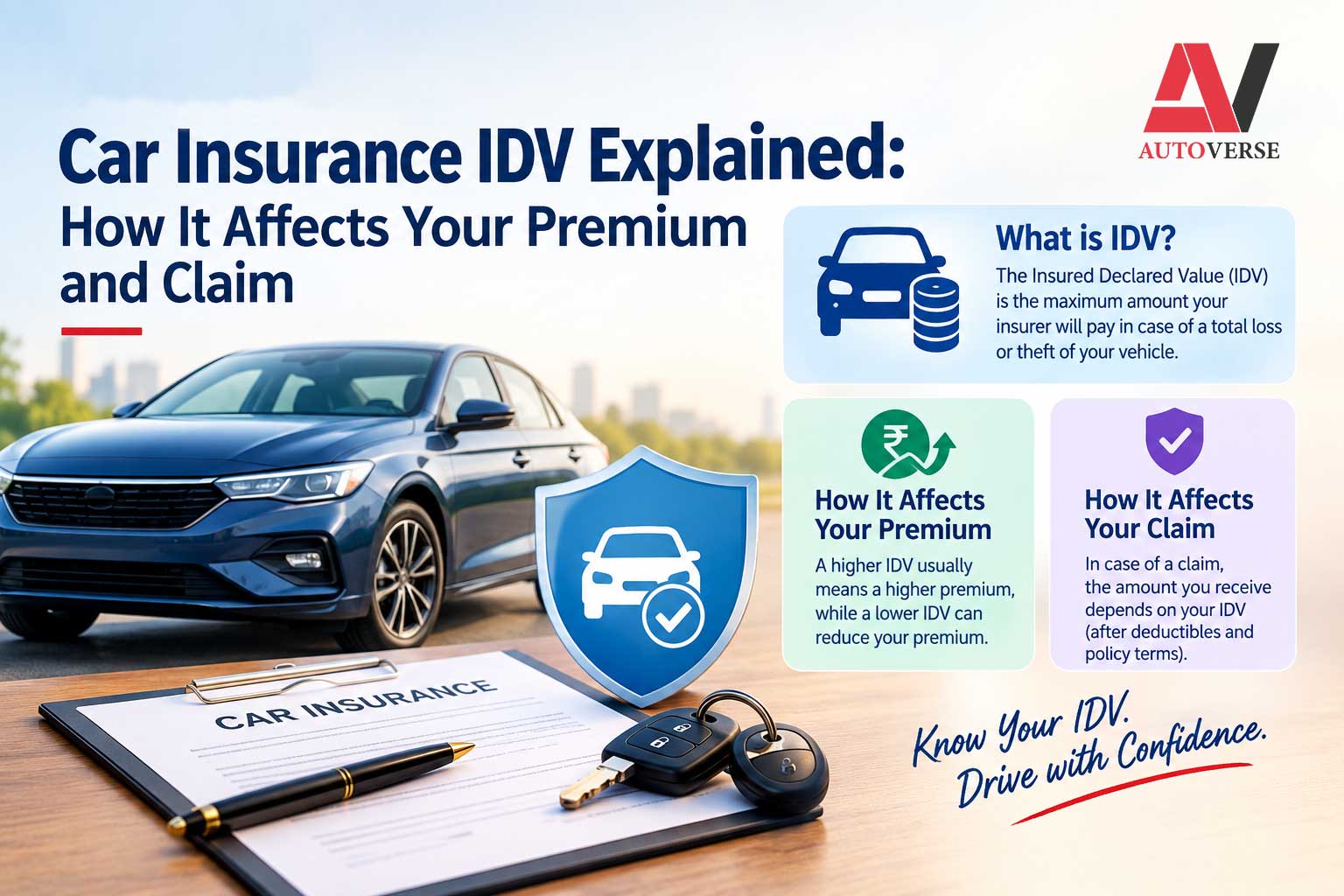
When you buy or renew car insurance, you may come across a term called IDV, or Insured Declared Value. It is one of the most important figures in a comprehensive car insurance policy because it broadly represents the insurer’s maximum liability for the insured vehicle in situations such as theft or a total loss, subject to the terms and conditions of the policy.
But what exactly is IDV? How is it calculated? Does choosing a higher IDV always mean better protection? And what happens if your car is completely damaged in an accident?
Understanding car insurance IDV can help you make a more informed decision when comparing policies and renewing your insurance.
What Is IDV in Car Insurance?
IDV stands for Insured Declared Value.
In simple terms, IDV is the insured value of your car for the purpose of the policy. It generally reflects the vehicle’s current value after accounting for depreciation, rather than the price you originally paid for the car.
For example, suppose you purchased a car for ₹10 lakh when it was new. After a few years, the car’s value will naturally decline because of age, usage and depreciation.
Therefore, its IDV at the time of insurance renewal may be considerably lower than its original purchase price.
This does not mean that the insurer will automatically pay the IDV whenever your car is damaged. The actual claim settlement depends on the nature of the loss, policy coverage, applicable terms, deductibles and other conditions.
Why Is IDV Important?
IDV becomes particularly important when a vehicle is:
- Stolen and not recovered
- Damaged beyond economical repair
- Declared a total loss under the applicable policy conditions
For an ordinary repairable accident, the claim is generally handled based on the cost of covered repairs and the policy terms rather than simply paying the vehicle’s IDV.
This distinction is important because many car owners assume that IDV is the amount they will receive for every type of accident.
How Is Car Insurance IDV Calculated?
The IDV of a vehicle generally decreases as the vehicle gets older because depreciation is taken into account.
For a new car, the calculation can be linked to the manufacturer’s listed selling price, excluding certain registration and insurance-related costs. For older vehicles, depreciation is applied according to the insurer’s applicable methodology and policy terms.
A simplified way to understand the concept is:
IDV ≈ Vehicle’s applicable value − Depreciation
The actual calculation can vary between insurers and policies, so the IDV displayed in your insurance quotation or policy document should be checked carefully.
Simple Example
Imagine you purchased a car for approximately ₹10 lakh when it was new.
After several years, its applicable insured value may have fallen because of depreciation. Suppose the insurer offers an IDV of ₹6.5 lakh at renewal.
The car’s original purchase price is still ₹10 lakh, but its insurance IDV is now ₹6.5 lakh.
If the vehicle is subsequently declared a total loss under a covered claim, the settlement would be considered according to the policy terms and the applicable IDV, rather than automatically being based on the original ₹10 lakh purchase price.
Does a Higher IDV Mean a Higher Insurance Premium?
Generally, the IDV and the own-damage portion of a car insurance premium are connected.
If you select a higher IDV, the insurer is potentially taking on a higher liability for a total-loss or theft claim. This can therefore affect the premium.
However, IDV is not the only factor that determines your car insurance premium.
Other factors can include:
- Car model and variant
- Age of the vehicle
- Location
- Type of insurance cover
- Add-on covers
- Claim history
- Voluntary deductible
- No Claim Bonus
- Insurer-specific pricing
- Applicable taxes and charges
This is why two insurance quotations for the same car may not always have exactly the same premium.
What Happens If You Choose a Very Low IDV?
Choosing a lower IDV may make the quoted premium look attractive, but it can reduce the insured value available for certain major losses.
Consider this example.
Your car has an applicable IDV of around ₹7 lakh, but you choose a policy with an unusually low IDV of ₹5.5 lakh simply because the premium is lower.
If the vehicle is later stolen or declared a total loss under the policy, the lower insured value could affect the amount available for settlement, subject to the policy’s terms and conditions.
Therefore, selecting an IDV simply because it produces the cheapest premium may not always be the right approach.
What If You Choose a Higher IDV?
The opposite situation is also worth understanding.
Suppose your car’s reasonable applicable IDV is around ₹7 lakh, but another quotation shows an IDV of ₹8 lakh.
The higher IDV may provide a higher insured value for a qualifying total-loss or theft claim, but it may also result in a higher premium.
That does not necessarily mean you should always select the highest number available.
Instead, compare the IDV with the insurer’s valuation, the premium, coverage and policy conditions before making a decision.
IDV Example: Why It Matters in a Total-Loss Claim
Let’s take a simple example.
Car details
- Original purchase price: ₹12 lakh
- Current applicable IDV: ₹7.5 lakh
- Comprehensive insurance policy: Yes
- Accident damage: Severe
- Vehicle declared a total loss according to the applicable policy conditions
In this situation, the claim is not simply calculated using the car’s original ₹12 lakh purchase price.
The applicable IDV of ₹7.5 lakh becomes an important figure for determining the insurer’s liability, subject to the policy terms, deductibles and other applicable conditions.
The final settlement may therefore be significantly different from what the owner originally paid for the car.
This is why understanding IDV is particularly important when renewing an older vehicle’s insurance policy.
IDV vs Market Value: Are They the Same?
Not necessarily.
Market value refers broadly to what the vehicle may be worth in the market.
IDV is the insured value specified under the motor insurance policy.
These figures can differ because insurance valuation follows the insurer’s applicable methodology and policy terms.
For example, you might believe that your five-year-old car could sell for ₹7 lakh in the used-car market, while an insurer’s policy quotation shows an IDV of ₹6.5 lakh.
That difference does not automatically mean that the insurer’s valuation is incorrect. It is worth checking how the insurer arrived at the quoted IDV and comparing quotations from different insurers.
Does IDV Include Accessories?
This depends on the policy and how the accessories are covered.
Factory-fitted equipment is generally reflected in the vehicle’s insured valuation, while certain electrical or non-electrical accessories may need separate declaration or additional cover.
For example, if you have installed expensive aftermarket equipment, do not assume that its entire value is automatically included in the vehicle’s IDV.
Check the policy schedule and the applicable add-on or accessory coverage before purchasing or renewing the policy.
What Is the Difference Between IDV and Zero Depreciation Cover?
These two terms are often confused.
IDV represents the insured value of the vehicle.
Zero depreciation cover, often called zero dep cover, is an add-on designed to reduce the impact of depreciation deductions on certain parts when settling eligible repair claims, subject to the insurer’s terms and exclusions.
For example, if a covered accident damages certain parts of your car, depreciation may normally be considered while calculating the claim. A zero-depreciation add-on can reduce or eliminate certain depreciation deductions on covered parts, depending on the policy.
However, zero depreciation does not mean that the insurer will pay the full original purchase price of your car in a total-loss situation.
That is an important distinction.
Does IDV Decrease Every Year?
In general, the insured value of a car tends to reduce as the vehicle becomes older because depreciation is taken into account.
However, the exact IDV offered at renewal can depend on the insurer’s valuation methodology, vehicle details and applicable policy terms.
Therefore, don’t simply renew your policy every year without checking the IDV shown in the new quotation.
Can You Change the IDV During Renewal?
The available options depend on the insurer and the policy.
When renewing your car insurance, you may see different IDV values or a range offered by the insurer. If the quoted value appears unusually low or high compared with the vehicle’s condition and age, compare it with other available quotations and check the insurer’s explanation.
The important point is to look at the IDV before paying for the policy, rather than noticing it only after the policy has been issued.
What Happens to IDV When You Sell Your Car?
IDV is linked to the insured vehicle and the applicable insurance policy; it is not the same thing as the selling price of the car.
If you sell your vehicle, the insurance policy and its transfer or cancellation should be handled according to the insurer’s process and applicable rules.
The amount you negotiate with a buyer is a separate matter from the vehicle’s insurance IDV.
5 Things to Check Before Renewing Car Insurance
Before clicking the renewal button, take a few minutes to check these details:
1. Check the IDV
Don’t look only at the premium. Compare the IDV being offered for your car.
2. Check the coverage
Understand whether you are buying only third-party cover or a policy that also provides own-damage protection.
3. Check the add-ons
Useful add-ons can vary depending on the age and type of vehicle. Don’t pay for features you don’t need simply because they are included in a package.
4. Check deductibles
A voluntary deductible can affect the premium and the amount you would have to contribute toward an eligible claim.
5. Read the exclusions
A cheaper policy is not necessarily equivalent to another policy with a higher premium. Check exclusions, conditions, limits and claim requirements before making the final decision.
Common Mistakes Car Owners Make With IDV
Choosing the lowest premium without checking IDV
A low premium may look attractive, but it is important to understand what coverage and insured value you are actually getting.
Assuming IDV is the resale price
IDV and the actual second-hand selling price are not necessarily identical.
Assuming IDV is paid for every accident
IDV is particularly relevant to situations such as theft or total loss. Repairable accident claims are handled differently according to the policy.
Ignoring IDV at renewal
Your car’s insured value can change as it gets older. Always check the renewal quotation.
Assuming zero depreciation means no depreciation everywhere
Zero-depreciation cover has specific terms, conditions and exclusions. It does not turn every claim into a full-value payout.
Frequently Asked Questions About Car Insurance IDV
What does IDV mean in car insurance?
IDV means Insured Declared Value. It represents the insured value of the vehicle under the motor insurance policy and is particularly relevant to theft and total-loss claims, subject to policy terms.
Is higher IDV better?
A higher IDV means a higher insured value, but it may also affect the premium. The right IDV depends on the vehicle’s applicable value and the insurer’s policy terms.
Does IDV affect car insurance premium?
Yes, IDV can affect the own-damage component of the premium, although several other factors also influence the final premium.
Does IDV affect a normal accident claim?
Not in the same way as a total-loss or theft claim. For a repairable accident, the claim is generally assessed based on covered damage, repair costs, deductibles, depreciation rules and the policy’s terms.
Does IDV equal the car’s resale value?
No. IDV and resale value are different concepts and may not be the same.
Does zero depreciation cover increase IDV?
No. Zero-depreciation cover is an add-on that affects how depreciation may be treated for eligible repair claims. It does not increase the vehicle’s IDV.
Final Takeaway
Car insurance IDV is more than just a number on your renewal quotation. It represents the insured value of your vehicle and can become particularly important when a car is stolen or declared a total loss under the policy.
At the same time, choosing the highest possible IDV without considering the premium, or choosing the lowest IDV simply to save money, may not be the right way to compare insurance policies.
When renewing your car insurance, look at the IDV, coverage, deductibles, add-ons, exclusions and premium together. A few minutes of comparison can help you understand exactly what your policy provides before you need to make a claim.
For more automobile news, buying guides and useful car information, visit the AutoVerse homepage.
This is really interesting, You’re a very skilled blogger. I’ve joined your feed and look forward to seeking more of your magnificent post. Also, I’ve shared your site in my social networks!