India’s automobile industry could get a major boost in its global export ambitions as the India-European Union Free Trade Agreement (FTA) opens a much larger opportunity for Indian-made vehicles in the European market.
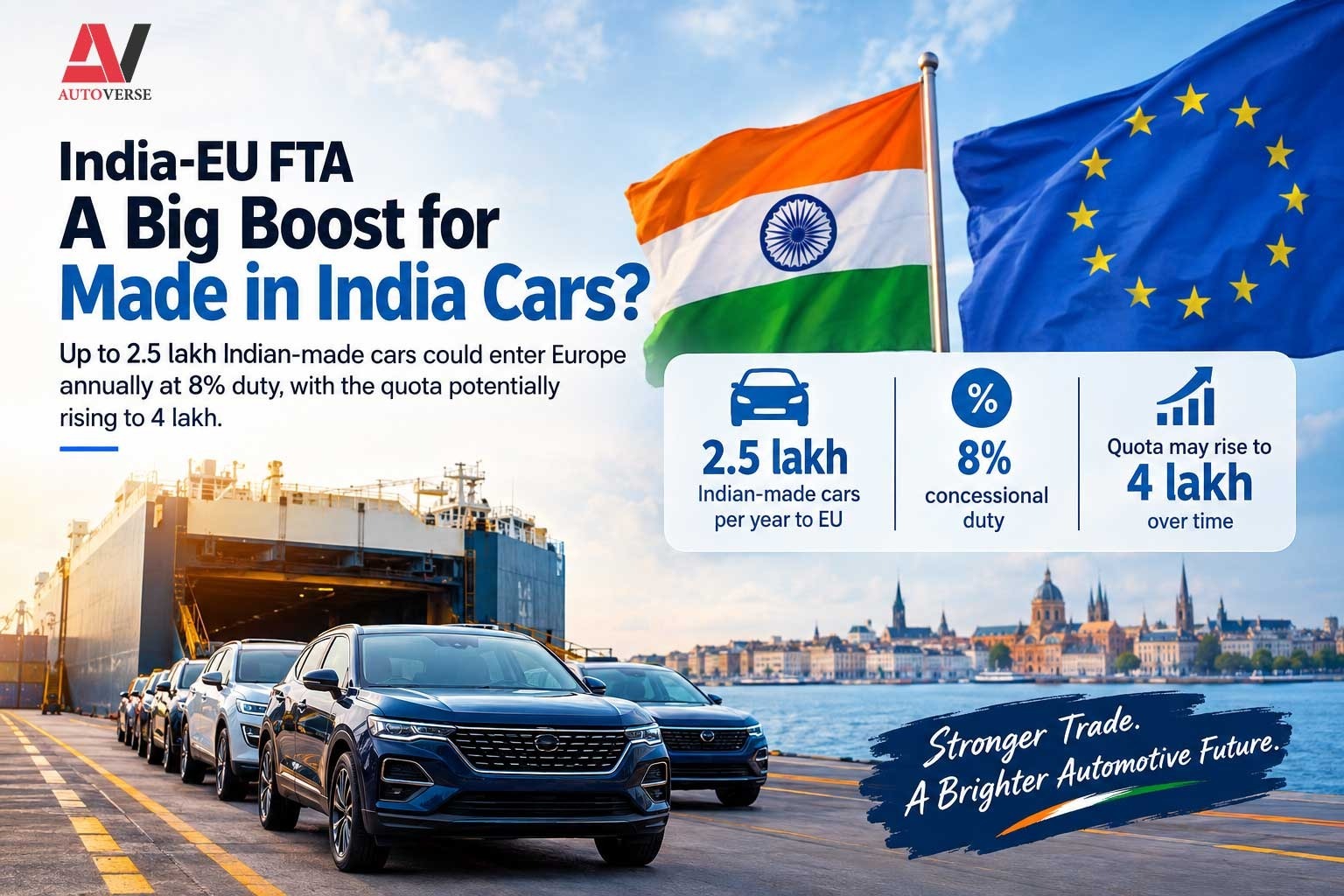
Under the detailed tariff schedule released with the agreement, the European Union will provide an initial annual quota of 250,000 Indian-origin passenger vehicles at a preferential 8% import duty. The quota is scheduled to increase gradually, reaching 400,000 vehicles from the 10th year.
The preferential duty will also fall over time. For qualifying vehicles within the initial quota, the tariff is scheduled to decline from 8% in Year 1 to 6% in Year 2, 4% in Year 3, 2% in Year 4 and zero from Year 5.
The concession is particularly significant because it could make India a more competitive production and export base for vehicles destined for Europe.
However, the arrangement is not a blanket 8% duty for every Indian car.
The initial 250,000-vehicle quota applies to Indian-origin internal-combustion-engine (ICE) and non-plug-in hybrid passenger vehicles priced up to €50,000 on a CIF basis. Different provisions apply to higher-priced vehicles and to electric and plug-in hybrid vehicles.
So, what exactly does the India-EU FTA mean for Indian carmakers, European automakers and Indian consumers?
What Is the India-EU FTA?
The India-EU Free Trade Agreement is a major trade agreement designed to reduce trade barriers and improve market access between India and the European Union.
India and the EU concluded negotiations on 27 January 2026, following years of negotiations. The European Commission subsequently published the negotiated texts and tariff schedules.
However, the agreement is not yet legally binding. The European Commission states that the published texts can undergo legal revision and that the agreement will become binding only after the required internal procedures are completed by both sides.
The agreement covers much more than automobiles.
It includes trade in goods and services, customs and trade facilitation, rules of origin, digital trade and other areas of economic cooperation.
For India’s automobile industry, however, the vehicle tariff schedules are among the most important provisions because they could significantly improve access to the European market.
What Does the India-EU FTA Mean for Indian Cars?
The automotive provisions could change the economics of exporting certain India-made vehicles to Europe.
For qualifying Indian-origin ICE and non-plug-in hybrid passenger vehicles priced up to €50,000 CIF, the EU will provide an initial annual quota of 250,000 vehicles.
Within that quota, the preferential tariff will follow this schedule:
| FTA Year | Preferential EU Duty | Annual Quota |
|---|---|---|
| Year 1 | 8% | 250,000 |
| Year 2 | 6% | 268,750 |
| Year 3 | 4% | — |
| Year 4 | 2% | — |
| Year 5 | 0% | 325,000 |
| Year 10 | 0% | 400,000 |
The detailed schedule provides for the quota to increase progressively, reaching 325,000 vehicles by Year 5 and 400,000 from Year 10.
This could give Indian manufacturers a significant cost advantage compared with exporting under the normal tariff regime.
However, the quota does not mean that 250,000 cars will automatically be exported from India to Europe.
Manufacturers still have to decide:
- Which models to export
- Whether those vehicles meet European regulations
- Whether they qualify under the rules of origin
- Whether European customers want those products
- Whether production capacity is available
- Whether exporting is commercially viable
- How companies will use the available quota
The FTA creates a market-access opportunity. It does not guarantee export volumes.
Why the 250,000-Car Quota Matters
The initial 250,000-vehicle quota is significant because it gives Indian manufacturers a defined volume of preferential access to the European market.
The quota is considerably larger than India’s current passenger-vehicle exports to many individual European markets and could encourage manufacturers to plan India-based production with Europe specifically in mind.
The opportunity could be particularly relevant for manufacturers that already have:
- Large-scale Indian production
- Export experience
- Global vehicle platforms
- European distribution networks
- International safety and compliance capabilities
The quota is also scheduled to expand over time.
According to the detailed tariff schedule, it rises from 250,000 vehicles in the first year to 268,750 in Year 2, 325,000 by Year 5 and 400,000 from Year 10.
This means the opportunity is not limited to the first year of the agreement.
Which Indian Cars Qualify for the Initial 8% Duty?
The initial 8% preferential tariff is not available to every type of vehicle.
The first major tariff-rate quota covers Indian-origin ICE and non-plug-in hybrid passenger vehicles priced up to €50,000 CIF.
CIF means the value including the vehicle cost, insurance and freight up to the relevant EU port of entry.
This price threshold is important because it means manufacturers will need to consider the European landed value of their vehicles when determining eligibility.
Vehicles priced above €50,000 are treated separately.
For Indian-origin ICE and hybrid passenger vehicles priced above €50,000, the detailed schedule provides tariff reductions from 8% to zero over a longer 10-year period, without the same quantitative quota applicable to the vehicles priced up to €50,000.
Therefore, the FTA creates different opportunities for mass-market, premium and luxury vehicles.
Could Indian Cars Become Cheaper in Europe?
Potentially, but a lower import duty does not automatically mean an equivalent reduction in the showroom price.
The final price of an India-made vehicle in Europe will also depend on:
- Shipping costs
- Insurance
- VAT
- Local taxes
- Dealer margins
- Homologation costs
- Safety compliance
- Emissions requirements
- Currency exchange rates
- Logistics
- Manufacturer pricing strategy
For example, if an Indian manufacturer saves money because of the preferential tariff, it could choose to:
- Pass some savings to customers
- Improve dealer margins
- Invest in marketing
- Improve vehicle specifications
- Increase profitability
- Use the savings to support European expansion
Therefore, European consumers should not expect the full tariff benefit to automatically appear as a price reduction.
Which Indian Car Companies Could Benefit?
The FTA could potentially benefit Indian manufacturers with significant production capacity and international ambitions.
Maruti Suzuki
Maruti Suzuki is India’s largest passenger-vehicle exporter and already has substantial experience in international markets.
The company exported a record number of vehicles in FY2026 and has also begun exporting India-made electric vehicles to Europe.
The FTA could make India an even more attractive production base for selected European-bound models.
However, actual export decisions will depend on model suitability, European regulations, pricing and demand.
Tata Motors
Tata Motors has a major manufacturing presence in India and extensive global automotive experience through its ownership of Jaguar Land Rover.
The company could potentially use its Indian manufacturing operations for additional European export opportunities.
However, the FTA itself does not guarantee that any particular Tata model will be exported to Europe.
Mahindra
Mahindra has increasingly expanded its international presence and has developed several SUVs with global markets in mind.
Improved European access could create additional opportunities for India-made Mahindra vehicles, provided they meet European regulatory and consumer requirements.
Hyundai and Kia
Hyundai and Kia have substantial manufacturing operations in India and long-standing export experience.
Both companies already use India as an important production and export base.
The FTA could potentially make Europe more attractive for selected India-made models, although individual export strategies will be decided by the companies.
What About Electric Cars?
Electric vehicles require a separate look because they do not follow exactly the same tariff structure as ICE and non-plug-in hybrid vehicles.
The FTA provides separate tariff-rate quotas for battery-electric vehicles (BEVs), plug-in hybrid electric vehicles (PHEVs) and other passenger-vehicle technologies.
For certain BEVs and other qualifying vehicles priced up to €40,000 CIF, the concession starts from Year 5, with an initial quota of 27,500 vehicles at an 8% duty.
The quota then increases over time, while the tariff is scheduled to reach zero from Year 9.
Separate provisions apply to vehicles priced above €40,000 and up to €60,000, as well as vehicles priced above €60,000.
This means the FTA could eventually create a much larger export opportunity for Indian EVs, but the benefits will be phased in differently from conventional ICE and non-plug-in hybrid cars.
India’s growing EV manufacturing ecosystem could therefore become increasingly important for European exports in the coming years.
Why Rules of Origin Matter
One of the most important technical aspects of any FTA is the rules of origin.
A vehicle cannot simply be assembled in India and automatically qualify for preferential treatment.
The agreement establishes rules that determine whether a product qualifies as originating in India.
This matters because manufacturers will need to manage their supply chains carefully if they want their vehicles to receive preferential tariff treatment.
The provisions could encourage:
- Greater component localisation
- More Indian sourcing
- Deeper supplier networks
- Export-oriented component manufacturing
- Greater integration with global supply chains
For India’s automotive industry, this could have benefits beyond vehicle manufacturers themselves.
Could the FTA Increase India’s Car Exports?
Potentially, yes.
India already exports passenger vehicles, commercial vehicles and two-wheelers to several international markets.
The EU agreement could make Europe a more attractive destination for India-made passenger vehicles by improving tariff competitiveness.
This could encourage manufacturers to think about India not only as a major domestic market but also as a global manufacturing and export base.
Higher exports could create wider opportunities for:
- Vehicle manufacturers
- Auto-component suppliers
- Engineering companies
- Logistics providers
- Ports
- Automotive software companies
- Research and development centres
- Manufacturing workers
The effect could therefore extend well beyond the vehicle itself.
Will This Mean More ‘Made in India’ Cars in Europe?
That is one of the biggest long-term possibilities.
India has developed a large automotive ecosystem covering:
- Vehicle assembly
- Component manufacturing
- Engineering
- Software
- Research and development
- Design
- Testing
- Logistics
Better access to Europe could encourage manufacturers to use India as a production hub for vehicles intended for multiple international markets.
However, European consumers have high expectations regarding safety, emissions, technology, comfort and build quality.
Indian manufacturers will therefore have to combine competitive production costs with products engineered for European requirements.
The Challenge: Europe Is a Difficult Market
Lower tariffs alone will not guarantee success for Indian carmakers.
Europe is one of the world’s most competitive automotive markets.
Manufacturers have to deal with:
- Strict safety regulations
- Emissions requirements
- Cybersecurity regulations
- Software requirements
- Strong established brands
- Rapid EV adoption
- High customer expectations
- Extensive after-sales requirements
A vehicle that is successful in India may therefore require changes before being sold in Europe.
This could include changes to:
- Safety equipment
- Driver-assistance systems
- Emissions systems
- Software
- Lighting
- Vehicle dimensions
- Crash protection
- Infotainment
- Connectivity
The opportunity created by the FTA will ultimately favour manufacturers that can meet these requirements while remaining competitive on price.
What About European Cars Entering India?
The FTA also creates greater market access for European automakers in India.
The structure is different from the EU’s concession for Indian vehicles.
India will provide European manufacturers with a separate tariff-rate quota for ICE and non-plug-in hybrid passenger vehicles.
The initial quota is 100,000 vehicles in the first year, rising to 160,000 by Year 10.
Within the quota, the duty will gradually decline to 10% from Year 5.
India has also structured the arrangement to protect its mass-market vehicle segment.
ICE and hybrid passenger cars priced below €15,000 are outside the concession, while European EVs do not receive concessional access during the first four years under the relevant arrangement.
This means the biggest competitive impact in India is expected to be concentrated in higher-priced and premium vehicle segments.
Could BMW and Mercedes-Benz Cars Become Cheaper in India?
European luxury manufacturers could potentially benefit from improved market access.
Brands such as BMW and Mercedes-Benz could have greater flexibility to import selected vehicles into India if the tariff and quota structure makes those products commercially viable.
However, this does not mean every European luxury car will suddenly become significantly cheaper.
The final customer price will continue to depend on:
- Import volumes
- Manufacturer pricing
- Model positioning
- Taxes
- Dealer margins
- Logistics
- Currency movements
- Local assembly decisions
- Competition
The more realistic outcome could be greater choice and stronger competition in selected premium segments.
What Does the FTA Mean for Indian Car Buyers?
For the average Indian car buyer, the immediate impact is likely to be limited.
The agreement does not mean that popular models from Maruti Suzuki, Tata Motors, Mahindra or Hyundai will suddenly become cheaper in India.
The bigger effects could emerge over several years.
More Global Competition
Greater access for European manufacturers could increase competition in premium and luxury segments.
More Export-Focused Manufacturing
Indian manufacturing plants could increasingly serve global markets.
Higher export volumes could encourage investment in production capacity and technology.
Better Product Development
Manufacturers developing vehicles for Europe must meet demanding safety, environmental and technical standards.
That could encourage further improvements in:
- Safety
- Engineering
- Electronics
- Software
- Emissions technology
- Manufacturing quality
Stronger Auto-Component Industry
More vehicle exports could create additional opportunities for Indian component manufacturers and suppliers.
That could strengthen India’s position in global automotive supply chains.
Could the FTA Strengthen India’s EV Industry?
The agreement could also become relevant to India’s developing EV export industry.
Indian manufacturers are investing in:
- Electric SUVs
- Electric passenger cars
- Battery technology
- Charging technology
- Vehicle software
- EV platforms
India-made EVs already have a growing presence in international markets.
The phased EV provisions under the India-EU FTA could create additional opportunities as the agreement moves into later years.
However, European EV buyers are highly demanding, and Indian manufacturers will have to compete with established European, Chinese, Korean and Japanese brands.
Price competitiveness alone will not be enough.
Range, charging capability, software, safety, efficiency, reliability and after-sales support will all matter.
For readers following India’s affordable EV market, our EVs Under ₹20 Lakh coverage provides a broader look at the models and technology available in India.
What Happens to Indian Auto Exports If the Quota Is Filled?
The preferential tariff applies within the agreed quota structure.
For vehicles covered by the quota, the duty falls progressively according to the schedule.
Vehicles beyond the applicable quota do not automatically receive the same preferential rate and can be subject to the relevant Most Favoured Nation (MFN) duty.
This means manufacturers will have to plan their European export volumes carefully.
The quota could become particularly important if demand for India-made vehicles grows rapidly in Europe.
What Happens Next?
India and the European Union concluded their FTA negotiations on 27 January 2026.
The European Commission published the negotiated texts for transparency, but they are not yet legally final.
The Commission states that the texts can undergo legal revision and that the agreement becomes binding only after both sides complete their respective internal legal procedures.
In September 2026, the European Commission also moved forward with proposals concerning the signature and conclusion of the agreement.
The actual preferential tariffs will therefore apply once the agreement enters into force.
Until then, the negotiated tariff schedules should be viewed as the agreed framework rather than tariffs that are already applicable to vehicles being exported today.
India-EU FTA: What Changes for the Auto Industry?
| Area | Potential Impact |
|---|---|
| Indian car exports to EU | Lower preferential tariffs for qualifying vehicles |
| Initial Indian vehicle quota | 250,000 vehicles |
| Initial EU tariff for qualifying ICE/hybrid cars | 8% |
| Year 5 tariff within the main quota | 0% |
| Long-term Indian vehicle quota | 400,000 from Year 10 |
| EU car imports into India | Greater access under a separate quota |
| Premium cars in India | Potentially greater competition |
| Indian EV exports | Larger long-term opportunity |
| Auto components | Potentially stronger global supply-chain integration |
| Indian manufacturing | Greater export potential |
| Consumers | Potentially more choice over time |
The Bigger Picture for India’s Auto Industry
The significance of the India-EU FTA goes beyond the headline figure of 250,000 vehicles.
For years, India’s automobile industry has been known primarily for the size of its domestic market.
The next stage could be different.
India could increasingly become a manufacturing base for vehicles designed not only for Indian customers but also for developed international markets.
That would represent an important shift.
The automotive industry could potentially move from:
“Make in India for India”
towards:
“Make in India for the world.”
The FTA alone cannot create that transformation.
Indian manufacturers still need competitive products, strong technology, high safety standards, efficient supply chains and successful European distribution networks.
But the agreement could remove an important barrier to exports: high import duties.
What Indian Car Buyers Should Watch Next
The real impact of the India-EU FTA will become clearer as manufacturers make actual business decisions.
Key developments to watch include:
- New India-made models announced for Europe
- Indian SUVs entering European markets
- Expansion of EV export programmes
- New production capacity in India
- European luxury models entering India
- Changes in premium-car pricing
- More global-specification vehicles being developed in India
- New investments in Indian automotive manufacturing
- Growth in India-made vehicle exports to Europe
These developments will show whether Indian manufacturers can turn the new market access into meaningful export growth.
AutoVerse Verdict
The India-EU FTA could become a major milestone for India’s automobile industry.
For qualifying Indian-origin ICE and non-plug-in hybrid passenger vehicles priced up to €50,000 CIF, the European Union will initially allow 250,000 vehicles a year at an 8% preferential duty.
That duty is scheduled to fall to 6% in Year 2, 4% in Year 3, 2% in Year 4 and zero from Year 5, while the quota gradually expands to 400,000 vehicles from Year 10.
The agreement also creates separate provisions for higher-priced vehicles, EVs and other powertrains.
For Indian manufacturers, this could make Europe a significantly more attractive export destination.
For India, the larger opportunity could be even more important: stronger export-oriented manufacturing, deeper integration with global automotive supply chains and greater recognition of India as a global vehicle production base.
For European manufacturers, greater access to India’s premium vehicle market could intensify competition.
For Indian consumers, the immediate impact may be limited, but the longer-term effects could include more global products, stronger competition and greater investment across the automotive ecosystem.
The key takeaway is simple:
The India-EU FTA could give Indian automakers a much bigger opportunity to make vehicles in India and sell them to Europe.
If manufacturers can combine competitive Indian production with vehicles engineered for European safety, technology and customer expectations, the agreement could help accelerate India’s transition from a major automobile market into an even stronger global automotive manufacturing and export hub.
AutoVerse Verdict: The India-EU FTA is a potentially significant opportunity for India’s automobile industry. The 250,000-vehicle initial quota, 8% starting duty and planned move to zero duty by Year 5 could improve the economics of exporting qualifying India-made vehicles to Europe, while the wider agreement could reshape competition and investment across India’s automotive sector.