Electric cars are becoming increasingly popular in India, thanks to lower running costs, instant performance and growing charging infrastructure. But while EV owners may save considerably on fuel, a new set of data suggests that there is another ownership cost worth paying attention to: insurance claims.
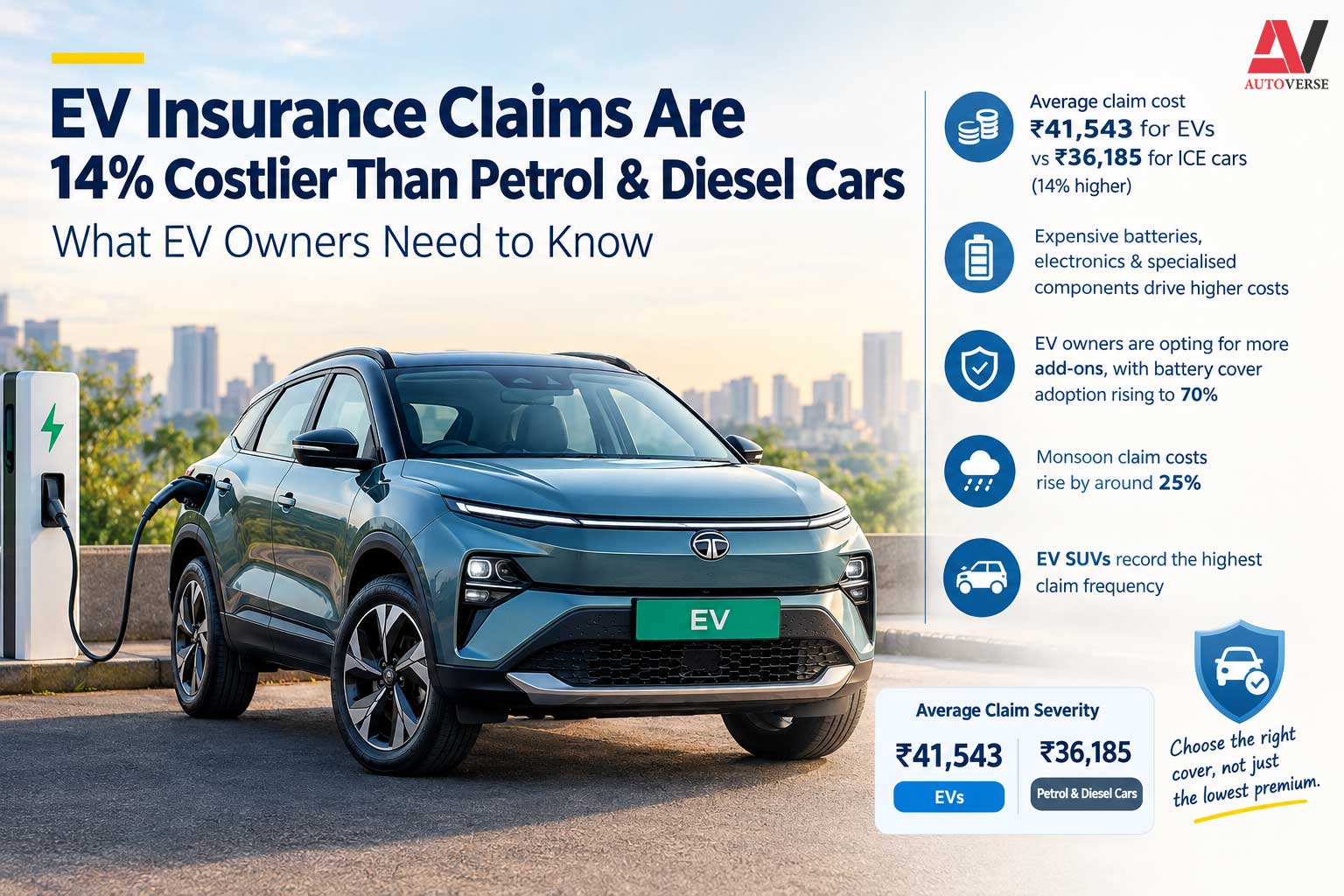
According to recent data from Policybazaar, the average insurance claim cost for electric cars is 14% higher than that of comparable internal combustion engine (ICE) cars. The data shows an average claim severity of ₹41,543 for EVs compared with ₹36,185 for ICE cars.
The comparison covers cars within their first three years of ownership and in the ₹10 lakh to ₹15 lakh price range, while excluding large-loss claims. In simple terms, when an EV and a comparable petrol or diesel car need an insurance-covered repair, the EV can result in a higher average payout.
But why are electric cars more expensive to repair? And does this mean EV insurance premiums will always be higher? Let’s take a closer look.
Why Are EV Insurance Claims More Expensive?
The biggest reason comes down to the technology underneath an electric car.
A conventional petrol or diesel car has an engine, transmission, exhaust system and a relatively established repair ecosystem. EVs, on the other hand, rely on a high-voltage battery pack, electric motor, battery-management system, power electronics, sensors and sophisticated electronic systems.
Some of these components are significantly more expensive to replace or repair.
Policybazaar attributes the higher EV claim costs to factors including expensive battery systems, electronics, imported components and limited EV repair infrastructure. Battery cooling systems, infotainment hardware and other specialised electrical components can also add to the repair bill.
The battery is particularly important. Depending on the model, the battery pack can represent a substantial portion of the vehicle’s overall value. Policybazaar data cited in recent reports suggests battery replacement can account for around 40–50% of a vehicle’s total cost in some cases.
That does not mean every minor accident will result in a battery replacement. However, damage to the battery enclosure, cooling system or high-voltage components can make an otherwise ordinary accident considerably more expensive.
EV Owners Are Choosing More Insurance Add-Ons
Another interesting finding is the growing preference for additional insurance protection among EV owners.
Around 80% of EV owners in the reported data opted for at least two key add-ons, such as battery protection, zero depreciation, roadside assistance and consumables cover. The corresponding figure was around 77% for diesel owners and 75% for petrol owners.
Battery protection, in particular, is becoming increasingly popular.
According to Policybazaar’s data, adoption of battery protection cover increased from 51% to 70% in just six months. Such coverage can be particularly relevant for risks such as water ingress or power surges, depending on the terms and conditions of the policy.
For an EV buyer, this is an important lesson: buying the cheapest insurance policy may not necessarily be the smartest option.
The important question is not simply, “How much is the premium?” It is also, “What exactly is covered if something goes wrong?”
Monsoon Can Make EV Claims Even More Expensive
India’s monsoon season presents another challenge for electric vehicles.
Policybazaar’s data shows that the average EV claim severity rises to nearly ₹65,000 during the monsoon, compared with around ₹52,000 during the rest of the year. That represents an increase of approximately 25%.
Flooding, waterlogging and adverse weather conditions can increase the risk of damage.
While modern EVs are designed with extensive protection against water and electrical hazards, serious flooding or water entering sensitive components can still create expensive repair requirements.
For EV owners, this makes it even more important to avoid driving through deep water unnecessarily and to understand exactly what their insurance policy covers in case of flood-related damage.
EV SUVs Have the Highest Claim Frequency
The data also reveals an interesting difference based on vehicle body style.
Among electric vehicles, SUVs recorded the highest claim frequency at 31 claims per 100 insured vehicles. EV hatchbacks followed with 28 claims per 100 vehicles, while sedans recorded 26 claims per 100 vehicles.
There could be several reasons behind this trend.
SUVs are often used for longer journeys and highway travel, while their larger size and greater exposure to rough roads can potentially increase the chances of underbody, tyre or suspension-related damage. Urban driving, parking and traffic conditions can also influence claim frequency.
It is worth remembering, however, that claim frequency and claim severity are two different things. A vehicle can have fewer accidents but more expensive repairs when an accident does occur.
Tier-II Cities Are Also Seeing Higher EV Claim Frequency
The trend isn’t restricted to India’s biggest metropolitan cities.
Policybazaar data shows EV claim frequency at 33 claims per 100 insured vehicles in Tier-II cities, compared with 30 in Tier-I cities and 27 in Tier-III cities. Regionally, East India recorded the highest frequency at 41 claims per 100 insured EVs, followed by North India at 34, West India at 32, Northeast India at 30 and South India at 27.
This is particularly interesting because India’s EV market is expanding beyond major metros.
As electric cars become more common in smaller cities, insurers and manufacturers will have to build stronger repair and service networks outside major urban centres.
Does This Mean EV Insurance Premiums Are Always Higher?
Not necessarily.
This is perhaps the most important point to understand.
A 14% higher average claim severity does not automatically mean that every EV insurance policy will cost 14% more than an equivalent petrol or diesel car.
Insurance premiums depend on several factors, including the vehicle’s value, IDV, location, age, claim history, coverage selected, deductible and add-ons.
EVs can have higher own-damage costs because of their technology and repair requirements, but the final premium depends on the individual vehicle and policy.
In fact, India’s third-party insurance framework has provided EVs with a discount compared with conventional vehicles. However, third-party insurance is only one part of the overall insurance cost. The own-damage component and optional covers can have a much larger influence on the final premium.
What EV Buyers Should Check Before Buying Insurance
For someone buying an electric car, insurance deserves almost as much attention as range and charging speed.
Here are a few things worth checking:
Battery protection: Find out whether accidental battery damage, water ingress and related risks are covered and what exclusions apply.
Zero depreciation: This can be useful because EV components can be expensive to repair or replace.
Charging equipment: Check whether the home charger, charging cable and other declared charging equipment are covered.
Roadside assistance: Make sure the policy provides appropriate towing support, particularly if you frequently travel outside major cities.
Cashless garages: A wide network of EV-capable workshops can make a major difference after an accident.
Deductibles and exclusions: A cheaper policy can sometimes come with higher deductibles or more restrictive terms.
The Bigger Picture for India’s EV Market
The latest Policybazaar data doesn’t mean electric cars are becoming a bad financial proposition.
Quite the opposite: EVs continue to offer advantages such as lower energy costs and reduced routine maintenance. But their ownership economics are different from those of conventional cars.
The insurance industry is still learning how electric vehicles behave over longer ownership periods. At the same time, manufacturers are expanding EV service networks, technicians are gaining specialised skills and the ecosystem around batteries and components is developing.
As that ecosystem matures, repair costs could become more predictable.
For now, however, EV buyers need to look beyond the showroom price and claimed driving range.
Final Word
The 14% higher EV insurance claim cost is a useful reminder that owning an electric car involves more than simply calculating fuel savings.
Policybazaar’s latest figures show that comparable EVs can generate higher average claim costs than petrol and diesel cars, largely because of expensive batteries, electronics, specialised components and the still-developing EV repair ecosystem.
For buyers, the takeaway is simple: don’t choose EV insurance based only on the lowest premium.
A policy with strong battery protection, zero-depreciation cover, roadside assistance and access to capable repair facilities may prove far more valuable when something actually goes wrong.
As India’s electric-car market grows, insurance will increasingly become an important part of the EV ownership conversation. And for anyone planning to make the switch, understanding that cost before buying could save a lot of money later.