India’s transition towards E20 petrol, which contains up to 20% ethanol blended with petrol, has become one of the country’s biggest changes in the automotive fuel landscape. The move is aimed at reducing dependence on imported crude oil, improving energy security, supporting domestic ethanol production and lowering emissions.
However, the transition has also created questions among car and two-wheeler owners. Does E20 petrol reduce mileage? Is E20 safe for older cars? Can ethanol damage engine components? Which cars are E20 compatible?
These questions have become increasingly important as India expands the use of ethanol-blended petrol.
According to the government, India achieved an average ethanol blending level of around 20% during the 2025-26 ethanol supply year from November 2025 to June 2026. The government has also said that there is currently no decision to increase nationwide petrol blending beyond 20%.
What is E20 petrol?
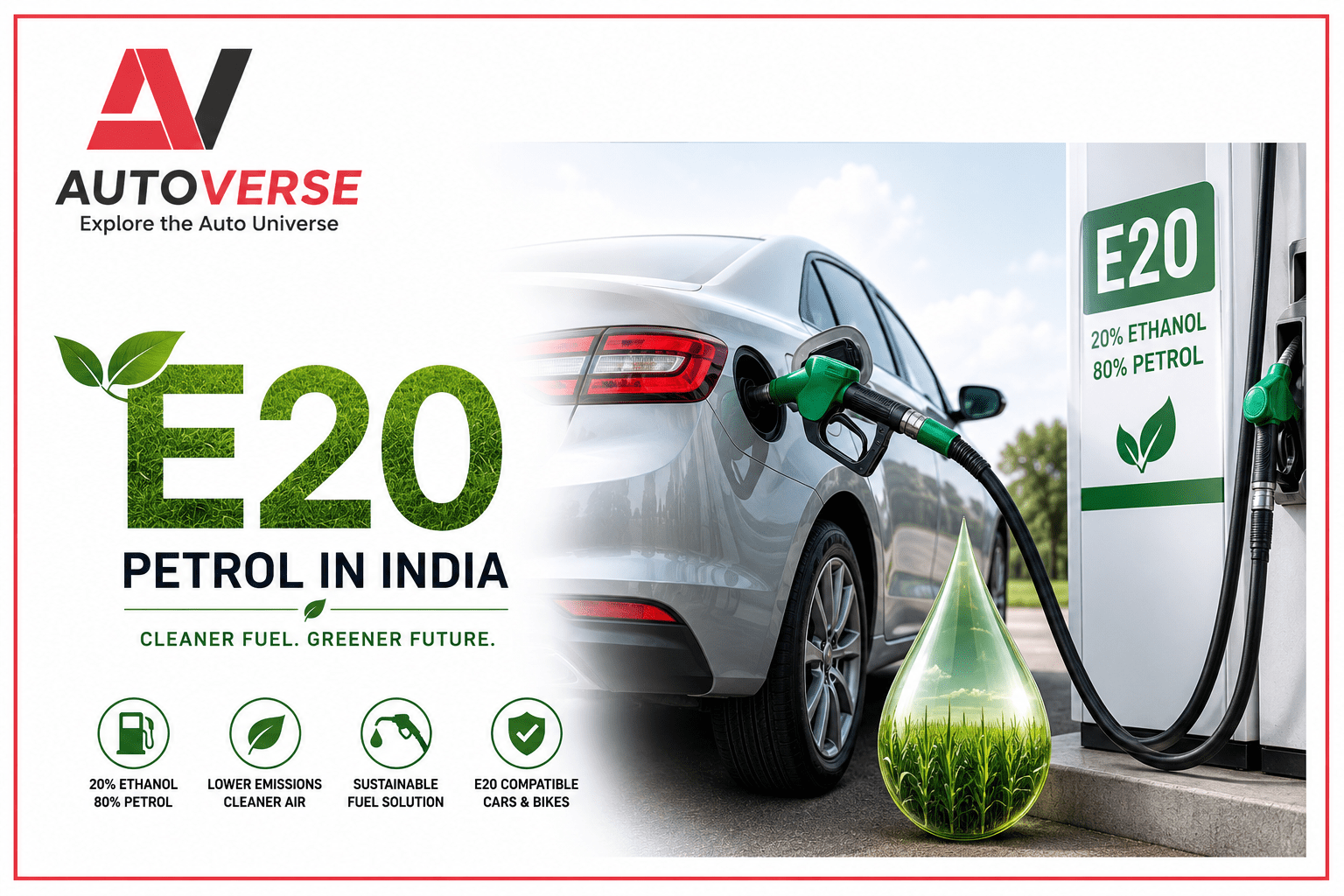
E20 petrol is a fuel containing up to 20% ethanol and 80% petrol. Ethanol is an alcohol-based renewable fuel that can be produced from feedstocks such as sugarcane and maize.
Know more about it.
India has gradually increased ethanol blending over the past decade. Average blending increased from around 12% in 2022-23 to approximately 14.6% in 2023-24 and 19.2% in 2024-25, before reaching about 20% during 2025-26.
The objective is not simply to change the fuel used by motorists. Ethanol blending is part of a wider energy security and biofuel strategy designed to reduce India’s dependence on imported crude oil.
The government has previously estimated that successful implementation of the E20 programme could generate substantial foreign-exchange savings by replacing a portion of petrol consumption with domestically produced ethanol.
Why is India moving towards ethanol-blended petrol?
India imports a large share of the crude oil required for its transport sector. Increasing domestic ethanol use can therefore help reduce the amount of petroleum that needs to be imported.
There are several potential advantages of ethanol blending:
- Reduced crude oil import dependence
- Lower foreign-exchange outflow
- Support for domestic ethanol production
- Additional demand for agricultural feedstocks
- Potential reduction in lifecycle greenhouse-gas emissions
- Greater diversification of India’s transport-fuel mix
The government says ethanol blending has already resulted in significant crude-oil substitution, foreign-exchange savings and carbon-emission reductions.
However, these benefits need to be balanced against practical concerns related to vehicle compatibility, fuel quality and consumer costs.
Does E20 petrol reduce car mileage?
This is one of the biggest concerns for Indian car owners.
Ethanol contains less energy per litre than petrol. Therefore, when a vehicle designed for a lower ethanol blend uses E20, its fuel efficiency can be lower.
The NITI Aayog roadmap estimated that four-wheelers designed for E0 and calibrated for E10 could experience a fuel-efficiency reduction of around 6-7% when operating on E20. For vehicles designed for E10 and calibrated for E20, the estimated reduction was much smaller, at around 1-2%.
This distinction is important.
A modern E20-compatible car is not necessarily expected to experience the same mileage impact as an older vehicle designed around E10 fuel.
Actual mileage also depends on driving style, traffic, air-conditioning use, tyre pressure, vehicle load, engine condition and fuel quality.
Therefore, claims that every car will automatically lose a very large percentage of mileage on E20 should be treated cautiously.
Are older cars compatible with E20 petrol?
This is where the debate becomes more complicated.
Vehicles manufactured and calibrated for lower ethanol blends may have fuel-system components that were not specifically designed for prolonged exposure to higher ethanol concentrations.
Potentially affected components can include:
- Fuel hoses
- Seals and O-rings
- Fuel pumps
- Injectors
- Fuel tanks
- Other fuel-system components
Ethanol also has different chemical properties from conventional petrol. It can absorb moisture and act as a solvent, which is why fuel-system material compatibility and fuel quality are important considerations.
The government has said that vehicles designed for E20 have been developed with appropriate materials and calibration. It also states that extensive real-world experience has not demonstrated widespread engine failures attributable to E20.
For owners of older cars, however, the safest approach is to check the vehicle manufacturer’s E20 compatibility information rather than assuming compatibility purely from the registration year.
E20 Petrol and Engine Health: What Is the Actual Concern?
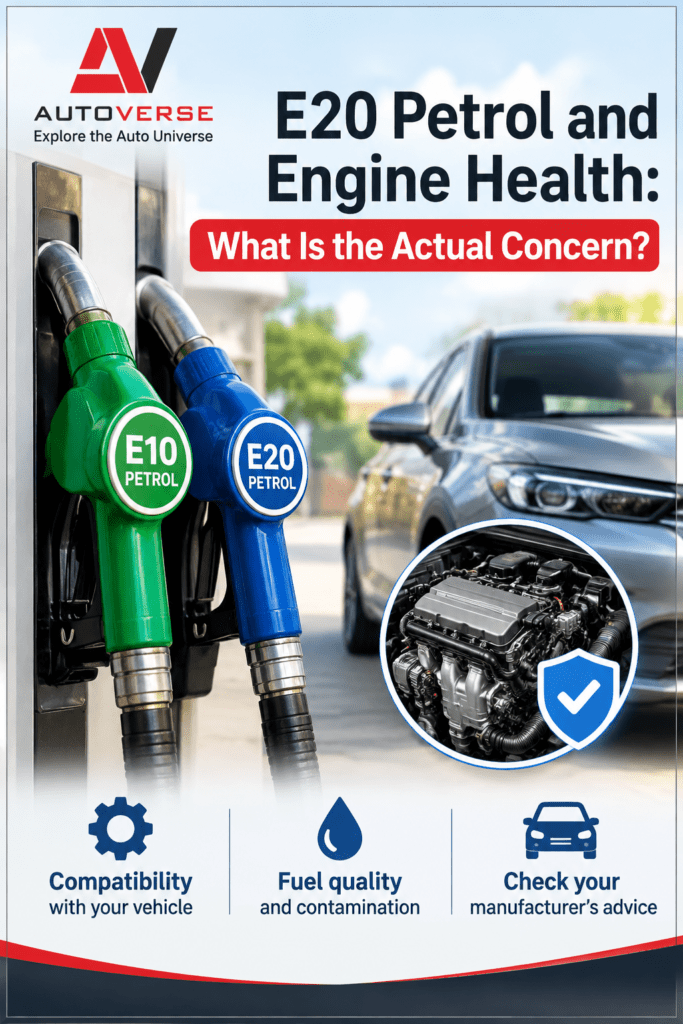
E20 petrol does not automatically damage every older petrol engine. The key concern is whether the vehicle’s engine and fuel-system components are compatible with higher ethanol blends.
There is also a separate fuel-quality concern. In 2026, reports about chloride and moisture levels in some E20 samples led to discussions around fuel testing, storage and contamination. Subsequent testing by oil marketing companies reported that sampled E20 fuel was within prescribed quality limits.
For car owners, the important distinction is between E20 compatibility and contaminated fuel. Owners of older vehicles should check their manufacturer’s recommendations before using E20 regularly. Source
Why fuel quality matters as much as ethanol percentage
The E20 debate should not be reduced to the question of whether ethanol itself is good or bad for an engine.
Fuel quality is equally important.
Problems can arise if petrol becomes contaminated with excessive water or other unwanted substances during production, transportation or storage. Such contamination can affect engine performance regardless of the vehicle’s basic E20 compatibility.
Recent reporting has also brought attention to concerns raised by automakers about contamination in some fuel samples. At the same time, industry bodies and government authorities have disputed or questioned the interpretation and representativeness of some of these findings.
This makes independent testing and transparent fuel-quality monitoring particularly important.
E20-compatible cars are becoming the new normal
Automakers have increasingly developed petrol engines with higher ethanol-blend compatibility.
The government has stated that material compatibility for E20-fuelled engines was achieved from April 2023 and that the rollout of vehicles with E20-tuned engines was targeted from April 2025.
For someone buying a new car in India, therefore, E20 compatibility should be one of the specifications worth checking alongside mileage, engine type, transmission and emissions compliance.
Buyers should look at the manufacturer’s official documentation for:
- Recommended fuel
- Ethanol compatibility
- Minimum octane requirement
- Fuel-system specifications
- Warranty conditions
What about two-wheelers?
The E20 transition is particularly significant for India’s enormous two-wheeler population.
Motorcycles and scooters often remain in service for many years, meaning a substantial number of vehicles on Indian roads were manufactured before the latest E20-oriented engineering changes.
For owners of older motorcycles and scooters, fuel economy, starting behaviour and fuel-system maintenance may therefore be more important considerations.
Regular servicing and following the manufacturer’s fuel recommendations become particularly important as the vehicle ages.
Will E20 petrol make running a car more expensive?
The answer depends on the vehicle.
If an older vehicle experiences lower fuel efficiency, the owner may need to purchase more fuel to cover the same distance. In that situation, the effective running cost per kilometre can increase.
For a newer E20-compatible vehicle, however, the impact can be considerably smaller because the engine calibration and fuel-system components are designed around the higher ethanol blend.
This is why E20 mileage should be evaluated on a vehicle-by-vehicle basis, rather than assuming one mileage figure applies to every petrol car.
E20 petrol vs E10 petrol
The difference is straightforward:
| Feature | E10 Petrol | E20 Petrol |
|---|---|---|
| Ethanol content | Up to 10% | Up to 20% |
| Petrol content | Around 90% | Around 80% |
| Energy per litre | Higher | Lower |
| Compatibility | Wider legacy compatibility | Best suited to compatible vehicles |
| Potential mileage impact | Lower | Can be higher in non-optimised vehicles |
| Renewable fuel component | Lower | Higher |
The important point is that higher ethanol blending does not automatically mean worse fuel. Its suitability depends on vehicle engineering, fuel quality and how effectively the vehicle is calibrated for the blend.
What should car owners do now?
If you own a petrol car, there is no need to panic about E20.
Instead, take a practical approach.
First, check your owner’s manual. The manufacturer normally specifies the acceptable ethanol blend.
Second, check the model’s manufacturing period and specifications. Do not rely only on general claims circulating on social media.
Third, monitor mileage. If fuel efficiency changes significantly, compare it over several refuelling cycles rather than judging it from a single tank.
Fourth, maintain the fuel system properly. Regular servicing becomes especially important for older vehicles.
Finally, use fuel from reliable outlets. Fuel quality and proper storage remain important regardless of ethanol percentage.
The road ahead for E20 petrol in India
India’s E20 transition is bigger than a change at the petrol pump. It represents a major shift in the country’s automotive fuel policy, energy security strategy and biofuel ecosystem.
The benefits are significant: lower dependence on imported crude oil, greater domestic ethanol production and potential environmental gains.
At the same time, policymakers and the automotive industry need to address legitimate concerns involving older vehicles, mileage, fuel-system compatibility and fuel-quality monitoring.
The government says more than 20 crore two-wheelers and over 3 crore petrol cars have operated on ethanol blends without verified evidence of widespread engine failure attributable to ethanol blending.
https://www.pib.gov.in/PressReleasePage.aspx?PRID=2288271®=48&lang=2
That provides an important counterpoint to some of the more extreme claims circulating online.
However, consumer confidence will ultimately depend on transparent data, reliable fuel quality, clear vehicle compatibility information and effective communication from automakers and authorities.
For Indian car buyers, the takeaway is simple: E20 petrol is now an important part of India’s automotive future, but the impact is not identical for every vehicle. Newer E20-compatible cars are engineered for the transition, while owners of older petrol vehicles should check manufacturer recommendations and pay attention to mileage and fuel-system performance.
As India moves deeper into the ethanol era, the focus should be on making the transition cleaner, technically sound and, most importantly, understandable for the millions of motorists who depend on petrol every day.
SEO note: I would avoid using the exact headline “The Road to E20 Is Not Without Bumps” for AutoVerse because it closely mirrors the source article. The title above targets stronger automotive search intent such as “E20 petrol in India,” “E20 petrol mileage,” “E20 compatible cars,” “E20 impact on cars,” and “E20 petrol older vehicles.”
The article is based on the subject of the linked The Hindu report but has been independently structured and updated with current 2026 information from government and other reporting.