
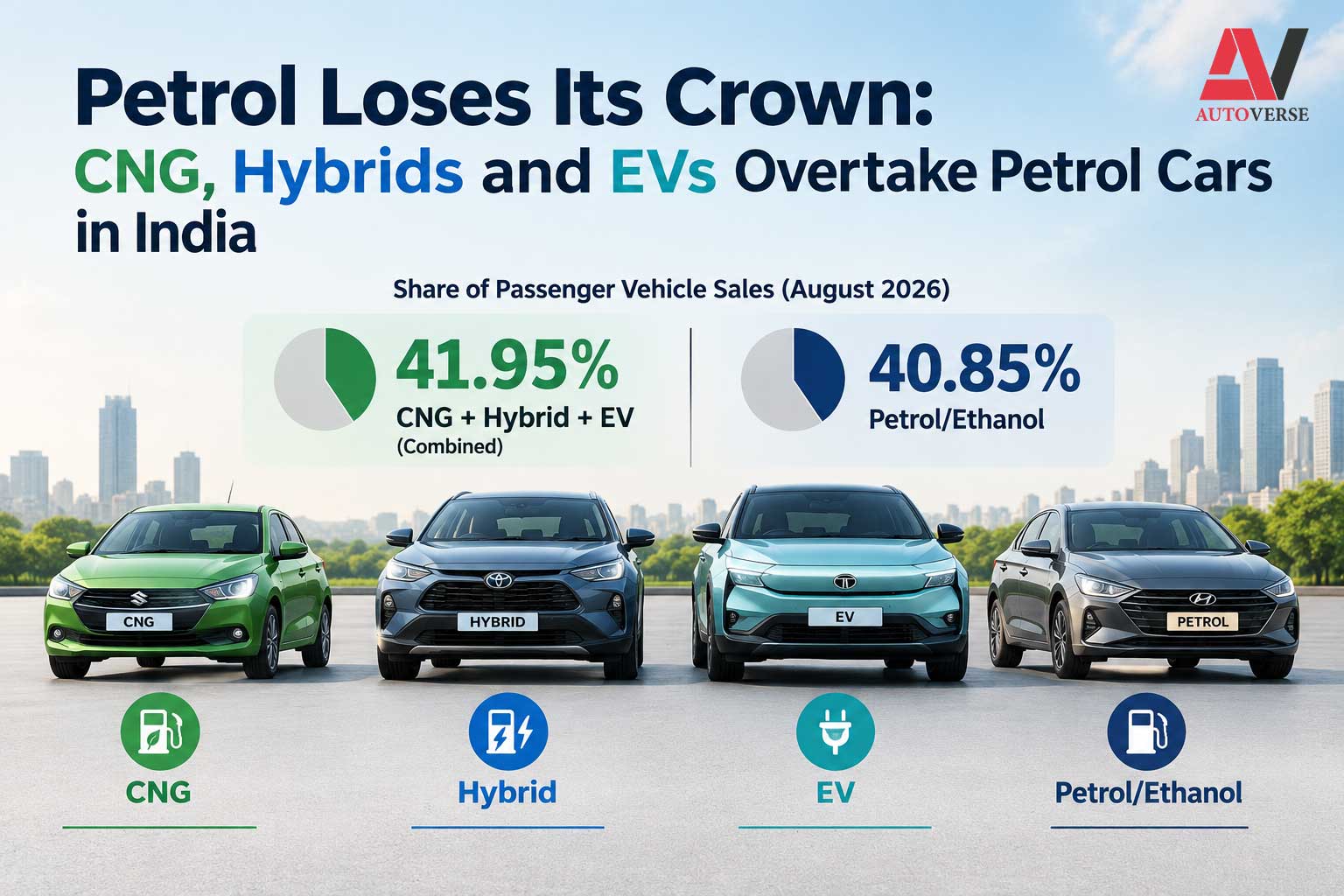
For decades, the petrol car has been the default choice for Indian car buyers.
That is changing.
In a development that would have seemed unlikely just a few years ago, CNG, hybrid and electric cars together outsold petrol/ethanol-powered cars in India during August 2026. According to retail registration data released by the Federation of Automobile Dealers Associations (FADA), alternative-fuel vehicles accounted for 41.95% of passenger-vehicle sales, compared with 40.85% for petrol/ethanol vehicles.
The difference is only 1.10 percentage points, but the significance is much bigger.
For the first time, Indian car buyers collectively chose alternatives to conventional petrol in greater numbers than petrol cars themselves.
And interestingly, this isn’t simply an EV revolution.
It is a story about CNG, hybrids and EVs all gaining ground at the same time.
The Numbers Tell an Interesting Story
India retailed 4,02,398 passenger vehicles in August 2026, marking a 16.14% increase over the same month last year. It was also the first time passenger-vehicle retail sales crossed the four-lakh mark in August.
But the fuel mix is where things get really interesting.
| Powertrain | Share of PV Retail Sales |
|---|---|
| Petrol/Ethanol | 40.85% |
| CNG/LPG | 25.28% |
| Hybrid | 9.04% |
| Electric | 7.63% |
| Diesel | 17.21% |
| CNG + Hybrid + EV | 41.95% |
So, while petrol remains the largest individual category, it has lost its overall lead when the three alternative powertrains are combined.
And there is another number worth remembering.
A year earlier, petrol/ethanol had a lead of roughly 11 percentage points over the combined alternative-fuel category. The fact that this gap has disappeared in such a short period shows how quickly the Indian market is changing.
No, This Isn’t Just About EVs
When we hear that petrol cars are losing ground, it is tempting to assume that EVs are responsible.
But the numbers tell a different story.
CNG is actually the biggest contributor to this shift.
CNG/LPG vehicles accounted for 25.28% of passenger-vehicle retail sales in August. Hybrids followed with 9.04%, while EVs accounted for 7.63%.
In other words, India’s transition away from petrol is not following the same path as some developed markets where battery-electric vehicles are rapidly replacing internal-combustion engines.
Indian buyers are choosing different solutions for different needs.
For someone covering large distances every day, CNG can make financial sense.
For someone who wants better fuel efficiency without changing the way they refuel, a hybrid can be attractive.
And for a buyer with access to convenient charging, an EV can offer low running costs and a completely different driving experience.
That makes India’s transition particularly interesting.
Why Are Buyers Moving Away From Petrol?
The simplest answer is running cost.
Fuel prices have always played an important role in Indian car-buying decisions. With households becoming increasingly conscious of the cost per kilometre, alternatives that promise lower running expenses are becoming harder to ignore.
CNG has benefited tremendously from this equation.
Factory-fitted CNG cars are now available across multiple segments, from affordable hatchbacks to SUVs. Manufacturers have also improved packaging, performance and boot-space solutions, making CNG less of a compromise than it once was.
Then there are hybrids.
Toyota and Maruti Suzuki have helped make strong hybrids increasingly visible in the mainstream market, while other manufacturers are also exploring electrified powertrains.
Hybrids offer an interesting middle ground: you still have a petrol engine, but electric assistance can significantly improve efficiency, particularly in city traffic.
And then there is the EV.
Electric cars accounted for 7.63% of passenger-vehicle retail sales in August, a notable increase from their earlier share. Better range, a wider choice of models and expanding charging infrastructure are making EV ownership increasingly practical for more buyers.
E20 Is Also Part of the Conversation
There is another factor that cannot be ignored: E20 petrol.
India’s transition towards petrol containing up to 20% ethanol has generated considerable discussion among car owners, particularly those using older vehicles.
FADA and dealers have pointed to consumer hesitation around the E20 transition as one factor contributing to the shift towards CNG, hybrids and EVs.
This does not mean E20 alone is responsible for the change.
Far from it.
Fuel economics, product availability, technology improvements, government policy and changing consumer preferences are all working together.
But when consumers have concerns about the fuel they are currently using, it can naturally encourage them to explore alternatives.
The Indian Car Market Is Becoming Multi-Powertrain
Perhaps the biggest takeaway from the August numbers is that India is not replacing petrol with one particular technology.
Instead, the market is becoming multi-powertrain.
CNG has emerged as a practical low-running-cost solution.
Hybrids are appealing to buyers who want efficiency without range anxiety or charging dependence.
EVs are attracting consumers who are ready to make the bigger technological jump.
Diesel, meanwhile, still holds a meaningful 17.21% share, particularly in SUVs and vehicles used for highway and long-distance driving.
That means India’s automotive future is unlikely to be a simple story of “petrol versus EV”.
It is going to be much more complicated — and much more interesting.
What This Means for Car Manufacturers
For carmakers, the message is fairly clear.
Indian consumers want choice.
Manufacturers that offer only petrol-powered cars could increasingly find themselves at a disadvantage as customers start comparing not just purchase prices but also long-term running costs.
This is already visible in the strategies of major manufacturers.
Maruti Suzuki has built a strong CNG portfolio. Toyota has pushed strong hybrids. Tata Motors and Mahindra have expanded their EV offerings. Hyundai, Kia and other manufacturers are also increasing their focus on electrified vehicles.
The result is that buyers now have more powertrain choices than ever before.
And that competition should ultimately be good for the customer.
Is Petrol Really Finished?
Absolutely not.
In fact, petrol remains the largest single powertrain category at 40.85%.
The August crossover is therefore more symbolic than revolutionary.
The combined alternative-fuel share only narrowly exceeded petrol, and one month’s data does not mean the market will never swing back.
Seasonality, new launches, discounts, fuel prices and changes in consumer sentiment can all influence monthly registrations.
But the direction of travel is difficult to ignore.
The gap between conventional petrol and alternative powertrains is shrinking.
And it is shrinking quickly.
What Happens Next?
The next few years could be fascinating for India’s car market.
The government is also moving towards stricter fuel-efficiency and emissions regulations. The upcoming CAFE-III norms, which take effect from April 2027, provide compliance benefits for technologies including EVs, hybrids, plug-in hybrids, range-extender EVs and certain alternative-fuel vehicles.
That could encourage manufacturers to expand their electrified and alternative-fuel portfolios even further.
But ultimately, the consumer will decide which technologies survive and grow.
And Indian consumers are becoming increasingly practical.
They are asking questions like:
How much will it cost me per kilometre?
Where can I refuel or charge it?
How much will I save over five years?
Will the technology work for my daily commute and weekend trips?
Those questions may prove more important than simply asking whether a car is petrol, hybrid or electric.
AutoVerse Take
The most interesting thing about India’s latest car-sales milestone is that petrol hasn’t been defeated by the EV.
It has been challenged by three different technologies at once.
CNG is winning buyers with affordability. Hybrids are offering efficiency without asking consumers to completely change their habits. EVs are slowly becoming a mainstream choice as range and charging infrastructure improve.
And together, they have finally crossed the psychological barrier that petrol seemed unlikely to lose anytime soon.
August 2026 could therefore be remembered as a turning point — not because petrol cars suddenly became unpopular, but because Indian buyers showed that they are no longer dependent on a single type of powertrain.
The Indian car market is entering a new phase.
Petrol may still be the biggest individual player, but the future is increasingly about choice.
And for Indian car buyers, that could be the best news of all.
Suggested Social Media Headline
Petrol Cars Lose Their Crown! 🚗 CNG + Hybrids + EVs Cross 42% of India’s Car Sales for the First Time
41.95% vs 40.85% — India’s car market has officially entered a new era. But here’s the interesting part: CNG, not EVs, is leading the shift.
An interesting look at how India’s automotive market is becoming increasingly multi-powertrain. The fact that CNG, hybrids, and EVs together have overtaken petrol highlights how strongly running costs, fuel efficiency, and changing consumer preferences are influencing car-buying decisions. CNG leading the shift is particularly noteworthy.