Buying an electric car often starts with one important number: range.
A manufacturer may advertise an EV with a range of 400 km, 500 km or even more on a single charge. But after driving the car in everyday traffic, some owners may notice that the estimated range shown on the dashboard is lower than the headline figure.
Does that mean the car is underperforming?
Not necessarily.
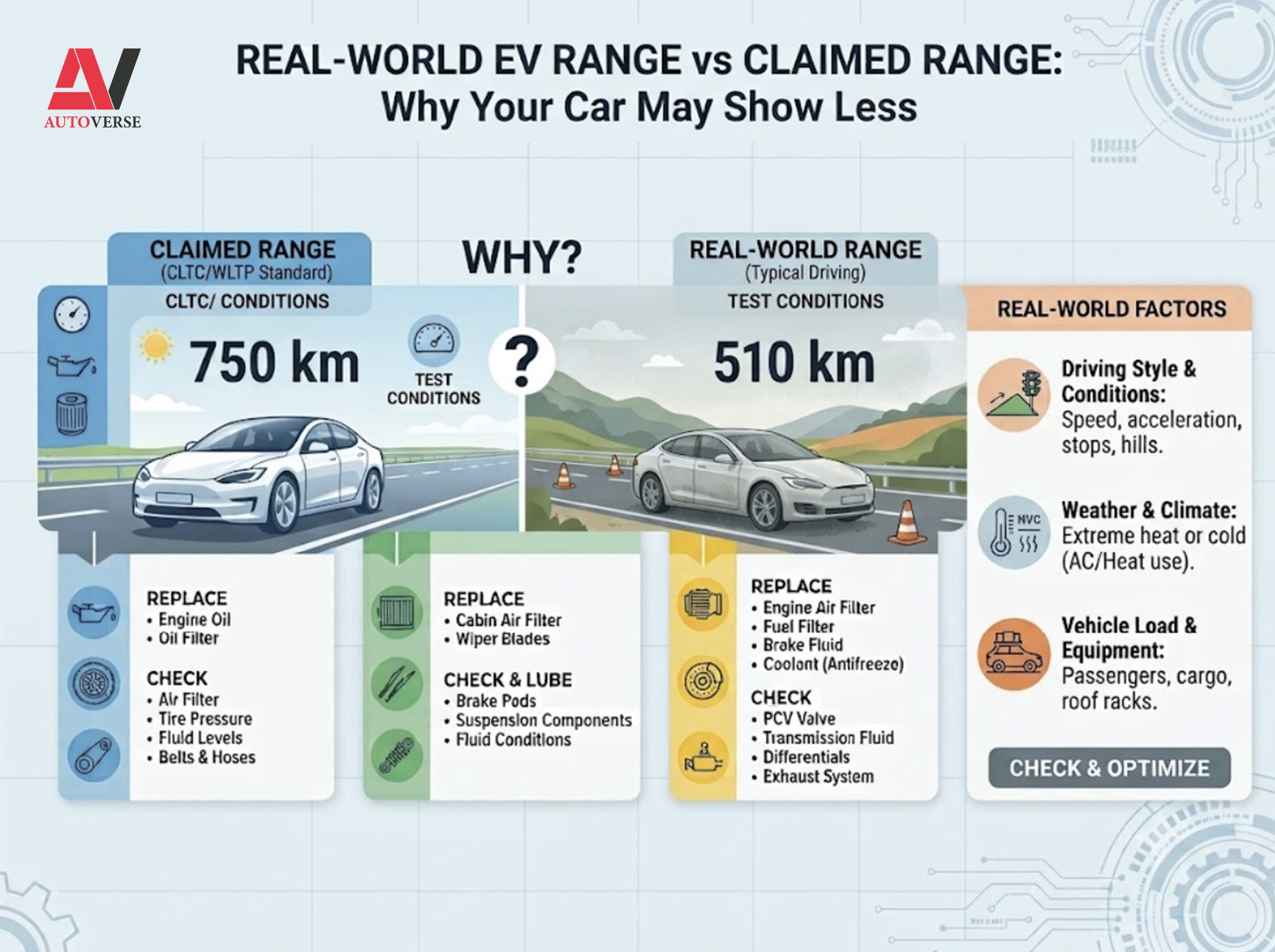
The difference between claimed range and real-world EV range is normal because official range testing takes place under defined conditions, while everyday driving is far less predictable. Traffic, speed, air-conditioning, temperature, road gradients, tyre pressure, driving style and vehicle load can all influence how much energy an EV consumes.
This is why EV buyers should look beyond the biggest range number in a brochure and understand how the car is likely to perform in their own driving conditions.
Claimed EV Range vs Real-World EV Range
The claimed range is a certified or declared figure determined through a specified testing procedure. In India, organisations such as the Automotive Research Association of India (ARAI) are involved in vehicle testing, evaluation and certification.
ARAI’s published EV testing information shows that range estimation and powertrain evaluation can involve defined driving cycles and different operating conditions. Its Drivetrain Development Centre lists range estimation using cycles including WLTC, JC08 and MIDC, along with validation under drive, coast, derating and regeneration modes.
ARAI also lists dedicated facilities for electric-vehicle range testing and energy-consumption evaluation.
The important point for buyers is that a certified range figure is a standardised benchmark, not a promise that every driver will achieve exactly that distance.
Real-world range is what your EV actually manages under your driving conditions.
For example, two drivers using the same EV can record different efficiency because one may drive mostly in city traffic while the other spends most of the time on highways.
Why Is Real-World EV Range Lower?
There isn’t one single reason. EV efficiency changes continuously depending on how the vehicle is being driven and the conditions around it.
Here are the biggest factors.
1. Driving Speed Makes a Big Difference
High-speed driving can reduce EV efficiency.
An electric motor can deliver strong acceleration at highway speeds, but maintaining a higher speed requires more energy because aerodynamic resistance increases as speed rises.
This means an EV that performs efficiently in moderate-speed urban driving may consume considerably more energy when driven quickly on an expressway.
For long-distance travel, therefore, speed can be just as important as battery size.
A driver who consistently travels at high speeds should not assume that the advertised range will be replicated during every highway journey.
2. Air-Conditioning Uses Energy
Air-conditioning is particularly relevant to Indian EV buyers.
Unlike a conventional car, an EV does not have an engine whose waste heat is simply available as a by-product for cabin heating. More importantly for Indian conditions, the electric climate-control system requires electrical energy to cool the cabin.
During India’s hot summer months, cooling the cabin can therefore become an important part of overall energy consumption.
This does not mean that you should avoid using AC. It simply means that climate-control usage is one of the variables that can affect real-world range.
3. Traffic and Frequent Acceleration
City traffic creates a different efficiency pattern.
Repeatedly accelerating from a standstill requires energy. Regenerative braking can recover some energy when the vehicle slows down, but it cannot recover all of the energy used to accelerate the vehicle.
Heavy traffic can therefore produce very different consumption figures compared with smooth, steady driving.
Interestingly, this does not mean city driving will always give worse range than highway driving. EVs can be efficient in urban conditions because of regenerative braking and lower average speeds.
The result depends on the actual traffic pattern and driving style.
4. Your Driving Style Matters
An EV’s instant torque makes it easy to accelerate quickly.
That can be enjoyable, but repeated hard acceleration followed by heavy braking can increase energy consumption.
A smoother driving style generally helps efficiency.
Instead of repeatedly making rapid speed changes, maintaining a steady pace where traffic allows can help reduce unnecessary energy use.
This is one reason two owners of the same EV can report noticeably different range figures.
5. Tyre Pressure Can Affect Efficiency
Tyres are often overlooked when discussing EV range.
Under-inflated tyres can increase rolling resistance, meaning the motor has to work harder to move the vehicle.
Keeping tyre pressure at the manufacturer’s recommended level is therefore a simple maintenance step that can help maintain efficiency.
It also has benefits for tyre life, handling and safety.
For EV owners, checking tyre pressure regularly is particularly worthwhile because even small efficiency losses can become noticeable over longer journeys.
6. Extra Weight Can Reduce Range
An EV carrying several passengers and a fully loaded luggage compartment has to move more mass than the same car carrying only one occupant.
More weight generally means more energy is required, particularly during acceleration and on gradients.
This is why the range you see when travelling alone may not be the same as the range you experience on a fully loaded family road trip.
The difference does not automatically indicate a battery problem.
It is simply a consequence of the physics involved in moving a heavier vehicle.
7. Temperature and Weather Conditions Matter
Battery performance and vehicle efficiency can vary with temperature.
India presents an interesting environment for EVs because drivers can experience very hot summers, cooler winters, monsoon conditions and significant variations in climate between regions.
Extreme temperatures can influence battery thermal management and cabin climate-control requirements.
ARAI’s published testing capabilities include EV range testing under different environmental conditions, including temperature simulation, while its EV development facilities also support range estimation at different ambient temperatures.
For consumers, the takeaway is simple: the same EV may not deliver identical efficiency throughout the year.
8. Hills and Road Gradients Consume More Energy
Driving uphill requires additional energy because the vehicle is effectively being moved against gravity.
On the way downhill, regenerative braking can recover some energy.
However, regeneration should not be interpreted as a complete energy refund.
If your daily route includes steep climbs, you may see lower efficiency than someone driving on relatively flat roads.
This is particularly relevant for buyers living in or regularly travelling through hilly regions.
9. Regenerative Braking Helps — But It Isn’t Magic
Regenerative braking is one of the major advantages of an electric drivetrain.
When the vehicle decelerates under regenerative braking, some of the vehicle’s kinetic energy can be converted back into electrical energy and sent to the battery.
ARAI’s EV development work includes validation of drive, coast, derating and regeneration modes. Its EV testing facilities also cover regenerative-braking and thermal-characteristics evaluation.
But regeneration does not mean that every bit of energy used during acceleration comes back.
There are conversion losses, tyre and road losses, aerodynamic losses and other inefficiencies.
Therefore, regenerative braking can improve efficiency, but it cannot completely eliminate the energy cost of driving.
10. Battery Temperature and Thermal Management
The battery is at the centre of an EV’s performance.
Modern electric vehicles use battery-management and thermal-management systems to monitor and manage battery conditions.
ARAI’s EV-BMS work includes monitoring cell voltage, pack current and temperature, along with state-of-charge and state-of-health estimation and thermal management.
Thermal-management systems can themselves consume energy, while battery temperature can influence how the vehicle manages power and charging.
This is another reason why real-world range should be viewed as a changing estimate rather than a fixed number.
ARAI Range vs What You See on the Road
One common misunderstanding is that a certified range figure represents the exact distance every owner should achieve.
It doesn’t.
Standardised testing exists so that vehicles can be evaluated using defined procedures and conditions. Without a common methodology, comparing different vehicles would be far more difficult.
ARAI’s published information lists several driving cycles used for EV range estimation and performance work, including MIDC and WLTC, along with other evaluation conditions. The exact testing procedure applicable to a vehicle depends on the relevant certification requirements.
Real-world driving is much less predictable.
You may encounter:
- Traffic jams
- Sudden acceleration
- High-speed sections
- Uneven roads
- Steep gradients
- Hot weather
- Heavy rain
- Multiple passengers
- Continuous air-conditioning
- Different tyre pressures
A standardised test cannot reproduce every possible combination of these conditions.
That is why claimed range and real-world range should not be treated as identical numbers.
Why Your EV’s Dashboard Range Keeps Changing
There is another number that can confuse new EV owners: the estimated range displayed on the dashboard.
This should not be confused with the manufacturer’s certified range.
The dashboard figure is an estimate of how far the vehicle may be able to travel with the available battery charge. The estimate can change according to recent energy consumption and driving conditions.
For example, after several high-speed drives with heavy AC use, the estimated range may fall faster than expected.
After a period of smoother and more efficient driving, the estimate can change again.
This means a falling dashboard range does not automatically indicate that the battery has suddenly lost capacity.
Claimed range, dashboard estimated range and actual range achieved on the road are three different things.
Understanding that distinction can prevent unnecessary range anxiety.
A Simple Example of How Range Can Change
Imagine an EV has a claimed range of 450 km.
That does not mean every owner should expect to travel exactly 450 km between charges.
Consider two hypothetical journeys.
Driver A
- Moderate speeds
- Light traffic
- One or two occupants
- Correct tyre pressure
- Moderate AC use
- Mostly flat roads
Driver B
- High highway speeds
- Four passengers
- Luggage
- Strong AC use
- Frequent acceleration
- Hilly sections
Both drivers are using the same vehicle, but their energy consumption can be different.
Therefore, quoting a single real-world range number for every owner would be misleading.
The 450-km figure in this example is illustrative only, not a tested result for any particular EV.
Does a Lower Range Mean Your EV Has a Problem?
Not automatically.
The range displayed by an EV is often an estimate, and the vehicle’s computer may continuously adjust that estimate based on recent driving efficiency and other operating conditions.
For example, after several high-speed drives with heavy AC use, the displayed estimated range may fall.
After more efficient urban driving, the estimate may change again.
A temporary reduction in displayed range therefore does not necessarily indicate battery degradation or a mechanical fault.
However, a persistent and unusually large reduction in efficiency, especially when accompanied by warning messages, charging issues or other unusual symptoms, should be investigated through the manufacturer’s service network.
What About EV Battery Degradation?
Battery capacity can gradually change as an EV ages.
Battery degradation is different from a temporary change in the dashboard’s estimated range.
A vehicle may show a lower estimated range on a particularly hot day, after high-speed driving or following heavy climate-control use without having suffered any permanent loss of battery capacity.
Over a much longer period, however, battery ageing and usage can reduce available capacity.
Modern battery-management systems monitor battery conditions and can estimate parameters such as state of charge (SoC) and state of health (SoH). ARAI’s EV-BMS technology specifically includes SoC and SoH estimation.
Therefore, buyers should distinguish between:
Temporary range variation: caused by driving and environmental conditions.
Long-term battery degradation: gradual reduction in usable battery capacity over time.
If an EV shows a persistent and unusual loss of usable range, owners should have the vehicle assessed by the manufacturer or an authorised service centre rather than relying only on the dashboard estimate.
Which EV Range Number Should You Trust?
An EV buyer may encounter three different range numbers.
1. Manufacturer’s Claimed Range
This is useful for comparing vehicles under the applicable standardised testing framework.
2. Dashboard Estimated Range
This is useful for understanding how far the car currently estimates it can travel with the available charge.
However, it can change according to recent energy consumption and conditions.
3. Your Own Long-Term Efficiency
For an owner, this can be the most useful number of all.
After driving the EV for several weeks or months, you can develop a much better understanding of how the car performs on your normal commute, highway trips and family journeys.
The third number is often the most relevant for ownership decisions.
How to Improve Your EV’s Real-World Range
You don’t need to drive unnaturally slowly to improve efficiency.
A few practical habits can help.
Maintain Correct Tyre Pressure
Check tyre pressure regularly and follow the manufacturer’s recommended figures.
Avoid Unnecessary High Speeds
Moderate, consistent speeds are generally more efficient than repeatedly driving at very high speeds.
Accelerate Smoothly
Take advantage of the EV’s instant torque without constantly using full acceleration.
Use Regenerative Braking Effectively
Where appropriate, use the vehicle’s regenerative braking system to recover some energy during deceleration.
Reduce Unnecessary Weight
Don’t carry heavy items in the vehicle unless you actually need them.
Use Climate Control Sensibly
You should not compromise safety or comfort just to save a few kilometres of range. However, sensible climate-control use can help reduce unnecessary energy consumption.
Plan Long Trips
On longer journeys, consider charging locations, weather conditions, traffic and the availability of alternative charging points.
Watch Energy Consumption, Not Just the Range Number
Instead of becoming anxious every time the estimated range changes, pay attention to your vehicle’s energy consumption over time.
This gives you a better understanding of how efficiently you are actually driving.
What About EV Range Anxiety?
Range anxiety often comes from treating the advertised number as an absolute promise.
A better approach is to understand your usable daily range.
Suppose your daily commute is 50 km. An EV with substantially more usable range than your normal daily requirement may be perfectly practical even if your actual range is lower than the advertised figure.
The question shouldn’t simply be:
“Does this EV give the claimed range?”
A more useful question is:
“Does this EV provide enough real-world range for my regular driving, with a comfortable charging buffer?”
That is a much better way to evaluate an electric car.
How Much EV Range Should You Actually Expect?
There is no universal real-world percentage that applies to every electric car.
A vehicle’s actual range depends on its battery capacity, efficiency, weight, tyres, motor and drivetrain configuration, software calibration, climate, traffic and driving conditions.
Instead of assuming that the certified figure will always be achieved, buyers should look at the range requirement of their own lifestyle.
Before buying an EV, consider:
- How many kilometres you drive every day
- How much highway driving you do
- Whether you regularly use AC
- Whether you live in a very hot or cold climate
- Whether your route includes hills
- How easily you can access charging
- How frequently you take long-distance trips
- Whether you normally travel alone or with a full load
This approach is much more useful than comparing brochure numbers alone.
Claimed Range Is a Benchmark, Not a Promise
The biggest lesson for EV buyers is simple: claimed range and real-world range are two different things.
A certified range figure provides an important standardised benchmark. It helps buyers compare vehicles under defined testing conditions.
Real-world range, however, depends on what happens after you leave the showroom.
Traffic, speed, AC usage, temperature, tyres, load, road gradients and driving behaviour can all change energy consumption.
ARAI’s current EV testing and development capabilities include range estimation, vehicle range testing, battery and BMS evaluation, thermal management and powertrain validation, illustrating how many variables are relevant to EV performance.
Therefore, seeing a lower number on your EV’s range display than the manufacturer’s headline figure is not automatically a reason to worry.
The smarter approach is to understand your vehicle’s typical efficiency and plan your charging around your real driving pattern.
AutoVerse Verdict
Don’t buy an EV based only on its biggest range number.
For an electric car, the most useful range figure is the one that fits your daily life.
A 500-km claimed-range EV may not deliver 500 km on every journey, while an EV with a lower claimed figure could still be more than sufficient for a buyer whose daily travel is modest and whose home or workplace charging is convenient.
The right way to judge an EV is to consider claimed range, expected real-world conditions, charging infrastructure and your own driving pattern together.
In other words, range is not just a battery number — it is a driving-condition number.
Quick Buyer Takeaway
Before buying an EV, ask these five questions:
- What is the officially claimed range?
- What kind of driving will I do most often?
- How much could my AC, speed and traffic conditions affect energy consumption?
- Where will I charge the car?
- Will I have enough practical range left as a safety buffer?
Answer those questions honestly, and the difference between claimed and real-world range becomes much easier to understand.
Frequently Asked Questions
Is real-world EV range the same as the claimed range?
No. The claimed range is measured using a specified testing procedure, while real-world range depends on factors such as speed, traffic, weather, AC use, load, tyres and driving style.
Why does my EV show less range than the advertised figure?
The dashboard estimate can change based on recent driving conditions and energy consumption. High speeds, heavy AC use, frequent acceleration, extra load and other factors can reduce efficiency.
Does AC reduce EV range?
Yes. The EV’s climate-control system uses electrical energy, so extensive air-conditioning use can increase energy consumption and reduce the distance available from a given battery charge.
Does highway driving reduce EV range?
High-speed highway driving can reduce efficiency because aerodynamic resistance increases with speed. The actual effect depends on speed, road conditions, traffic, temperature and the vehicle itself.
Does tyre pressure affect EV range?
Yes. Incorrect or low tyre pressure can increase rolling resistance and make the vehicle use more energy. Owners should maintain the tyre pressure recommended by the manufacturer.
Is ARAI range the same as real-world range?
No. A certified range figure is produced using a defined testing methodology. Real-world range varies according to driving and environmental conditions.
Does battery degradation reduce EV range?
Over time, battery capacity can gradually decline. However, a temporary drop in the dashboard’s estimated range does not automatically mean battery degradation. Persistent loss of usable range should be assessed by an authorised service centre.
How can I improve my EV’s real-world range?
Maintaining correct tyre pressure, avoiding unnecessary high speeds, accelerating smoothly, using regenerative braking effectively, reducing unnecessary weight and planning longer trips can help improve efficiency.
For more automobile news, reviews and practical car insights, visit AutoVerse.