
The Tata Punch EV has become costlier in September 2026, with Tata Motors revising prices by up to ₹20,000 across its electric SUV range. The latest price revision comes just months after the updated Punch EV received a larger battery, refreshed styling and additional technology.
After the September 2026 price hike, the Tata Punch EV is priced from ₹9.79 lakh to ₹12.99 lakh (ex-showroom). The increase is ₹10,000 for the 30kWh Smart and Smart+ variants, while the 40kWh versions have become ₹20,000 more expensive.
The Punch EV continues to be positioned as a compact electric SUV for buyers who want an EV that is easy to drive in the city while offering enough range for occasional longer journeys.
But with the latest price increase and real-world range figures now available, the bigger question is: Is the Tata Punch EV still worth buying in September 2026?
Tata Punch EV September 2026 Price After Hike
The Punch EV is available with 30kWh and 40kWh battery packs, with six variants spread across the two battery options.
Here is the latest ex-showroom pricing after the September 2026 revision:
| Variant | Battery | New Ex-Showroom Price |
|---|---|---|
| Punch EV Smart | 30kWh | ₹9.79 lakh |
| Punch EV Smart+ | 30kWh | ₹10.39 lakh |
| Punch EV Smart+ | 40kWh | ₹11.19 lakh |
| Punch EV Adventure | 40kWh | ₹11.94 lakh |
| Punch EV Empowered | 40kWh | ₹12.69 lakh |
| Punch EV Empowered+ S | 40kWh | ₹12.99 lakh |
All prices are ex-showroom and can vary with future revisions.
The entry-level Punch EV has therefore moved up by ₹10,000, while the 40kWh range has seen a ₹20,000 increase.
For buyers considering the larger battery, the ₹11.19 lakh Smart+ 40kWh is particularly important because it brings the bigger battery into a relatively accessible price point.
Tata Punch EV Battery and Range
The 2026 Tata Punch EV is available with two battery options: 30kWh and 40kWh.
The 30kWh version has an ARAI-certified range of 355km, while the larger 40kWh battery offers an ARAI-certified range of up to 468km.
However, buyers should not expect to achieve the full claimed figure in everyday driving.
Tata itself quotes an estimated C75 real-world range of around 355km for the 40kWh battery based on its internal testing methodology.
Independent testing gives a more varied picture.
Tata Punch EV Real-World Range
CarWale’s test of the 40kWh Punch EV recorded approximately 328km in city driving and 325km on the highway. The test was conducted with the air-conditioning set to 23°C and normal vehicle systems in use.
Autocar India’s test produced a different result. Its 40kWh Punch EV returned 317km in the city, 291km on the highway and around 304km overall under its testing conditions.
This difference is important because real-world EV range can change depending on driving style, traffic, air-conditioning, speed, temperature, road conditions and testing methodology.
Therefore, rather than assuming that the Punch EV will always deliver one fixed range, buyers should realistically expect the actual figure to vary.
For everyday use, however, the 40kWh version offers enough range to make the Punch EV practical for most urban requirements.
30kWh vs 40kWh Punch EV: Which Battery Should You Choose?
The choice between the two battery packs depends on your driving pattern.
The 30kWh version is more suitable for buyers whose usage is mainly limited to city commuting. If you drive relatively fewer kilometres every day and have easy access to home charging, the smaller battery can help keep the initial purchase price lower.
The 40kWh version makes more sense for buyers who travel more frequently or want greater flexibility between charges.
It also gets the stronger electric motor setup, with the 40kWh version producing around 127–129hp and 154Nm, while the 30kWh version produces 87hp and 154Nm.
For buyers planning to keep the vehicle for several years, the 40kWh version could be the more attractive choice because of its additional range and stronger performance.
Tata Punch EV Charging Time
Charging speed is another important part of the Punch EV package.
Tata says the 40kWh Punch EV can charge from 20% to 80% in around 26 minutes under specified test conditions. Tata also claims that a 15-minute fast-charge top-up can add around 135km of real-world C75 range.
Autocar India’s independent test recorded approximately 27 minutes for a 20–80% charge using a high-powered DC charger.
For daily users with access to home charging, overnight charging can make EV ownership particularly convenient. Fast charging becomes more important for highway trips and longer journeys.
Tata Punch EV Features
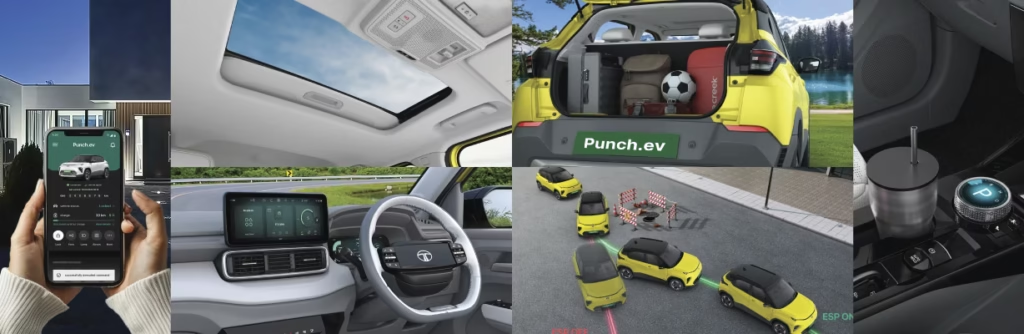
The updated Punch EV offers a considerably more modern feature package than the earlier version.
Depending on the variant, buyers can get features such as a 26.03cm HD infotainment system, 26.03cm digital cockpit, wireless Android Auto and Apple CarPlay, 360-degree surround-view camera, blind-spot view monitor, wireless smartphone charging, rain-sensing wipers and connected-car technology.
Higher variants also get front ventilated leatherette seats, an electric sunroof, auto-dimming IRVM and a front armrest.
The Punch EV also offers a 366-litre boot, which makes it reasonably practical for everyday family use.
Not every feature is available on every variant, so buyers should check the exact equipment list before booking.
Tata Punch EV Safety
Safety is one of the major strengths of the Punch EV.
The 2026 Punch EV has received a 5-star Bharat NCAP safety rating. It scored 31.09 out of 32 points for adult occupant protection and 45 out of 49 points for child occupant protection.
Tata also lists six airbags, Electronic Stability Program, ABS with EBD, ISOFIX child-seat anchors and tyre-pressure monitoring among the Punch EV’s safety equipment.
Higher variants add features such as a 360-degree camera and blind-spot view monitor.
For family buyers who place a strong emphasis on crash protection, the Punch EV’s Bharat NCAP result is a significant advantage.
Tata Punch EV Design and Cabin
The 2026 Punch EV received a refreshed exterior as part of its update.
The front gets a more modern closed-off EV-style treatment, while the lighting design has been updated. The connected rear lighting and revised bumpers further differentiate the new model.
Inside, Tata has focused on technology and convenience. The larger displays, digital cockpit, connected features and improved equipment list give the Punch EV a more premium feel.
Its compact dimensions remain one of its biggest strengths for city driving. It can be easier to manoeuvre through narrow roads and crowded parking areas compared with larger electric SUVs.
What Are the Advantages of the Tata Punch EV?
The Punch EV continues to have several strong points.
Affordable entry point: Even after the September price hike, it starts below ₹10 lakh ex-showroom.
Two battery options: Buyers can choose between 30kWh and 40kWh versions.
Strong safety credentials: The 5-star Bharat NCAP rating adds confidence for family buyers.
Useful real-world range: Independent tests have returned roughly 291–328km depending on the conditions and methodology.
Feature-rich higher variants: The 40kWh versions can be equipped with a 360-degree camera, larger screens, ventilated seats and other premium features.
Compact dimensions: The Punch EV remains well suited to Indian city traffic.
Lower running cost potential: For owners who can charge at home, electricity can be considerably cheaper per kilometre than petrol, depending on the local electricity tariff and driving conditions.
What Should Buyers Consider Before Buying?
The Punch EV is not the right choice for everyone.
The first consideration is charging access. Buyers who cannot install or regularly access a suitable charging point may find EV ownership less convenient.
The second is highway usage. Although the 40kWh Punch EV has a useful real-world range, highway range can vary considerably depending on speed and conditions. Autocar India’s test, for example, recorded around 291km on its highway test.
The third consideration is the price increase. The ₹10,000–₹20,000 hike is not huge, but buyers who were comparing the Punch EV purely on its entry price now have to account for the revised figures.
Is Tata Punch EV Still Worth Buying After the September 2026 Price Hike?
For many buyers, yes.
The September 2026 price increase has not changed the basic strengths of the Punch EV. It still offers a compact SUV body, two battery choices, strong safety credentials, modern features and a practical range for everyday driving.
The 40kWh versions are particularly interesting because they combine the larger battery with the stronger motor and up to 468km of claimed ARAI range. Real-world testing shows that the actual range can be considerably lower, but roughly 300km-plus of usable range is still enough for many urban and mixed-use buyers.
For someone who mainly drives in the city, has home charging and wants to reduce petrol expenses, the Punch EV remains a compelling option.
For buyers who regularly undertake long highway journeys and do not have convenient access to fast chargers, a petrol or larger-range vehicle may still be more suitable.
Final Verdict
The Tata Punch EV September 2026 price hike makes the electric SUV slightly more expensive, but it does not take away its core appeal.
With prices now starting at ₹9.79 lakh and going up to ₹12.99 lakh ex-showroom, the Punch EV continues to occupy an interesting position in India’s affordable electric-car market.
The biggest attraction remains the combination of compact SUV dimensions, 5-star Bharat NCAP safety, two battery choices, modern features and a practical real-world range.
However, buyers should look beyond the headline 468km figure. Independent tests have shown real-world results ranging from around 291km to 328km, depending on the test conditions.
If your daily driving is primarily urban and you can charge the car conveniently at home, the Tata Punch EV remains a strong EV option to consider in September 2026, even after the latest price hike.
For more automobile news, visit our homepage.