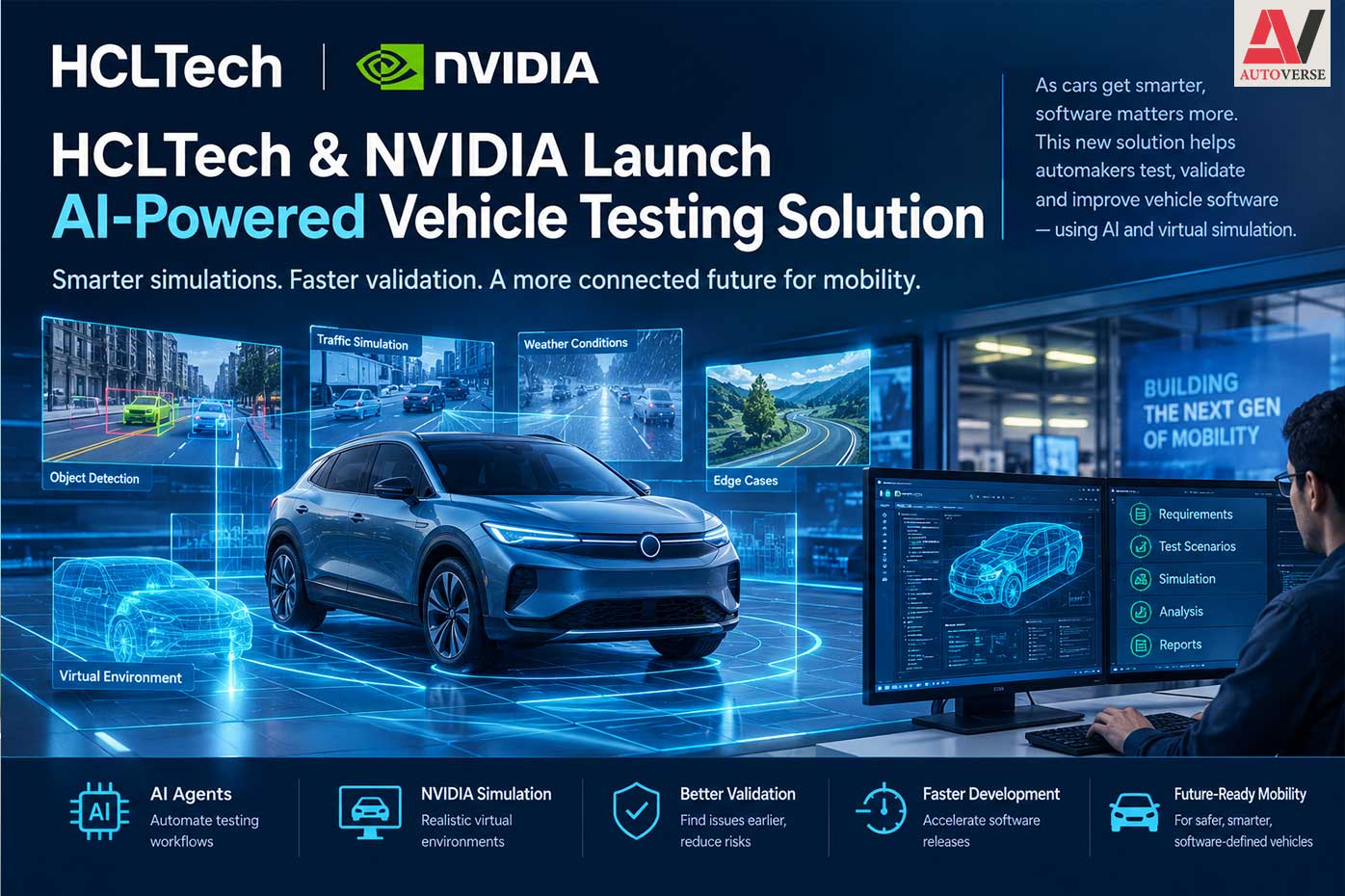
HCLTech has launched an NVIDIA-powered AI solution designed to automate vehicle software testing, improve simulation-based validation and help automakers accelerate software releases. The technology comes at a time when cars are becoming increasingly software-driven, with advanced driver assistance systems, connected features and over-the-air updates making vehicle development more complex than ever.
The way cars are developed is changing rapidly.
A modern vehicle is no longer just an engine, gearbox, suspension and a collection of mechanical components. It is increasingly a sophisticated computer on wheels, with software controlling everything from infotainment and connectivity to driver assistance, battery management and vehicle performance.
As this technology becomes more advanced, automakers face a new challenge: making sure that every software update works correctly and safely.
Testing these systems can be expensive, time-consuming and complicated. Engineers need to evaluate different driving conditions, vehicle configurations and potential software failures before a new feature reaches customers.
To address this challenge, HCLTech has introduced an AI-powered vehicle software verification and validation solution developed using NVIDIA’s simulation technologies and AI capabilities.
The announcement, made on October 21, 2026, highlights how artificial intelligence and virtual simulations are becoming important tools in automotive engineering.
The solution is designed for vehicle manufacturers and Tier 1 suppliers, with the objective of automating parts of the software testing process, expanding test coverage and helping companies release vehicle software with greater confidence.
Here is what the new technology means and how it could influence the future of automotive development.
What Is HCLTech’s New AI Vehicle Testing Solution?
HCLTech’s new offering is called Verification and Validation (V&V) for Auto.
It is part of the company’s Industry AI solutions portfolio and combines automotive engineering expertise with NVIDIA’s simulation technologies, AI models and orchestration tools.
In simple terms, the system is designed to help automakers test vehicle software in virtual environments rather than relying entirely on physical vehicles and real-world testing.
The solution connects different stages of the validation process, including:
- Understanding software requirements
- Creating test scenarios
- Running software tests
- Analysing test results
- Identifying and investigating failures
- Maintaining compliance documentation
Traditionally, these activities can involve multiple tools, engineering teams and manual processes.
HCLTech’s approach is to connect them through a simulation-first operating model, allowing engineers to automate selected tasks and maintain a continuous record of software validation.
The company says the solution can help automotive manufacturers expand test coverage, investigate software failures faster and improve visibility into whether a software release is ready.
However, it is important to understand that the technology is designed to support automotive engineering teams. It does not eliminate the need for engineering oversight, physical testing or regulatory validation.
Why Is Software Testing Becoming So Important in Cars?
The growing complexity of automotive software is one of the biggest challenges facing manufacturers.
Earlier, many vehicle functions were controlled primarily through mechanical systems.
Today, software plays a major role in several areas of vehicle operation.
Modern cars can include software-controlled braking assistance, adaptive cruise control, lane assistance, parking systems, digital instrument clusters, connected services and advanced infotainment features.
Electric vehicles add another layer of complexity through battery management, charging control, energy efficiency and thermal management systems.
Software updates can also introduce new features or modify existing vehicle behaviour after a car has been delivered.
This is where verification and validation become important.
Verification checks whether software has been developed according to its specified requirements.
Validation checks whether the system performs as intended under the conditions for which it was designed.
For automakers, both processes are essential before software can be released.
As vehicle software becomes more complicated and updates become more frequent, traditional testing methods can struggle to keep pace.
HCLTech’s new offering aims to address this challenge by making more of the validation process automated and simulation-based.
NVIDIA Simulation Technology at the Core
The new solution combines HCLTech’s automotive engineering capabilities with several NVIDIA technologies.
These include:
- NVIDIA Omniverse
- NVIDIA Cosmos
- NVIDIA Alpamayo
- NVIDIA Omniverse NuRec
- NVIDIA Isaac Sim
These platforms support different aspects of simulation, physical AI and virtual environment development.
Together, they can help create simulated driving environments in which engineers evaluate how vehicle software responds to different situations.
For example, an automotive manufacturer could use simulation to examine how a vehicle’s software responds to changing road conditions, unusual traffic situations or scenarios that are difficult to reproduce consistently in the real world.
This is particularly relevant for advanced driver assistance systems and other software-intensive vehicle functions.
The ability to test such scenarios virtually can help engineers explore more situations during development.
However, simulation results still need to be validated against real-world behaviour to ensure that the virtual environment accurately represents the conditions being tested.
AI Agents Could Automate Parts of Vehicle Testing
One of the most interesting aspects of HCLTech’s solution is its use of agentic AI.
Unlike a conventional software tool that performs a single predefined task, an AI agent can be designed to carry out a sequence of related activities within a defined workflow.
In the new automotive validation offering, HCLTech uses the NVIDIA Agent Toolkit to coordinate multiple AI agents.
The system also uses NVIDIA Nemotron open models to support reasoning across validation activities.
The objective is to automate selected parts of the testing process.
For instance, AI agents could help engineers organise test requirements, generate scenarios, execute validation workflows and analyse the resulting data.
If a test identifies a software failure, the system could help investigate the issue and connect the result with the relevant requirement or test case.
This could reduce the amount of repetitive work engineers need to perform manually.
It could also help teams manage larger testing workloads as vehicles receive more software updates.
The technology is intended to support engineers rather than replace their responsibility for evaluating safety, performance and compliance.
Testing Rare and Safety-Critical Situations
One of the biggest advantages of virtual simulation is the ability to examine unusual driving situations.
Certain conditions are difficult to reproduce safely or consistently using physical vehicles.
These could include combinations of road conditions, unusual traffic behaviour, unexpected obstacles or specific environmental circumstances.
For driver assistance systems, such situations can be particularly important.
Engineers need to understand how the vehicle software responds when conditions change unexpectedly.
Simulation can allow these scenarios to be recreated repeatedly, making it easier to compare software behaviour across different versions.
HCLTech says its solution is designed to generate and validate a wide range of virtual scenarios, including rare and safety-critical conditions.
This could help automakers identify potential issues earlier in the development process.
Nevertheless, virtual testing is not a substitute for every physical test.
Real-world validation remains important for checking vehicle behaviour, hardware performance and the accuracy of simulation models.
The strongest approach is likely to combine virtual testing with physical testing rather than relying exclusively on either method.
Could AI Reduce the Cost and Time of Vehicle Development?
The new technology is aimed at improving efficiency across the automotive software validation process.
Physical testing requires vehicles, specialised equipment, engineering teams and suitable testing environments.
Some tests also need to be repeated whenever software changes.
Virtual simulation could reduce the need to recreate certain conditions physically, allowing engineers to conduct more tests during the development process.
It may also help manufacturers identify software failures earlier, when correcting them could be easier than after a vehicle reaches production.
For automakers developing software-defined vehicles, this could become an important advantage.
However, HCLTech has not disclosed specific customer deployments, quantified cost savings or confirmed reductions in software testing timelines for the new offering.
Therefore, the potential benefits should be viewed as the objectives of the solution rather than proven results across production programmes.
The actual impact will depend on how automakers integrate the technology into their existing engineering processes.
What Are Software-Defined Vehicles?
Software-defined vehicles, commonly known as SDVs, are vehicles in which software plays a central role in defining and updating functionality.
Instead of relying only on fixed hardware capabilities, manufacturers can use software to introduce new features, improve existing functions and modify certain aspects of vehicle performance.
Over-the-air updates are an important part of this approach.
They allow compatible vehicle software to be updated remotely, reducing the need for customers to visit a service centre for every software improvement.
However, frequent updates also increase the amount of testing required.
Manufacturers must ensure that new software works correctly with existing vehicle systems and does not introduce unexpected problems.
This is why validation is becoming a critical part of the software-defined vehicle development process.
HCLTech’s new solution is aimed at helping manufacturers manage this growing complexity.
What Does This Mean for Indian Car Buyers?
For customers, the technology may not immediately translate into a new feature or a lower vehicle price.
Its impact is more likely to be seen behind the scenes.
If automakers can improve software validation, they may be able to develop and release updates more efficiently.
This could support better connected features, more reliable software and faster development of advanced vehicle technologies.
For electric vehicle buyers, software validation is particularly relevant.
EVs rely on software for battery management, charging, energy monitoring and several vehicle functions.
As these systems become more sophisticated, manufacturers need robust processes to test updates and ensure that different components continue to work together.
The same applies to vehicles equipped with advanced driver assistance systems.
However, AI-powered testing does not automatically guarantee that a vehicle is safer or more reliable.
Those outcomes depend on how effectively the technology is implemented, how accurately the simulations represent real conditions and how thoroughly engineers validate the results.
The Auto Verse Verdict
HCLTech’s NVIDIA-powered vehicle testing solution highlights an important shift in the automobile industry.
As cars become more software-driven, manufacturers are increasingly investing in technologies that can help them develop, test and update vehicle systems more efficiently.
The new V&V for Auto offering brings together simulation, AI agents and automotive engineering expertise to automate parts of the validation process.
Its focus on virtual testing could help engineers explore more scenarios, identify failures earlier and reduce dependence on certain physical testing activities.
For automakers, this could become increasingly important as software complexity and update frequency continue to grow.
For buyers, the long-term benefit could be more efficiently developed vehicle software and improved ownership experiences.
The future of automotive development will not be defined by hardware alone. Software, simulation and AI are becoming equally important—and the companies that can validate these technologies effectively will have a major role in shaping the next generation of cars.