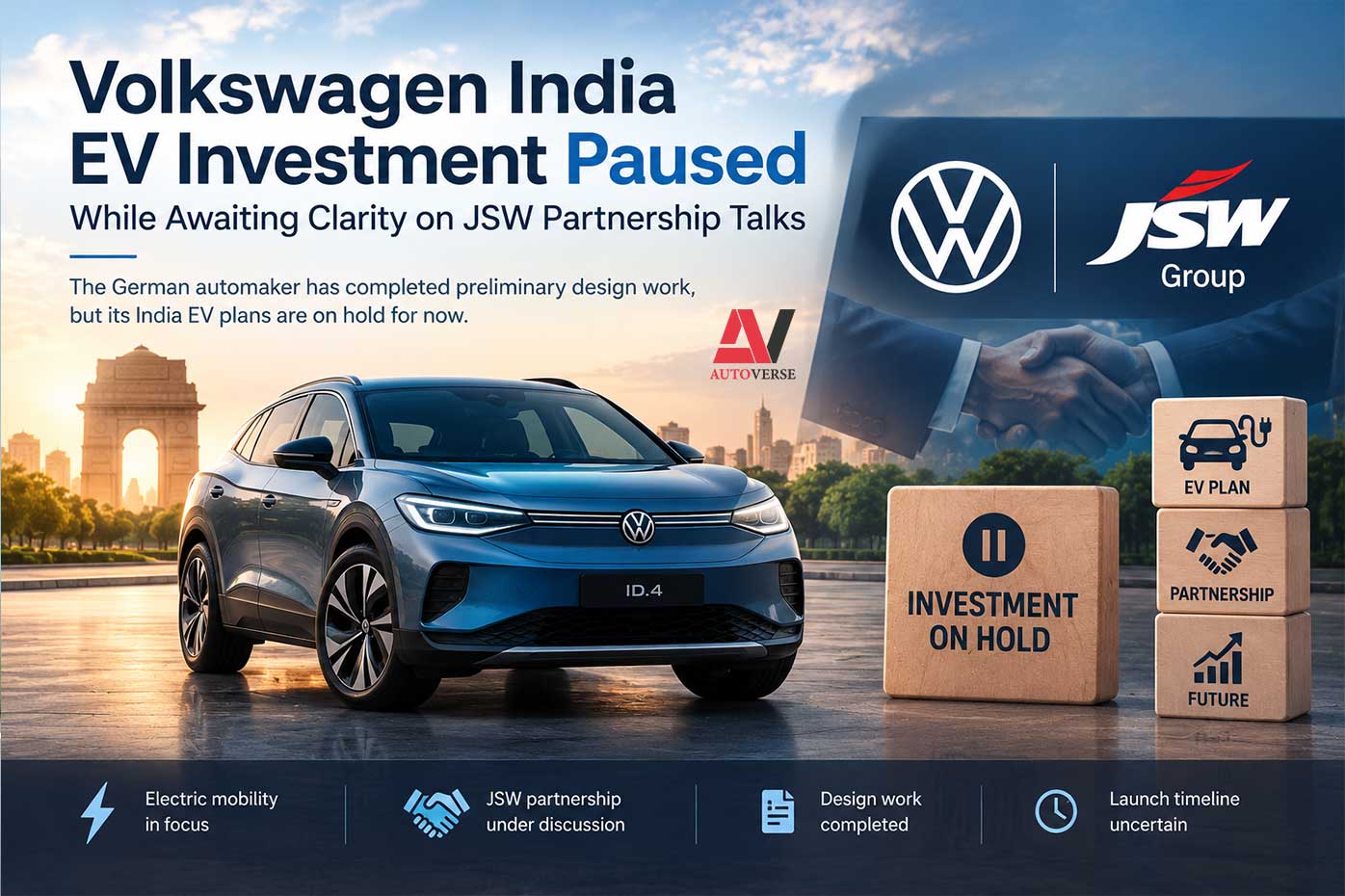
Volkswagen has reportedly paused further investment in its India electric-vehicle programme as it waits for greater clarity on a potential partnership with JSW Group. The German automaker has completed preliminary design work for a proposed EV project but is holding back fresh spending until the business plan and partnership structure become clearer. The move could delay Volkswagen’s electric-car entry into India, where competition from Tata, Mahindra, MG, BYD and other brands is growing.
Volkswagen has been trying to strengthen its presence in India for years, but its next big move in the electric-vehicle market is now waiting for a crucial decision.
According to a Bloomberg report published on October 24, 2026, Volkswagen AG has paused further investment in its India EV programme while discussions with Sajjan Jindal-led JSW Group continue.
The company has reportedly completed design work that would allow it to move ahead relatively quickly with an electric vehicle based on a lower-cost architecture originally developed for China.
However, Volkswagen is waiting for a clearer business plan before committing more money.
This development comes at an important time for the Indian automobile industry. Electric passenger vehicles are gaining attention, new manufacturers are entering the market and established brands are expanding their EV portfolios.
For Volkswagen, the challenge is not simply launching an electric car.
It needs to develop a product that is competitive on price, suitable for Indian customers and commercially viable for the company.
And that is where the proposed JSW partnership becomes important.
Why Has Volkswagen Paused Its India EV Investment?
The reported investment pause is primarily linked to Volkswagen’s discussions with JSW Group.
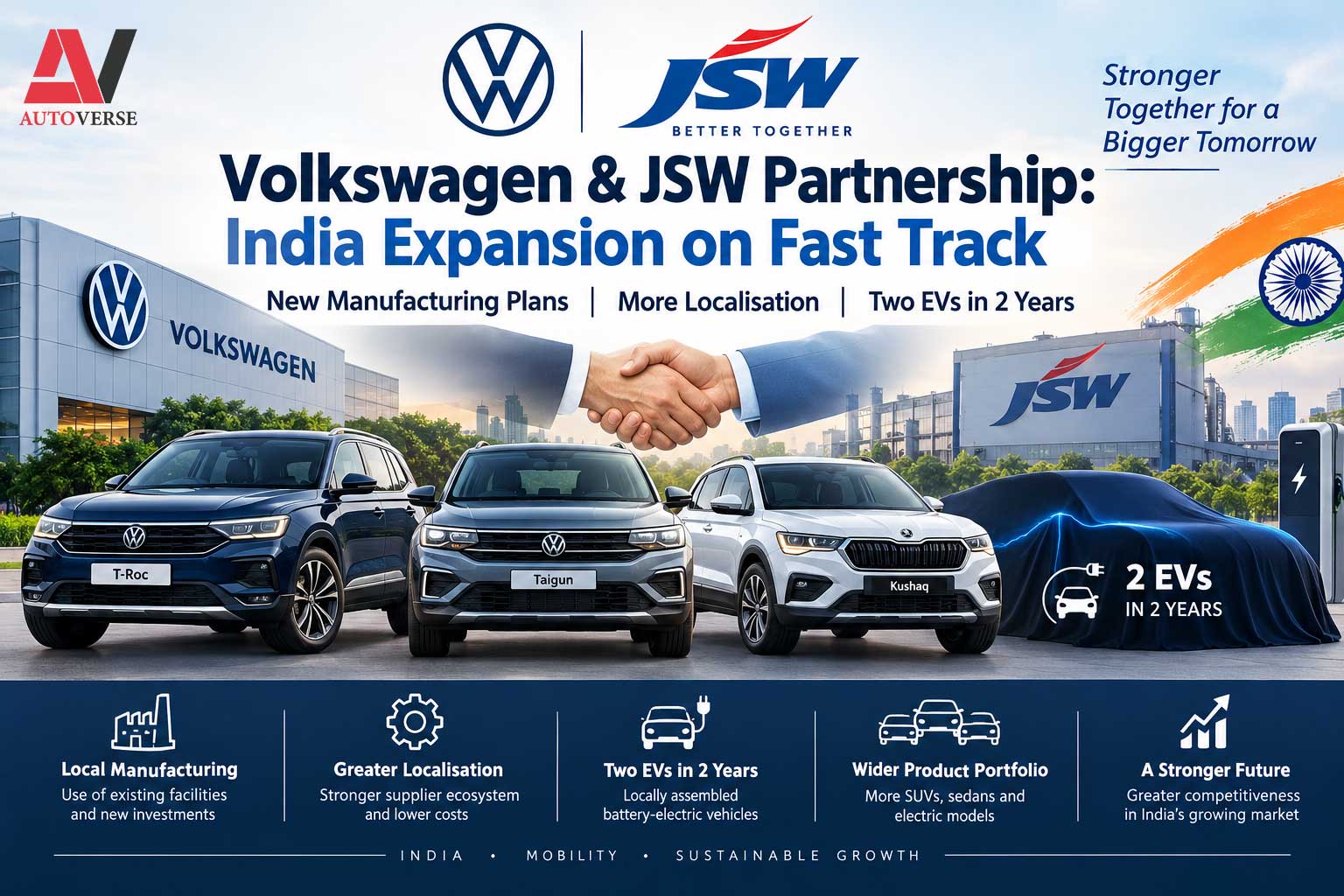
The two companies are exploring a potential partnership to develop, manufacture and market passenger vehicles in India and for export markets.
Volkswagen is reportedly waiting for greater clarity on the structure of the partnership and the business plan before committing additional funds to its EV programme.
This does not mean the company has officially cancelled its India electric-car plans.
Instead, it indicates that Volkswagen wants to understand how the project will be developed, funded and executed before moving into the next stage.
The decision also reflects Volkswagen’s wider financial situation.
The German automaker is pursuing a global cost-cutting strategy as it deals with weak demand in Europe and increasing competition from Chinese manufacturers.
Reports indicate that Volkswagen is looking to reduce investment spending by around 15% as part of its broader efforts to improve financial discipline.
The company has also outlined plans to reduce its workforce significantly as it attempts to control costs.
For a project such as India EV development, which requires investment in technology, localisation, manufacturing and distribution, the company appears to be taking a cautious approach.
Volkswagen and JSW: What Is the Proposed Partnership?
Volkswagen and JSW Group announced in September 2026 that they were exploring a potential passenger-vehicle venture for India and export markets.
The proposed collaboration could cover multiple powertrain technologies, including:
- Internal-combustion engine vehicles
- Battery-electric vehicles
- Plug-in hybrid vehicles
- Conventional hybrid vehicles
This is important because the potential partnership is not limited to electric cars.
It could provide a broader framework for the two companies to develop vehicles for different customer segments and market requirements.
For Volkswagen, the partnership could help reduce the financial burden of developing products specifically for India.
For JSW, it could offer access to Volkswagen’s vehicle technology, engineering capabilities and global automotive experience.
However, the final structure of the venture, investment commitments and operational responsibilities remain important questions.
The proposed partnership is still being explored, and the reported EV investment pause suggests that Volkswagen wants greater clarity before proceeding.
Why Does Volkswagen Need a Local Partner?
India is a price-sensitive automobile market.
Customers generally compare vehicles closely on purchase price, features, running costs and long-term ownership expenses.
This makes it difficult for global manufacturers to introduce expensive products without adapting them to local requirements.
Volkswagen has been searching for an Indian partner to share development and manufacturing costs.
The company had previously explored a partnership with Mahindra, but those discussions did not result in an agreement.
The search for a local partner has therefore become an important part of Volkswagen’s India strategy.
A partnership with JSW could potentially help the company improve localisation, access manufacturing facilities and develop products more efficiently.
It could also help Volkswagen understand the Indian market better while sharing the cost and risk of introducing new vehicles.
For a company trying to expand its electric-car presence, these advantages could make a significant difference.
Volkswagen Is Considering a Lower-Cost EV Platform
One of the most interesting aspects of Volkswagen’s India EV programme is the architecture it is considering.
According to the Bloomberg report, Volkswagen has been evaluating a version of its CMP 21 electric-vehicle architecture, which was initially developed for China.
An EV architecture is essentially the underlying platform on which an electric vehicle is developed.
It includes the basic engineering structure and components that can be used to create different vehicle models.
Using an existing architecture could help Volkswagen reduce development time and costs compared with creating an entirely new platform for India.
However, simply bringing a China-developed platform to India would not automatically make the resulting vehicle affordable.
The company would need to adapt the architecture to local requirements and increase the use of Indian components.
Local manufacturing and sourcing would be important to bring costs down.
This could also help Volkswagen reduce its dependence on imported components and improve the competitiveness of future products.
The challenge will be finding the right balance between technology, localisation and cost.
Volkswagen Currently Has No Battery-Electric Passenger Car in India
Volkswagen’s electric-car strategy is particularly interesting because the company currently does not sell a battery-electric passenger vehicle in India under either the Volkswagen or Skoda brands.
Its existing Indian operations are largely focused on conventional petrol-powered vehicles.
The company has been present in India for more than two decades, but its market share remains relatively small compared with several domestic manufacturers.
Skoda Auto Volkswagen India operates the group’s local passenger-vehicle business, including brands such as Volkswagen and Skoda.
However, the Indian EV market has developed rapidly during the period when Volkswagen has been evaluating its entry strategy.
Tata Motors, Mahindra & Mahindra and MG have already established themselves in the electric passenger-vehicle space.
International manufacturers such as BYD, VinFast and Tesla are also competing for customers.
This means Volkswagen could face a more challenging entry environment when its first India-specific electric cars eventually arrive.
India’s EV Market Is Growing, but Competition Is Intensifying
India’s electric passenger-vehicle market remains smaller than the conventional petrol and diesel market.
However, sales are increasing as manufacturers introduce more electric models across different price categories.
According to the Bloomberg report, electric passenger-vehicle sales in India nearly doubled year-on-year in September 2026, crossing 35,000 units.
This growth highlights the opportunity available to manufacturers that can offer competitive electric cars.
But the market is also becoming more crowded.
Tata Motors has a strong presence in the electric-car segment, while Mahindra is expanding its EV portfolio.
MG has also established itself in the market, and international manufacturers are introducing new products.
For Volkswagen, entering the market later could mean facing competitors with established customer bases, charging networks and locally developed products.
The company will therefore need to ensure that its future EVs offer a clear advantage in areas such as pricing, technology, range and ownership experience.
Could the Investment Pause Delay Volkswagen’s EV Launch?
The reported pause could affect the timeline of Volkswagen’s electric-car programme in India.
The company has completed preliminary design work, which may help it move forward once the partnership and business plan are finalised.
However, several steps would still be required before a vehicle reaches Indian showrooms.
These could include finalising the partnership structure, approving investment, adapting the platform, increasing localisation, preparing manufacturing facilities and completing product validation.
Volkswagen has not announced a confirmed India launch date for the proposed EV programme in the reports reviewed.
Therefore, buyers should not assume that a specific Volkswagen or Skoda electric car is arriving soon.
The actual timeline will depend on how quickly the partnership discussions progress and when the company decides to commit further investment.
What Does This Mean for Indian Car Buyers?
For customers waiting for an electric Volkswagen or Skoda, the development means that the company’s India EV plans remain uncertain in the near term.
Volkswagen has experience developing electric vehicles for international markets, but an India-specific product needs to meet local expectations.
Pricing will be particularly important.
A premium electric car may appeal to a limited group of buyers, but a more competitive product could help Volkswagen reach a wider audience.
Customers will also look at driving range, charging options, battery warranty, service availability and resale value.
The company will need to address these factors if it wants to compete effectively with established EV manufacturers in India.
A partnership with JSW could potentially help Volkswagen make its future products more locally relevant.
However, until the investment and product plans are finalised, buyers will have to wait for further announcements.
The Auto Verse Verdict
Volkswagen’s reported India EV investment pause highlights the challenges global automakers face when entering a competitive and price-sensitive market.
The company has completed preliminary design work for a potential electric-car programme, but it is waiting for greater clarity on its proposed partnership with JSW Group before committing additional funds.
The potential partnership could help Volkswagen share costs, increase localisation and improve its chances of developing competitive electric vehicles for India.
However, the delay also comes at a time when the Indian EV market is expanding and competitors are strengthening their positions.
For Volkswagen, the next step will be to turn its technology and partnership discussions into a clear product and investment strategy.
The India EV plan is not officially cancelled, but its future timeline now depends heavily on the Volkswagen-JSW partnership.
For Indian buyers, the bigger question is not whether Volkswagen will eventually enter the EV market.
It is whether the company can arrive with the right product, at the right price, before the competition moves even further ahead.
Know more about Volkswagen and JSW Partnership.