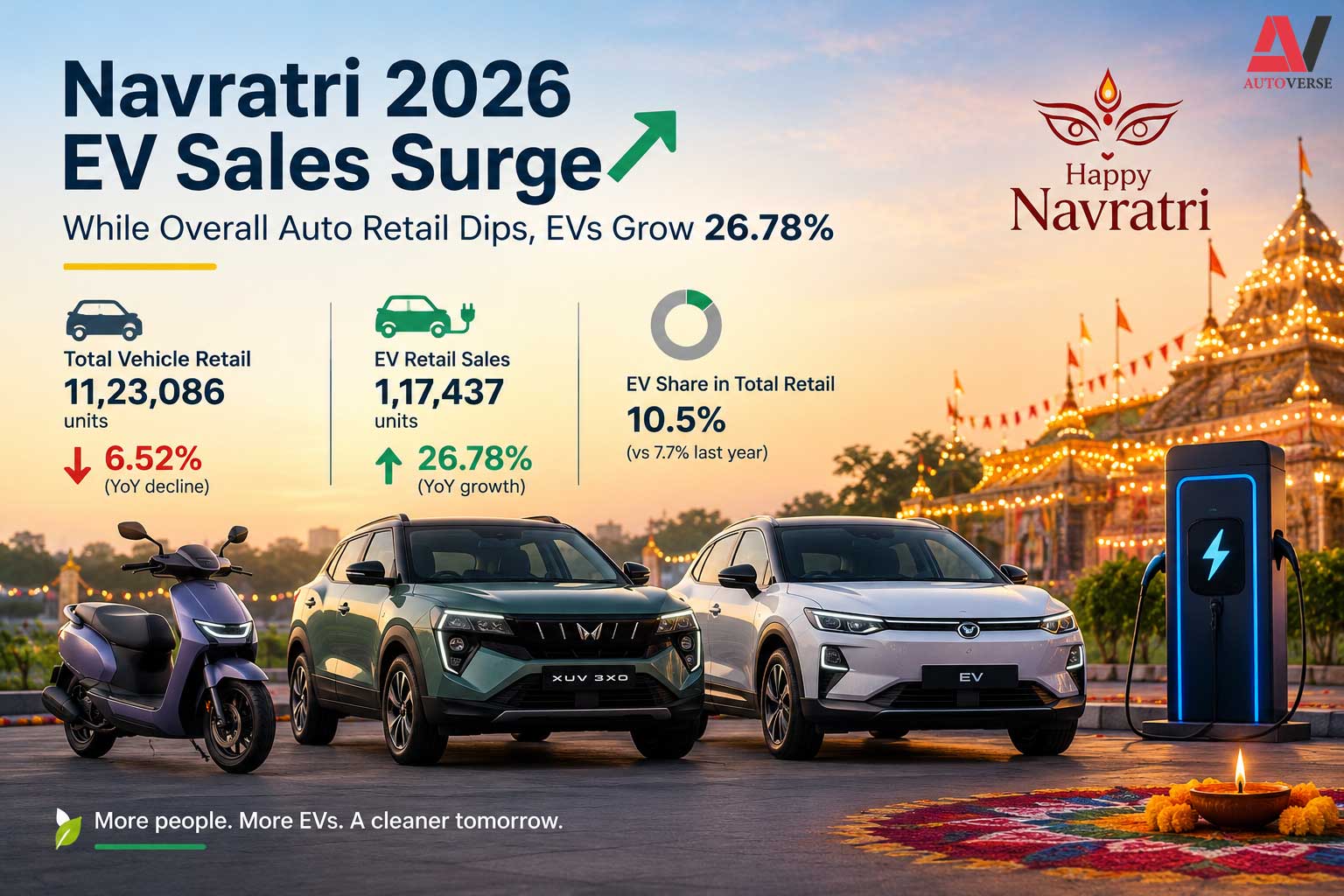
India’s festive vehicle market witnessed a mixed performance during Navratri 2026. While overall vehicle retail declined 6.52% year-on-year, electric vehicles continued to gain momentum, recording a strong 26.78% growth. EVs accounted for nearly 10.5% of total festive vehicle sales, highlighting the growing interest in electric mobility across India.
India’s festive season is usually one of the busiest periods for the automobile industry. From new cars and SUVs to scooters and motorcycles, buyers often wait for Navratri and Diwali to make their next vehicle purchase. However, this year’s Navratri retail numbers tell an interesting story.
According to provisional data released by the Federation of Automobile Dealers Associations (FADA), total vehicle retail during Navratri 2026 stood at 11,23,086 units, registering a 6.52% decline compared to 12,01,479 units during the same festive period last year.
But while the broader market experienced a slowdown, electric vehicles moved in the opposite direction.
EV retail sales reached 1,17,437 units, marking a 26.78% year-on-year increase. The electric vehicle segment also increased its share of total festive vehicle retail to approximately 10.5%, compared to around 7.7% during Navratri 2025.
The numbers suggest that electric mobility is gradually becoming a more important part of India’s automobile market, even when overall festive demand faces pressure.
Navratri 2026 Auto Sales: The Bigger Picture
FADA’s provisional data covers the ten-day Navratri period from October 11 to October 20, 2026.
During this period, total vehicle retail reached more than 11.23 lakh units across categories.
However, the year-on-year comparison needs some context.
Navratri 2025 lasted 11 days, compared to ten days in 2026. Last year’s festive period also coincided with the rollout of GST 2.0, which brought a wave of demand into the market.
According to FADA President Sai Giridhar, the decline against last year’s numbers is largely influenced by this unusually strong comparison period.
The market, meanwhile, remains significantly ahead of Navratri 2024. Total vehicle retail increased by 26.76% compared to that year, indicating that the broader automobile market continues to operate at a higher level than two years ago.
Here is how the major vehicle categories performed during Navratri 2026:
| Vehicle Category | Navratri 2026 Retail | YoY Growth |
|---|---|---|
| Two-wheelers | 8,34,075 | -2.79% |
| Three-wheelers | 45,735 | -7.51% |
| Commercial vehicles | 35,618 | +1.12% |
| Passenger vehicles | 1,82,728 | -21.91% |
| Tractors | 22,690 | +0.89% |
| Total vehicle retail | 11,23,086 | -6.52% |
Passenger vehicles recorded the sharpest decline among the major segments, while two-wheelers also experienced a marginal drop.
Commercial vehicles and tractors, on the other hand, registered small increases.
Source: FADA Research, provisional Navratri 2026 retail data.
Electric Vehicles Buck the Festive Slowdown
The biggest highlight of Navratri 2026 was the performance of electric vehicles.
While overall vehicle retail declined, EV sales increased by 26.78%, reaching 1,17,437 units.
This is a substantial improvement over the 92,628 EVs retailed during Navratri 2025.
The electric vehicle segment also recorded an impressive 83.06% growth compared to Navratri 2024, when retail stood at 64,153 units.
The rising EV share is particularly important.
Electric vehicles accounted for approximately 10.5% of all vehicle retail during Navratri 2026, compared to around 7.7% last year.
In simple terms, roughly one in every ten vehicles retailed during the festive period was electric.
This indicates that EVs are no longer limited to a small group of early adopters. More buyers are considering electric vehicles as a practical alternative for everyday commuting and personal mobility.
The growth also reflects the expanding range of electric scooters, motorcycles, cars and commercial vehicles available in the Indian market.
Electric Two-Wheelers Lead the Charge
Electric two-wheelers remained the biggest contributor to EV retail during Navratri 2026.
The segment recorded 75,758 units, registering a strong 33.41% growth compared to 56,787 units during the same period last year.
Electric scooters have become an important part of India’s EV story, particularly among urban commuters.
Their appeal comes from a combination of relatively lower running costs, convenient charging options for suitable users and an expanding product range.
For buyers who primarily travel within the city, an electric scooter can offer a practical alternative to a conventional petrol-powered model.
However, the choice still depends on daily travel distance, charging access, purchase price and the availability of service support.
The latest festive numbers suggest that more consumers are willing to explore this option.
Electric Cars Also Record Strong Growth
Electric passenger vehicles recorded 12,305 units during Navratri 2026.
This represents a 25.97% increase over the 9,768 units retailed during Navratri 2025.
The segment has also grown considerably over the past two years. EV passenger vehicle retail was 3,252 units during Navratri 2024, meaning the latest numbers are significantly higher than the earlier festive period.
The growing availability of electric cars across different price categories is helping buyers consider EVs for personal and family use.
At the same time, the decision to purchase an electric car remains closely linked to factors such as charging infrastructure, home parking, long-distance travel requirements and the initial purchase price.
For buyers with predictable daily driving patterns and convenient charging access, an EV can make sense.
For others, a petrol, diesel or hybrid vehicle may still offer greater flexibility.
The festive sales growth indicates increasing interest in electric cars, but it does not mean that every buyer is ready to make the switch.
Electric Three-Wheelers Continue to Grow
Electric three-wheelers recorded 28,086 units during Navratri 2026, registering 10.51% growth compared to 25,416 units last year.
The segment remains an important part of India’s electric mobility transition.
Electric three-wheelers are increasingly relevant for last-mile passenger transportation, local commercial operations and urban mobility services.
Their appeal is closely linked to operating economics.
For drivers and fleet operators, fuel or energy expenses can have a significant impact on daily earnings. An electric vehicle may help reduce running costs, depending on charging expenses, usage patterns and vehicle maintenance.
However, commercial buyers also need to consider vehicle availability, charging arrangements, battery performance, downtime and financing.
The latest growth suggests that electric three-wheelers continue to find demand in their intended applications.
Electric Commercial Vehicles Nearly Double
One of the most striking numbers in FADA’s report came from the electric commercial vehicle segment.
EV commercial vehicle retail increased from 657 units during Navratri 2025 to 1,288 units in Navratri 2026.
That represents a year-on-year growth of 96.04%.
Although the segment remains relatively small compared to electric two-wheelers and three-wheelers, the increase points towards growing interest in electric vehicles for commercial applications.
Electric commercial vehicles can be particularly relevant for businesses operating predictable routes, local deliveries and urban transport services.
The economics, however, depend on the vehicle’s purchase cost, daily utilisation, charging infrastructure and operational requirements.
As electric commercial vehicle options expand, fleet operators may find more opportunities to evaluate EVs for specific use cases.
What Is Driving EV Demand in India?
The latest sales figures point towards a gradual change in consumer preferences.
Electric vehicles are becoming more visible across Indian cities, while manufacturers continue to expand their product portfolios.
For two-wheeler buyers, electric scooters offer an alternative for daily commuting.
For passenger vehicle buyers, electric cars are increasingly being considered alongside conventional vehicles.
Commercial operators are also evaluating EVs based on their potential running-cost advantages.
However, EV adoption is not driven by one factor alone.
Purchase price, charging convenience, driving range, battery warranty, service availability and resale value all influence the final decision.
The availability of charging infrastructure remains particularly important.
Buyers who can charge their vehicles at home or at their workplace may find ownership more convenient than those who depend entirely on public charging.
Similarly, people who frequently travel long distances need to consider charging availability along their routes.
The growth in EV retail during Navratri suggests that these considerations are becoming part of a larger purchasing conversation.
Can EVs Maintain This Momentum During Diwali?
The Navratri numbers provide an encouraging signal for the electric vehicle industry.
However, the next phase of the festive season will be important.
Dhanteras and Diwali traditionally bring another wave of vehicle purchases, and manufacturers and dealerships will be looking to sustain customer interest.
FADA has expressed cautious optimism about the upcoming festive period, while acknowledging the unusual comparison with Navratri 2025.
The performance of electric vehicles will be worth watching, particularly whether their share of total vehicle retail continues to increase.
A sustained rise would indicate that EV demand is expanding beyond a short-term festive trend.
The Auto Verse Verdict
Navratri 2026 may not have delivered growth across the entire automobile market, but electric vehicles clearly emerged as one of its strongest performers.
With retail sales rising 26.78% to 1.17 lakh units, EVs recorded healthy growth across two-wheelers, three-wheelers, passenger vehicles and commercial vehicles.
The increase in EV share to around 10.5% of total festive retail is another important milestone.
For buyers, the message is straightforward: electric vehicles are becoming a more prominent option in India’s mobility landscape, but choosing one still requires evaluating individual driving needs and charging access.
For the industry, the numbers offer a positive sign.
Overall festive vehicle retail may have slowed, but India’s electric mobility story continues to move forward.