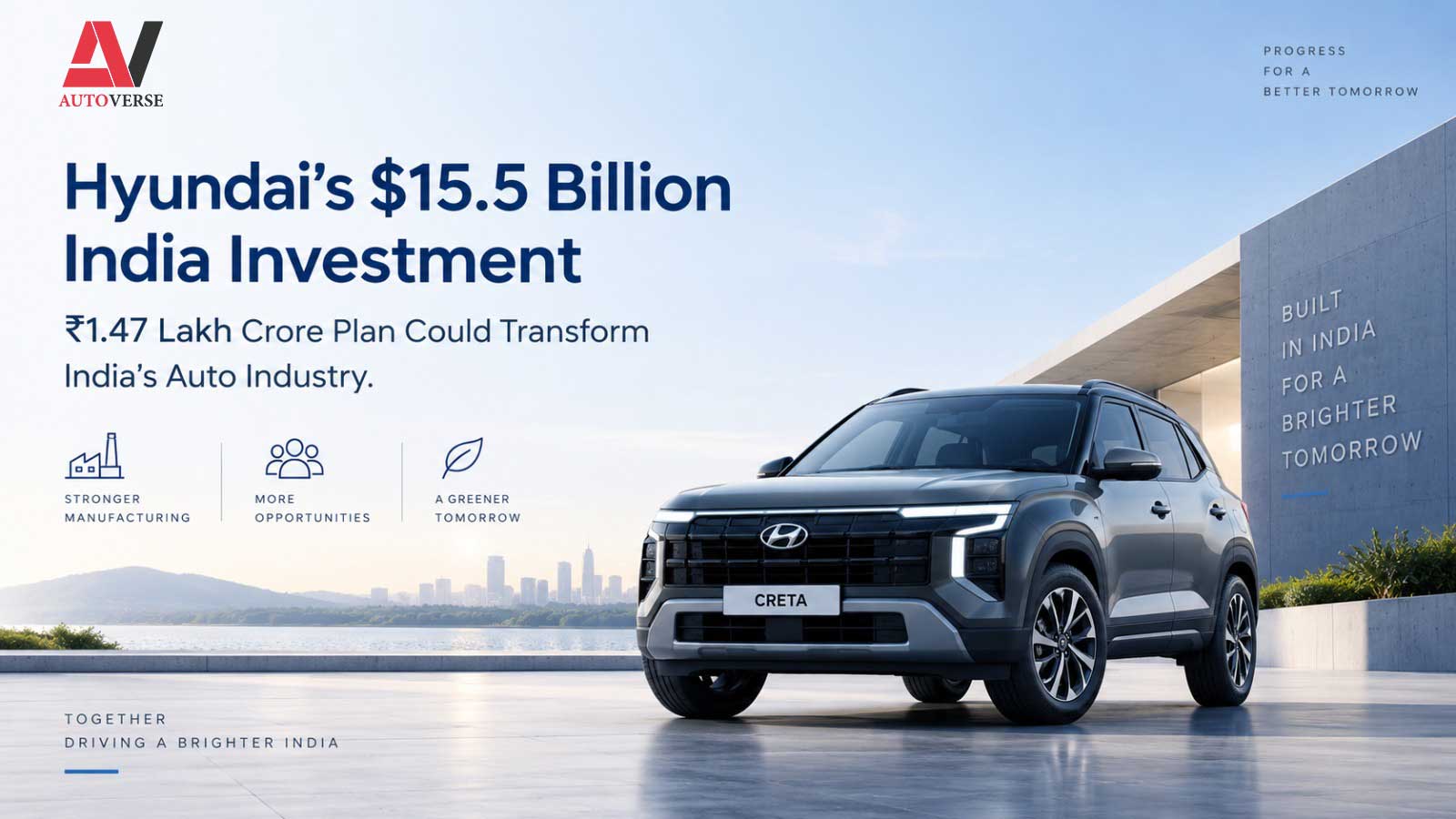
Hyundai India Investment: Hyundai Motor Group is preparing for a much bigger role in India’s automotive market. The South Korean automotive giant has announced an investment commitment of $15.5 billion (approximately ₹1.47 lakh crore) between 2026 and 2032, signalling its long-term ambitions for manufacturing, electric mobility and next-generation automotive technologies in the country.
The announcement followed a meeting between Hyundai Motor Group Executive Chair Euisun Chung and Prime Minister Narendra Modi in New Delhi on October 13, 2026. The investment comes as Hyundai strengthens its Indian manufacturing footprint, expands its research capabilities and looks to make India a more important export hub.
For Indian car buyers, this could eventually translate into more locally developed vehicles, new powertrain technologies and an expanded range of electric and hybrid models. For the automotive industry, the plan could bring fresh opportunities for component manufacturers, technology companies and skilled workers.
But what exactly does Hyundai plan to do with this massive investment? Let’s break it down.
Hyundai’s $15.5 Billion Investment: What’s the Plan?
Hyundai Motor Group’s investment programme will cover several areas, including manufacturing expansion, research and development (R&D), local supplier development and future mobility technologies.
The group plans to establish a dedicated investment entity in India to coordinate projects, identify potential partners and manage investments across these areas. The idea is to build a broader automotive ecosystem rather than concentrate spending on vehicle assembly alone.
Here are the major focus areas:
- Manufacturing expansion: Increase production capacity across Hyundai Motor India and Kia India.
- Research and development: Strengthen India’s role in developing vehicles and automotive technologies.
- Localisation: Work with Indian suppliers to increase locally sourced components.
- Future mobility: Explore opportunities in EV charging, automotive financing and vehicle recycling.
- Technology innovation: Develop solutions suited to Indian customers and expand India’s contribution to global automotive programmes.
This is significant because the benefits of a large automotive investment often extend beyond the manufacturer itself. Component suppliers, logistics companies, dealerships and service networks can also gain from increased production and business activity.
Pune Plant Takes Centre Stage in Hyundai’s Expansion
One of the biggest developments accompanying the investment announcement is Hyundai Motor India’s new manufacturing facility in Talegaon, Pune, Maharashtra.
The facility was formally inaugurated on October 14, 2026, marking another important milestone in Hyundai’s three decades of operations in India. The plant currently has an annual production capacity of 170,000 vehicles, with plans to increase capacity to 320,000 units by 2030.
The Pune facility strengthens Hyundai’s existing manufacturing operations in Chennai and gives the company additional capacity to respond to future demand.
According to the company’s published figures, Hyundai Motor India has a combined annual manufacturing capacity of approximately 994,000 vehicles across its Chennai and Pune facilities. When Kia India’s Anantapur plant is included, the group’s total Indian production capacity reaches approximately 1.425 million vehicles annually.
The expansion is particularly important as Hyundai looks to grow its sales, introduce new products and increase exports from India.
For customers, greater manufacturing capacity could help the company respond more effectively to demand for popular models. It could also provide the flexibility required to accommodate a wider range of vehicles and powertrains as the market evolves.
₹700 Million? No, $700 Million for R&D: Why It Matters
Manufacturing cars is only one part of Hyundai’s long-term strategy. The company also wants India to play a bigger role in designing and developing future automotive technologies.
Hyundai Motor Group plans to invest approximately $700 million in its Indian research and development centre, including a vehicle testing track. The investment is intended to strengthen local engineering capabilities, develop talent and accelerate work on next-generation automotive technologies.
Why does this matter?
Indian driving conditions are different from those in many international markets. Congested roads, varied weather, uneven surfaces, changing traffic patterns and price-sensitive customers all influence how vehicles need to be designed.
Stronger local R&D capabilities can help Hyundai develop products and technologies better suited to these conditions. It could also allow more engineering work to take place in India instead of relying entirely on overseas development centres.
The long-term ambition is to move beyond manufacturing vehicles in India and increase the country’s contribution to their design, engineering and technological development.
Will Hyundai Launch More Electric and Hybrid Cars?
Electric mobility is expected to be an important part of Hyundai’s next phase of growth in India.
The investment announcement covers future technology innovation, while the company’s wider manufacturing expansion provides room to accommodate changing powertrain requirements.
Hyundai already sells electric vehicles in India, including the Ioniq 5 and Creta Electric. The company has also indicated plans for a new small electric SUV developed for the Indian market, underlining the importance of more accessible EVs in its future portfolio.
However, the $15.5 billion commitment should not be interpreted as an EV-only investment. The programme covers the group’s broader automotive operations, including manufacturing, R&D, supplier development and emerging mobility businesses.
For Indian customers, the most important question will be how these investments translate into actual products. More locally developed EVs, improved charging support and a wider choice of powertrains could help make electric mobility more accessible, provided the company delivers on its plans.
Indian Suppliers Could Benefit From the Investment
Another important part of Hyundai’s strategy is strengthening its local supply chain.
Modern vehicles rely on thousands of components, from electronic systems and sensors to braking equipment, interiors and powertrain parts. Developing these capabilities locally can reduce dependence on imported components and help manufacturers build a more resilient production network.
Hyundai plans to work with Indian suppliers to increase localisation and develop stronger partnerships. This could create opportunities for component manufacturers to expand their operations, invest in new technologies and become more competitive in international markets.
The potential benefits extend to companies involved in electric vehicle components, software, electronics and other emerging automotive technologies.
For India, the opportunity is to capture more value from the automotive supply chain, rather than limiting its role to vehicle assembly.
Beyond Cars: EV Charging, Financing and Recycling
Hyundai’s investment strategy also looks beyond traditional vehicle manufacturing.
The company plans to explore opportunities in areas such as EV charging infrastructure, specialised automotive financing and end-of-life vehicle recycling. These businesses could become increasingly important as India’s vehicle ownership base expands and the industry transitions towards newer technologies.
EV charging infrastructure, in particular, remains an important consideration for buyers evaluating electric cars. Better charging access can improve convenience and help reduce concerns about long-distance travel.
Vehicle recycling is another emerging opportunity. As more vehicles reach the end of their useful lives, organised recycling can help recover valuable materials and support more sustainable manufacturing practices.
Although the investment announcement does not mean all these initiatives will arrive immediately, it indicates that Hyundai is looking at India’s automotive future as a connected ecosystem of products, services and supporting infrastructure.
Why India Is So Important to Hyundai
India offers Hyundai a combination of a large domestic market, a growing manufacturing base and the potential to export vehicles to other regions.
The company has operated in India for 30 years and has built a substantial presence through manufacturing, dealerships, suppliers and exports. The inauguration of the Pune plant also coincides with Hyundai Motor India’s achievement of four million cumulative passenger vehicle exports.
At the same time, competition in India’s passenger vehicle market is intense. Domestic manufacturers and international brands are investing in SUVs, electric vehicles, connected technology and new manufacturing capabilities.
Hyundai’s latest commitment reflects the need to strengthen its position for the years ahead. Increased capacity, stronger local engineering and a more developed supplier network could help the company respond to competition while expanding its international operations.
The challenge will be turning the investment into products that customers actually want to buy, at prices they can afford.
The AutoVerse Take
Hyundai’s $15.5 billion investment is much more than a manufacturing expansion announcement. It is a long-term commitment to building a larger automotive ecosystem in India, covering everything from vehicle production and engineering to electric mobility and local supplier development.
The Pune plant provides an immediate foundation for growth, while the planned R&D investment could strengthen India’s role in future vehicle development. The wider focus on charging infrastructure, financing and recycling also suggests that Hyundai is preparing for changes in how vehicles are powered, purchased and used.
For Indian buyers, the real impact will depend on the products and technologies that emerge over the next several years. More locally developed vehicles, expanded EV choices and improved manufacturing capabilities could all be positive outcomes.
Hyundai has made a substantial bet on India’s automotive future. The investment sets an ambitious direction, but execution will be the real test. If the company can translate its plans into competitive products, stronger localisation and useful new technologies, India could become an even more important pillar of Hyundai’s global strategy by 2032.
For the Indian automotive industry, that could mean more than new factories. It could mean a bigger role in deciding what the world’s next generation of cars looks and feels like.