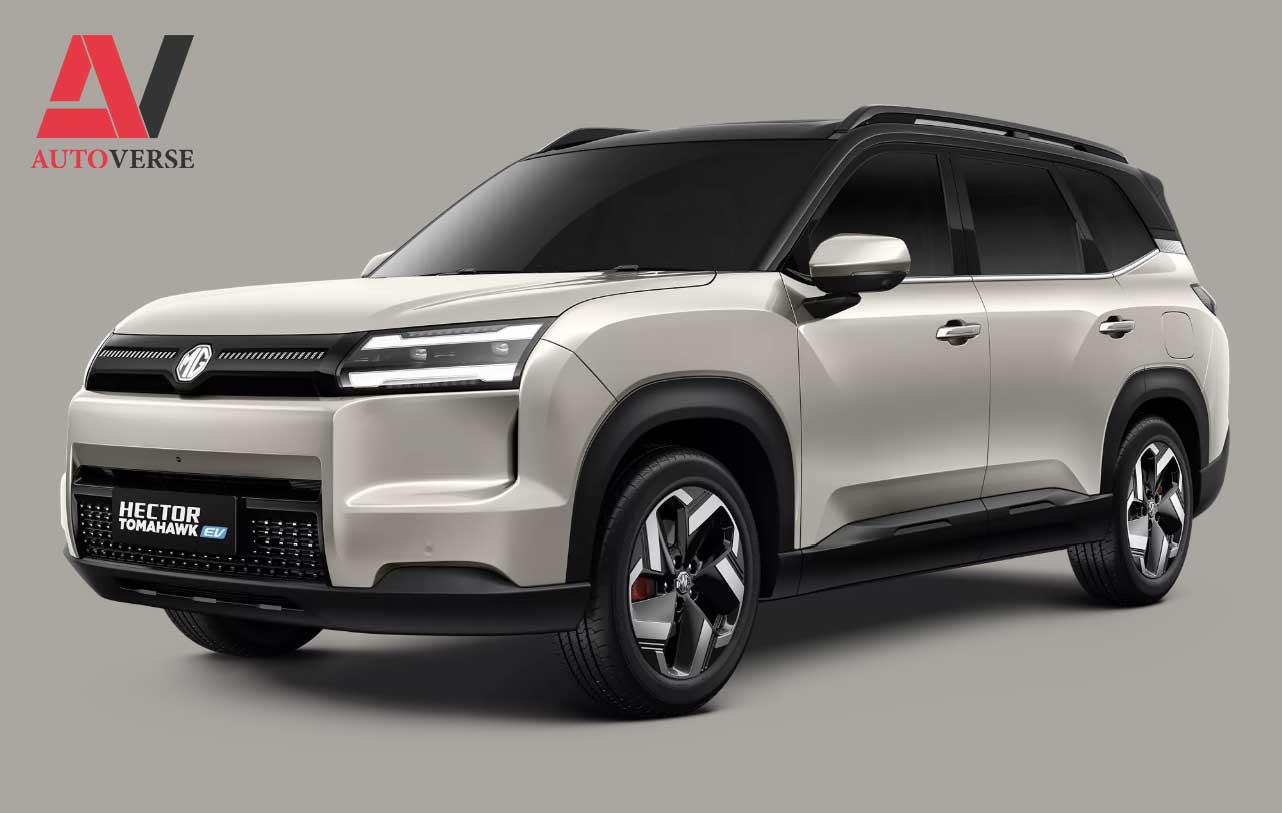
The MG Hector Tomahawk EV promises a 517km range on a single charge, but real-world testing reveals a more practical figure of around 446km. Here’s how the electric SUV performs in city traffic, on highways and during fast charging.
Electric vehicle buyers have one question that matters almost as much as the price: how far can the car actually travel on a full charge? While manufacturers advertise impressive range figures, everyday driving conditions can tell a different story.
The newly launched MG Hector Tomahawk EV is the latest example. With a claimed range of 517km, a large 69.2kWh battery and seating options for five or seven occupants, the electric SUV aims to appeal to families looking for a spacious, feature-rich EV.
However, a real-world range test conducted by Autocar India offers a clearer picture of what buyers can expect. The SUV delivered an estimated range of around 446km under the publication’s standardised testing conditions. While that is lower than the official figure, it remains a useful range for daily commutes and many intercity journeys.
So, what explains the difference, and how does the Tomahawk EV perform when driven in the real world?
MG Hector Tomahawk EV: Battery, Motor and Claimed Range
The MG Hector Tomahawk EV is built on the company’s new ADAPT architecture and is mechanically distinct from the petrol-powered Hector. It is available in five-seat and seven-seat configurations, giving buyers the flexibility to choose between a more conventional family SUV and a three-row option.
Power comes from a front-mounted Permanent Magnet Synchronous Motor (PMSM) producing 204hp and 310Nm of torque. The motor draws energy from a 69.2kWh Lithium Iron Phosphate (LFP) battery pack.
MG claims a range of up to 517km on the Modified Indian Driving Cycle (MIDC). This is a certified test-cycle figure rather than a promise that the vehicle will cover the same distance in every driving situation.
The SUV also offers Eco, Standard, Sport and Custom driving modes, along with four regenerative braking settings: Comfort, Standard, Strong and Intelligent. These options allow drivers to adjust the car’s response and how it recovers energy while slowing down.
MG Hector Tomahawk EV Real-World Range: The Test Results
The Autocar India test recorded different efficiency figures for city and highway driving. The results highlight why an EV’s actual range depends heavily on where and how it is driven.
| Driving conditions | Efficiency | Estimated range |
|---|---|---|
| City driving | 7.15km/kWh | 495km |
| Highway driving | 5.73km/kWh | 397km |
| Combined efficiency | 6.44km/kWh | 446km |
The combined real-world estimate of around 446km is approximately 14% below the claimed 517km range. That difference is not unusual, as official test cycles cannot reproduce every variation in traffic, road conditions, speed and driving style.
The city result is particularly encouraging. At 7.15km/kWh, the Tomahawk EV could offer a substantial driving range for people who primarily use their cars for office commutes, shopping and everyday family duties.
The highway figure, however, is noticeably lower. At 5.73km/kWh, the estimated range drops to around 397km. This matters for buyers who frequently travel between cities, especially if their routes have limited fast-charging infrastructure.
It is worth remembering that these figures are estimates derived from the test’s measured energy efficiency, not a guarantee of the distance every owner will achieve.
Why Does the Range Drop on Highways?
Many buyers assume an electric car will always be more efficient on open roads than in stop-start traffic. In reality, EV efficiency depends on several factors, and highway driving can consume more energy than expected.
At higher speeds, aerodynamic drag increases significantly. The Tomahawk EV’s tall, upright SUV body offers the road presence and cabin space many buyers prefer, but it also has to push more air aside at highway speeds.
Speed is another important factor. Maintaining a high cruising speed generally requires more energy than driving at a moderate pace. Frequent acceleration, steep inclines, a fully loaded cabin and the use of climate control can also influence consumption.
Regenerative braking helps recover some energy when the vehicle slows down. However, there are fewer opportunities for this on a highway where the car maintains a steady speed for long stretches.
For buyers planning long-distance trips, the practical lesson is simple: plan journeys around the highway range rather than relying entirely on the official 517km figure.
Regenerative Braking: Room for Improvement?
The range test also highlighted an area where the Tomahawk EV could improve: regenerative braking.
Although the SUV offers four regeneration settings, the test found that the braking effect remained relatively mild, even in the Strong setting. The system also took approximately a second to engage after the driver lifted off the accelerator.
Regenerative braking converts some of the vehicle’s kinetic energy into electrical energy, returning it to the battery instead of losing all of it as heat through conventional braking.
In city traffic, where drivers regularly slow down and accelerate, a more immediate and stronger regenerative response could help improve efficiency. It can also make one-pedal-style driving easier in vehicles that offer sufficiently strong regeneration.
The delay observed during the test could make the system feel less predictable, particularly in congested urban conditions. This is not necessarily a deal-breaker, but it is a detail prospective buyers should assess during a test drive.
MG Hector Tomahawk EV Charging Time: What the Test Revealed
Charging performance is just as important as driving range, particularly for buyers who plan to use their EV for road trips.
MG claims that the Hector Tomahawk EV can charge from 30% to 80% in around 35 minutes using a 90kW DC fast charger. The company also states that a 7.4kW AC charger takes approximately 12.5 hours to charge the battery from 10% to 100%.
During its test, Autocar India charged the vehicle from 20% to 80% in 32 minutes using a 150kW DC charger. The session recorded a peak charging speed of approximately 89kW.
These results are encouraging, although the charger’s advertised capacity should not be confused with the power the car can actually accept. Even when connected to a higher-capacity charger, the vehicle’s charging system determines the maximum power delivered.
Charging speed can also vary depending on battery temperature, initial state of charge, charger conditions and the battery’s charging curve. The peak figure is not necessarily maintained throughout the session.
For everyday use, home charging remains the more convenient option for owners with a dedicated parking space and suitable electrical installation. Public DC fast charging becomes more important on longer journeys.
How Was the Real-World Range Tested?
To make the results more representative of everyday use, Autocar India conducted its test on a weekday in Mumbai, covering city roads and an adjoining state highway along a fixed loop.
The vehicle started with a fully charged battery, and its tyre pressures were maintained according to the manufacturer’s recommendations. The testers measured the percentage of battery charge consumed over each cycle to estimate efficiency and range.
Climate control was set to 22 degrees Celsius in full-auto mode. Other electrical equipment, including the audio system and ventilated front seats, was used when required.
This approach offers a useful indication of expected performance because it includes normal comfort features rather than testing the car under unrealistically stripped-down conditions.
Nevertheless, results can differ across regions. Temperature, traffic density, elevation, road quality, passenger load and driving habits can all affect the range an owner experiences.
Is the MG Hector Tomahawk EV a Practical Family Electric SUV?
With a claimed range of 517km and a tested combined estimate of around 446km, the Tomahawk EV makes a reasonably strong case for buyers who want a spacious electric SUV without needing to charge every day.
Its city efficiency is a clear positive, while the highway figure suggests that long-distance drivers will need to plan charging stops more carefully. The seven-seat configuration may also appeal to larger families who want the flexibility of a three-row vehicle.
Before buying, prospective owners should consider their daily travel distance, access to home charging and the availability of reliable DC fast chargers along frequently used routes. A test drive that includes both city roads and faster stretches would also help set realistic expectations.
The SUV’s actual range will depend on how it is used, so buyers should leave a reasonable battery reserve rather than planning journeys around the maximum estimated distance.
Verdict: 446km Is the Number That Matters
The MG Hector Tomahawk EV’s claimed 517km range makes for an attractive headline, but its real-world test result of approximately 446km offers a more useful benchmark for prospective buyers.
The SUV performs better in city conditions, where its estimated range reaches 495km, than on the highway, where the figure falls to around 397km. Its fast-charging performance is promising, although the regenerative braking system could be more responsive.
Ultimately, the Tomahawk EV demonstrates why buyers should look beyond official range claims. For daily commuting and regular family use, its tested efficiency appears encouraging. For frequent highway journeys, however, charging access and realistic trip planning will remain essential.
For EV buyers, the biggest takeaway is this: don’t buy a car based only on the range printed in the brochure. Understand how it performs on the roads you actually drive.
Know more about MG Hactor Tomahawk