
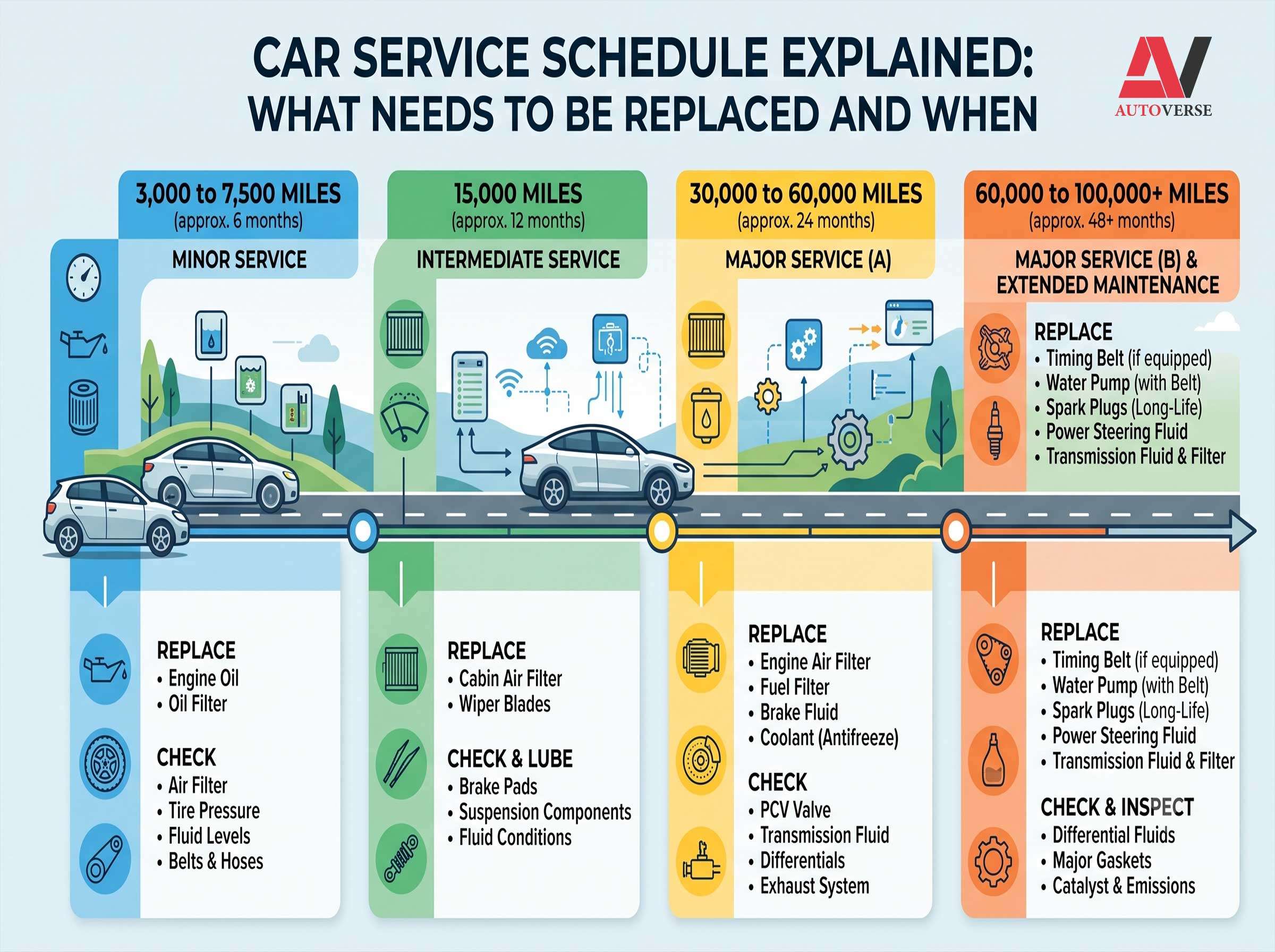
Buying a car is only the beginning of car ownership. To keep it reliable, safe and efficient for years, regular car servicing and preventive maintenance are just as important as choosing the right vehicle.
But many car owners are unsure about what actually needs to be replaced during a service. Does engine oil need to be changed at every service? How often should the air filter be replaced? When do brake pads, coolant, spark plugs and tyres need attention?
The answer is not the same for every car.
Your car’s maintenance requirements depend on factors such as the manufacturer, model, engine type, kilometres driven, vehicle age, driving conditions and maintenance history.
This car service schedule guide explains the major maintenance items in simple terms, including what usually needs inspection, what may require replacement and when you should pay attention to it.
Important: The information in this article is general guidance for car owners. Always follow the maintenance schedule and owner’s manual for your specific vehicle. Manufacturers can specify different intervals even for vehicles with similar engines or fuel types.
Why Is a Car Service Schedule Important?
A scheduled car service is more than simply changing engine oil.
During routine maintenance, technicians generally inspect several components that affect the vehicle’s safety, performance, reliability and running costs.
Regular maintenance can also help identify wear or developing problems before they become more serious or expensive to repair.
For example, worn brake pads may be identified during a routine inspection before braking performance becomes a major concern. Similarly, filters, fluids, tyres and other consumable components can be monitored before they cause avoidable problems.
Manufacturer service schedules commonly include items such as engine oil, filters, brakes, coolant, tyres, battery and other vehicle systems. Hyundai India, for example, publishes model-specific periodic maintenance information rather than one universal schedule for all its cars.
Car Service Schedule: What Needs Attention?
There is no single service schedule that applies to every car in India. However, these are some of the major maintenance items that most car owners should keep track of.
| Component | Typical Maintenance Approach |
|---|---|
| Engine oil | Replace according to manufacturer schedule |
| Oil filter | Usually replaced with engine oil |
| Air filter | Inspect and replace as specified |
| Cabin filter | Inspect/replace according to schedule and condition |
| Brake pads | Inspect regularly; replace when worn |
| Brake fluid | Inspect and replace according to manufacturer schedule |
| Coolant | Check level and condition; replace according to schedule |
| Tyres | Check pressure, tread, damage and age |
| Battery | Test condition; replace when required |
| Spark plugs | Replace according to engine/manufacturer schedule |
| Wiper blades | Replace when worn or visibility deteriorates |
| Transmission fluid | Follow gearbox-specific manufacturer requirements |
Remember: Time and Kilometres Both Matter
Many manufacturers specify maintenance using both time and driving distance, with the applicable interval being whichever comes first.
For example, a manufacturer’s schedule may specify maintenance at a particular number of kilometres or months. The exact figures differ between vehicles. Current Hyundai maintenance schedules demonstrate this approach clearly.
That is why simply following a generic “service every 10,000 km” rule is not appropriate for every car.
1. Engine Oil
Engine oil is one of the most important maintenance items in a petrol or diesel car.
It lubricates moving engine components and helps manage friction and heat. Over time, oil can become contaminated and its performance can change.
The correct replacement interval depends on the engine, oil specification, vehicle and manufacturer’s recommended schedule.
Some vehicles have relatively frequent oil-change requirements, while others have longer intervals.
What should you do?
Follow the manufacturer’s recommendation for:
- Engine oil grade
- Oil specification
- Oil quantity
- Replacement interval
The owner’s manual should be your first reference.
Driving conditions can also matter. Heavy traffic, frequent short journeys, dusty environments or other demanding conditions may lead manufacturers to specify different maintenance requirements.
AutoVerse Tip: Don’t choose engine oil only on the basis of price. The correct specification for your engine is more important.
2. Oil Filter
The oil filter removes contaminants from engine oil.
Because it works continuously while the engine is operating, the oil filter is commonly replaced along with the engine oil.
However, the exact maintenance procedure should always follow the manufacturer’s recommendations.
A current Hyundai maintenance schedule, for example, lists engine oil and the engine oil filter together as replacement items at the specified maintenance intervals.
3. Air Filter
The engine requires clean air for combustion. The air filter helps prevent dust and other particles from entering the engine’s intake system.
As the filter collects contaminants, it can become dirty and eventually restrict airflow.
How quickly this happens depends partly on driving conditions.
A car regularly driven on dusty roads may require more frequent inspection than one primarily used on relatively clean highways.
Best approach: Have the air filter inspected during scheduled servicing and replace it according to the manufacturer’s schedule and its condition.
Manufacturer schedules can specifically distinguish between inspection and replacement.
4. Cabin Air Filter
The cabin or AC filter is different from the engine air filter.
It helps filter air entering the passenger compartment through the ventilation and air-conditioning system.
A clogged cabin filter can reduce airflow and may affect the performance of the AC system.
It can become particularly relevant in cities where vehicles are frequently exposed to dust and pollution.
If you notice:
- Weak AC airflow
- Unpleasant odours
- Excessive dust from the vents
ask for the cabin filter to be inspected.
The replacement interval varies between vehicles. Some manufacturer schedules specify a time-based replacement, while others use different intervals.
5. Brake Pads and Brake Components
Brake pads should not be treated as a simple fixed-interval replacement item.
Their lifespan depends on factors such as:
- Driving style
- Traffic conditions
- Vehicle weight
- Road conditions
- Frequency of braking
- Type of driving
A car used mainly in congested city traffic can experience different brake wear from a vehicle that spends most of its time on highways.
For this reason, brake pads should be inspected for actual wear rather than automatically replaced after a particular number of kilometres.
Signs that brakes need attention
Watch for:
- Squealing or unusual noises
- Vibration while braking
- Reduced braking performance
- Vehicle pulling to one side
- Brake warning indicators
- Excessive pedal travel
If braking behaviour changes noticeably, don’t wait until the next scheduled service.
Manufacturer schedules commonly list brake components for inspection rather than prescribing one universal replacement kilometre figure.
6. Brake Fluid
Brake fluid is important to the operation of hydraulic braking systems.
Unlike brake pads, brake fluid doesn’t simply wear out according to kilometres. Its condition and the manufacturer’s recommended replacement schedule are important.
Over time, brake fluid can absorb moisture, which is one reason manufacturers may specify periodic inspection and replacement.
The exact interval varies by vehicle.
For example, manufacturer maintenance schedules can specify both an initial inspection frequency and a later replacement interval.
AutoVerse Tip: Never assume that every car requires brake-fluid replacement at the same interval.
7. Coolant
Engine coolant helps regulate engine temperature and protects the cooling system.
A common mistake is to think coolant only needs attention when its level becomes low.
During maintenance, the cooling system may also need inspection for:
- Correct coolant level
- Leaks
- Hose condition
- Reservoir condition
- Coolant condition
The replacement interval varies significantly between vehicles and coolant types.
Some current manufacturer schedules have a relatively long initial coolant interval followed by different subsequent intervals.
Safety note: Never open a hot cooling system unnecessarily. Hot coolant and steam can cause serious burns.
8. Spark Plugs
Spark plugs are used in petrol engines and play an important role in combustion.
Their replacement interval depends on the engine and the type of spark plug used.
Some modern spark plugs are designed to last considerably longer than older designs, so a universal replacement figure can be misleading.
Worn or faulty spark plugs can contribute to issues such as:
- Difficult starting
- Rough engine operation
- Misfiring
- Reduced performance
- Poor fuel efficiency
Always check the manufacturer’s maintenance schedule for the correct interval.
Manufacturer schedules demonstrate why there is no single spark-plug replacement figure suitable for every petrol car.
9. Transmission or Gearbox Fluid
Transmission maintenance is often overlooked.
Depending on the vehicle, you may have:
- Manual transmission
- AMT
- Torque-converter automatic
- CVT
- DCT
Each type can have different maintenance requirements.
Some manufacturers specify fluid replacement intervals, while others may have different service procedures.
Therefore, never assume that every automatic gearbox requires the same maintenance schedule.
Check your owner’s manual for the correct transmission-fluid specification and maintenance requirements.
10. Battery
A car battery can gradually lose its ability to hold a charge.
Battery life depends on several factors, including:
- Climate
- Usage
- Driving frequency
- Electrical load
- Battery type
- Charging-system condition
A battery should be tested when you notice:
- Slow engine cranking
- Difficulty starting
- Repeated battery discharge
- Electrical issues
- Battery warning indicators
If your car uses a start-stop system, make sure the replacement battery is the correct type and specification.
Battery condition is also commonly included as an inspection item in manufacturer maintenance schedules.
11. Tyres
Tyres are among the most important safety components on a car.
Don’t wait for a puncture or visible damage before checking them.
Regularly inspect:
- Tread condition
- Tyre pressure
- Uneven wear
- Cracks
- Cuts
- Bulges
- Overall condition
Tyre pressure should generally be checked when the tyres are cold and maintained according to the vehicle manufacturer’s recommended specification.
Tyre replacement is not based only on tread depth. Age, damage and condition also matter.
Some manufacturer maintenance schedules also include tyre rotation along with tread-wear inspection and pressure checks.
12. Wheel Alignment and Balancing
Wheel alignment does not necessarily need to be performed at every service.
It becomes particularly relevant if you notice:
- Uneven tyre wear
- Steering pulling to one side
- Steering wheel not sitting straight
- Vibrations
- A significant impact with a pothole or kerb
Wheel balancing may be required when there is wheel-related vibration, particularly at certain speeds.
The right approach is to inspect and correct these issues when necessary rather than treating alignment and balancing as automatic services at every visit.
13. Wiper Blades
Wiper blades are relatively inexpensive compared with many other vehicle components, but they play an important role in visibility and safety.
They should be replaced when they:
- Leave streaks
- Skip across the windshield
- Produce excessive noise
- Fail to clear water properly
- Have visibly damaged rubber
This becomes particularly important during India’s monsoon season.
What Should Be Checked Regularly?
A simple way to understand car maintenance is to divide it into three categories.
Regular Checks
These should be monitored frequently:
- Tyre pressure
- Engine oil level, where applicable
- Coolant level
- Washer fluid
- Lights
- Wipers
- Warning indicators
Scheduled Maintenance
These generally follow the manufacturer’s service schedule:
- Engine oil
- Oil filter
- Air filter
- Cabin filter
- Brake fluid
- Coolant
- Spark plugs
- Transmission fluid
Condition-Based Replacement
These are generally replaced according to their actual condition or wear:
- Brake pads
- Tyres
- Battery
- Wiper blades
- Belts and related components
- Suspension components
This distinction is important because not every component needs to be replaced simply because the car has reached a particular kilometre mark.
Does City Driving Require More Maintenance?
It can.
A car used mainly in heavy urban traffic may experience more:
- Stop-and-go driving
- Idling
- Frequent braking
- Clutch operation in manual cars
- Short trips
- Frequent AC usage
A vehicle that spends most of its time on highways can experience a very different operating pattern.
Dusty roads can also influence the condition of filters and other components.
This doesn’t mean you should automatically shorten every service interval. Instead, tell the service centre about your actual driving pattern and check whether your manufacturer provides specific guidance for severe or demanding usage.
What About CNG, Hybrid and Electric Cars?
Not every powertrain has the same maintenance requirements.
CNG Cars
CNG vehicles still require regular maintenance of the base vehicle, while CNG-specific components may require additional inspection according to the manufacturer’s schedule.
Hybrid Cars
Hybrid vehicles combine an internal-combustion engine with electric components. Their maintenance requirements can therefore differ from conventional petrol or diesel cars.
Electric Cars
Electric vehicles don’t have conventional engine oil or many of the engine-related components found in ICE vehicles.
However, EVs are not maintenance-free.
Depending on the vehicle, maintenance can include:
- Tyres
- Brakes
- Brake fluid
- Cooling systems
- Cabin filters
- Suspension
- High-voltage battery systems
- Software and diagnostic checks
The exact requirements vary by EV, so owners should still follow the manufacturer’s prescribed maintenance schedule.
What Happens If You Skip Car Servicing?
Skipping a single routine service does not necessarily mean that a car will immediately develop a major problem.
However, consistently ignoring maintenance can increase the likelihood of:
- Reduced reliability
- Poorer performance
- Increased fuel consumption
- Premature component wear
- Reduced braking performance
- Unexpected breakdowns
- Higher repair costs
The bigger concern is that many maintenance problems develop gradually.
By the time a driver notices a serious symptom, the underlying issue may already require more extensive attention.
How to Save Money on Car Maintenance
Maintaining your car doesn’t necessarily mean replacing every part as soon as possible.
A smarter approach is to understand what your vehicle actually requires.
1. Follow the manufacturer’s schedule
Your owner’s manual should be the primary reference for maintenance intervals.
2. Remember both time and kilometres
Don’t assume that low annual mileage means you can ignore time-based maintenance.
3. Keep service records
Maintain invoices and service records. They help you track the vehicle’s maintenance history and can also be useful when selling the car.
4. Don’t replace parts unnecessarily
Ask why a component needs replacement and, where appropriate, request an inspection or measurement.
5. Use the correct specifications
Engine oil, coolant, transmission fluid, battery and other components should meet the manufacturer’s required specifications.
6. Don’t ignore warning signs
Unusual noises, vibrations, warning lights or changes in performance should be investigated rather than ignored.
Simple Car Service Checklist
Before taking your car for service, you can use this quick checklist:
☐ Engine oil
☐ Oil filter
☐ Air filter
☐ Cabin filter
☐ Brake pads and discs
☐ Brake fluid
☐ Coolant
☐ Battery
☐ Tyres and tyre pressure
☐ Wheel alignment if required
☐ Wiper blades
☐ Lights
☐ AC performance
☐ Suspension
☐ Transmission/gearbox
☐ Warning lights
☐ Service history
This checklist is not a replacement for your manufacturer’s maintenance schedule, but it can help you discuss important areas with your service centre.
Frequently Asked Questions
How often should I service my car?
There is no universal interval for every car. Follow the manufacturer’s recommended schedule based on time and kilometres, whichever comes first, unless your manufacturer specifies otherwise.
Should engine oil be changed at every service?
Not necessarily every time you visit a workshop, but engine oil and its filter are commonly replaced according to the manufacturer’s scheduled service interval. The correct interval depends on the vehicle and engine.
How often should brake pads be replaced?
There is no universal kilometre figure. Brake pads should be inspected and replaced when they reach the manufacturer’s specified wear limit or when their condition requires replacement.
Do electric cars need servicing?
Yes. EVs generally have fewer conventional powertrain maintenance requirements, but they still require inspections of items such as tyres, brakes, fluids, suspension and other vehicle systems.
Is a car service necessary if I drive very few kilometres?
Yes. Some maintenance is time-based rather than purely distance-based. A car that covers very few kilometres may still require scheduled maintenance.
Should I follow the service centre’s recommendation or the owner’s manual?
The manufacturer’s owner’s manual and official maintenance schedule should be your primary reference. If a service centre recommends additional work, ask what condition or inspection finding supports the recommendation.
AutoVerse Verdict
A good car service schedule is not about replacing every component at a fixed kilometre interval.
It is about understanding which components require regular inspection, which have manufacturer-defined replacement intervals and which should be replaced according to actual wear or condition.
Engine oil, filters, brakes, tyres, battery, fluids and other components all have different maintenance requirements. Your driving environment can also influence how quickly some components wear.
For Indian car owners, the best approach is simple: follow the manufacturer’s maintenance schedule, remember both time and kilometres, pay attention to warning signs and don’t postpone safety-related maintenance.
Most importantly, don’t rely on a generic internet service chart when your vehicle’s own maintenance schedule is available. Manufacturer schedules can differ significantly between models, and official owner manuals are the most reliable reference for your particular car. Hyundai, for example, provides model- and model-year-specific owner manuals and maintenance information.
Regular maintenance is not simply an expense. It is part of responsible car ownership and can help keep your vehicle dependable, safe and ready for everyday driving.
For more automobile news, buying guides, maintenance tips and expert insights, visit the AutoVerse homepage.