ADAS (Advanced Driver Assistance Systems), are becoming an increasingly important feature in new cars in India. What was once largely associated with expensive premium vehicles is now gradually moving into more affordable segments. In fact, the latest Maruti Suzuki Baleno facelift has brought Level 2 ADAS into a much more accessible part of the Indian car market.
But there is still considerable confusion around what Level 2 ADAS actually means.
Some buyers see features such as adaptive cruise control, lane-keeping assistance and automatic emergency braking and assume that the car can almost drive itself. That is not what Level 2 means.
A Level 2 vehicle can assist with important driving tasks, including steering and acceleration/braking, but the driver remains responsible for monitoring the road and being ready to take control at all times. This distinction is critical for anyone considering an ADAS-equipped car in India.
So, what can Level 2 ADAS really do on Indian roads? What are its limitations? And should you actually pay extra for it when buying a new car?
What Is ADAS?
ADAS stands for Advanced Driver Assistance Systems. It is a collection of electronic safety and convenience technologies designed to help the driver identify potential hazards, maintain vehicle control and reduce the likelihood or severity of certain accidents.
Depending on the car and manufacturer, ADAS can include:
- Adaptive Cruise Control (ACC)
- Lane Keeping Assist
- Lane Centering Assist
- Forward Collision Warning
- Autonomous Emergency Braking
- Blind Spot Monitoring
- Rear Cross-Traffic Alert
- Traffic Sign Recognition
- Driver Attention Monitoring
- Automatic High Beam Assist
Not every car equipped with ADAS offers all of these functions. More importantly, the presence of a feature does not necessarily mean it will operate in the same way on every vehicle.
That is why buyers should look beyond the simple phrase “Level 2 ADAS” and understand exactly what the particular car and variant offers.
What Does Level 2 ADAS Mean?
Level 2 is a specific level in the broader driving-automation classification.
At Level 2, the vehicle can simultaneously assist with steering and acceleration/braking under appropriate conditions. However, the driver must continue monitoring the driving environment and remain ready to intervene.
This is the most important point to remember:
Level 2 ADAS assists the driver. It does not replace the driver.
The difference between Level 2 assistance and higher levels of automation is significant. Consumer vehicles with Level 3–5 automated driving capabilities are not widely available for purchase today, according to NHTSA.
Therefore, an ADAS-equipped Indian car should not be treated as a self-driving car.
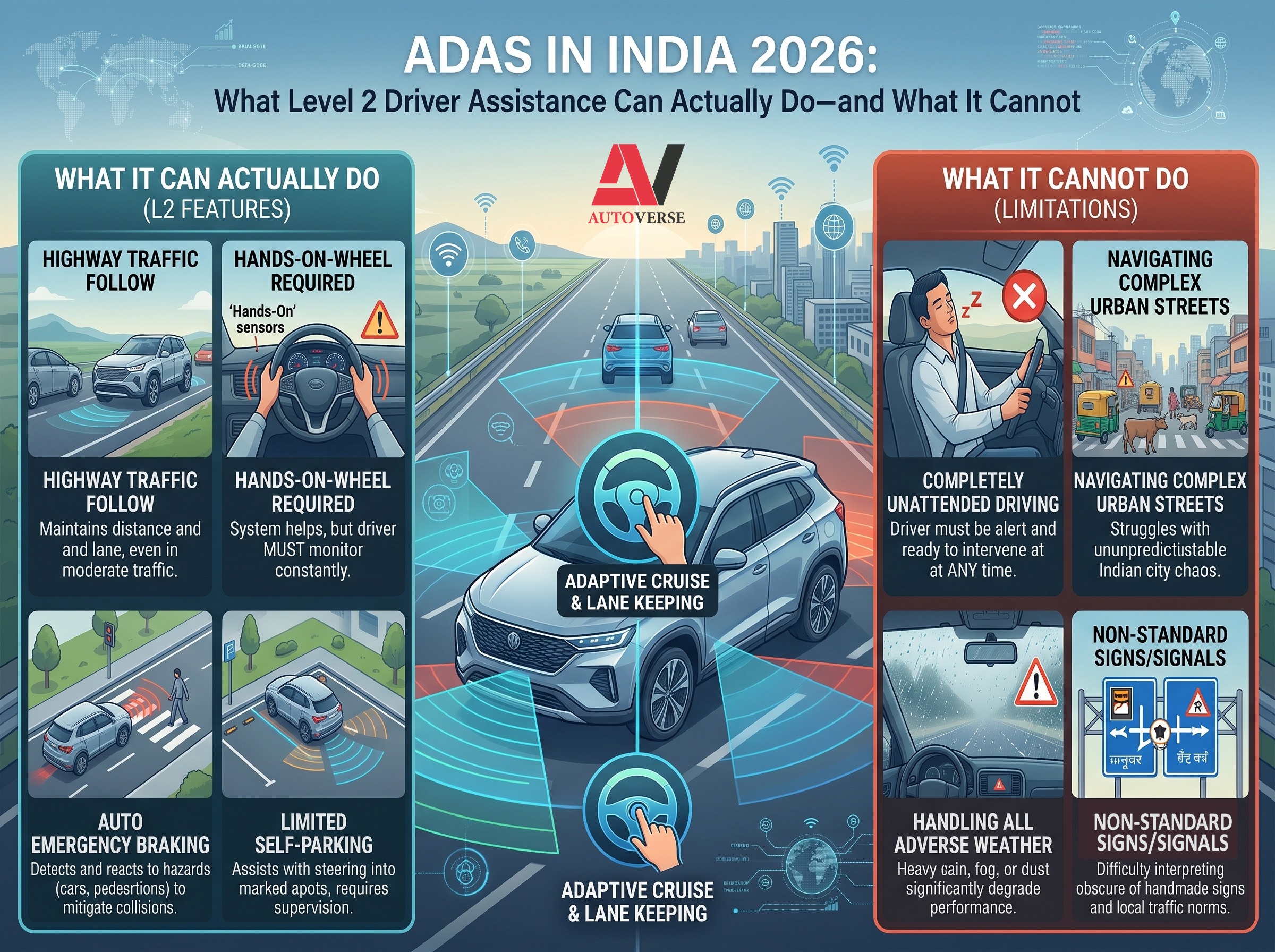
What Can Level 2 ADAS Actually Do?
1. Adaptive Cruise Control
Adaptive Cruise Control, or ACC, can automatically maintain a selected speed and adjust the vehicle’s speed according to traffic ahead.
For example, if you set a cruising speed and the vehicle ahead slows down, ACC can reduce your car’s speed to maintain a selected following distance. When the road clears, the system can accelerate again within its operating parameters.
Why it is useful in India
ACC can be particularly useful on:
- Highways
- Expressways
- Long-distance journeys
- Relatively predictable traffic
It can reduce the amount of repetitive accelerator and brake input required on long journeys.
However, it does not mean the driver can stop paying attention.
2. Lane Keeping Assistance
Lane Keeping Assistance uses cameras or other sensors to identify lane markings and can provide steering assistance when the vehicle begins to move away from its lane.
Some systems merely intervene when the car is drifting, while more advanced systems can provide continuous steering assistance.
NHTSA distinguishes lane-keeping assistance from lane-centering assistance: lane keeping generally helps prevent unintended lane departure, while lane centering can provide more continuous steering support to keep the vehicle positioned within its lane.
The Indian-road limitation
This is where local road conditions become important.
Indian roads can have:
- Faded lane markings
- Sudden lane changes
- Road construction
- Unmarked diversions
- Two-wheelers moving between lanes
- Pedestrians near traffic
- Temporary obstacles
- Vehicles travelling outside clearly marked lanes
If the system cannot confidently identify the lane, its performance can be reduced or the feature may disengage.
This is one reason buyers should not judge an ADAS system only by its feature list.
3. Automatic Emergency Braking
Automatic Emergency Braking, commonly called AEB, can detect certain potential collisions and provide braking assistance when the system determines that a collision may be imminent.
This can be an important additional layer of safety.
However, AEB is not a guarantee that every collision will be avoided.
Its effectiveness can depend on factors such as:
- Vehicle speed
- Object type
- Sensor visibility
- Lighting
- Weather
- Road conditions
- System design
- Detection range
The driver should therefore never deliberately rely on AEB as a substitute for attentive driving.
4. Forward Collision Warning
Forward Collision Warning monitors the road ahead and can alert the driver when the system detects a potential collision risk.
Unlike AEB, a warning system may simply alert the driver rather than automatically applying the brakes.
That distinction is important.
A buyer should check whether a vehicle offers collision warning only, braking intervention, or both.
5. Lane Centering
Lane centering is one of the features that can make Level 2 ADAS feel surprisingly sophisticated.
When conditions are suitable, the system can provide steering inputs to keep the vehicle near the centre of its lane while adaptive cruise control manages speed and following distance.
Together, these functions can reduce driver workload during certain highway journeys.
But again, the driver must continue supervising the vehicle.
NHTSA explicitly describes Level 2 as continuous assistance with both steering and acceleration/braking while the driver remains responsible and attentive.
What Level 2 ADAS Cannot Do
This is arguably more important than understanding what it can do.
It Cannot Drive the Car Without You
The biggest misconception about Level 2 ADAS is that it turns a car into a self-driving vehicle.
It does not.
The driver remains responsible for the driving task.
NHTSA’s guidance is particularly clear: even the highest levels of consumer driving assistance available today still require driver engagement and attention.
So you cannot safely:
- Sleep while ADAS is active
- Watch a movie
- Use your phone
- Take your hands and attention away from the road
- Assume the vehicle will handle every situation
It Cannot Understand Every Indian Traffic Situation
ADAS systems rely on sensors, cameras, software and algorithms.
But Indian traffic can be extremely unpredictable.
A motorcycle may suddenly appear between vehicles. A pedestrian may cross outside a marked crossing. A car may stop unexpectedly. A temporary road diversion may confuse lane recognition.
The system may assist in many situations, but it cannot be expected to understand every situation in the same way an attentive human driver might.
This is also why India-specific calibration matters. Industry discussion around ADAS development increasingly focuses on adapting systems to India’s mixed traffic, frequent lane changes, two-wheelers, pedestrians and other road conditions.
Why ADAS Can Be Challenging on Indian Roads
One of the biggest questions for Indian buyers is whether ADAS designed for well-marked highways will work equally well in everyday Indian traffic.
The answer is: not necessarily.
There is a major difference between:
A well-marked expressway
and
A busy urban road with motorcycles, autos, pedestrians and inconsistent lane markings.
ADAS generally works best when the road environment is predictable.
For this reason, buyers should think of Level 2 ADAS as a driver workload-reduction and safety-support system, rather than an autonomous driving solution.
Is Level 2 ADAS Useful for Indian Buyers?
Yes—but its value depends heavily on how you drive.
ADAS can be especially useful if you:
- Frequently drive on highways
- Travel long distances
- Use expressways regularly
- Want additional collision-warning technology
- Value driver-assistance features
- Prefer technology that can reduce fatigue during long journeys
ADAS may be less useful if you:
- Mostly drive short distances in crowded city traffic
- Rarely use highways
- Expect the car to drive itself
- Are uncomfortable with electronic steering interventions
- Do not understand the system’s limitations
This is why “Does this car have ADAS?” is not the right question by itself.
The better question is:
“Does this car’s ADAS actually suit the way I drive?”
Should You Pay Extra for ADAS?
This is where buyers need to be practical.
If the ADAS package is available only on a much more expensive variant, don’t automatically upgrade just because the feature sounds advanced.
First consider:
- Safety equipment
- Airbags
- Electronic stability control
- ABS
- Vehicle crash performance
- Tyre quality
- Visibility
- Driving position
- Braking performance
- Overall vehicle safety
ADAS should be viewed as one part of the safety package, not the entire safety story.
For a buyer who regularly drives on highways, the additional convenience and assistance may justify choosing a higher variant.
For a predominantly urban driver, spending a large premium solely for Level 2 ADAS may not provide the same value.
Level 2 ADAS vs Self-Driving: The Simple Difference
| Feature | Level 2 ADAS | Fully Autonomous Driving |
|---|---|---|
| Steering assistance | Yes | Yes |
| Acceleration/braking assistance | Yes | Yes |
| Driver monitoring | Required | Depending on automation level |
| Driver responsible | Yes | No, within system’s operating conditions |
| Can driver sleep? | No | Only where permitted by the automation system |
| Can driver ignore the road? | No | Depends on automation level |
| Suitable for all roads? | No | Depends on system design |
| Available widely in India? | Increasingly available | No |
The key takeaway is simple:
Level 2 is assistance, not independence.
How Buyers Should Evaluate ADAS Before Buying a Car
Instead of looking only at the brochure, ask the dealership specific questions.
1. Which ADAS functions are actually available?
Don’t assume every Level 2 system includes the same features.
2. Which variant gets the technology?
Sometimes ADAS is restricted to higher variants.
3. Does adaptive cruise control work at low speeds?
The exact operating behaviour can differ between systems.
4. Does lane centering work continuously?
Some systems provide stronger steering assistance than others.
5. How does the system respond when lane markings disappear?
This is particularly relevant for Indian roads.
6. Is driver monitoring included?
A system that monitors driver attention can be an important part of the overall package.
7. Can the system be switched off?
Understand how the vehicle manages ADAS settings and warnings.
8. Can you test-drive the car?
This may be the most useful step of all.
A test drive can tell you whether the steering inputs feel smooth or intrusive and whether the system suits your driving style.
ADAS in India 2026: What Is Changing?
ADAS is no longer limited to ultra-premium vehicles.
The technology is gradually moving down the price ladder. The latest example is the 2026 Maruti Suzuki Baleno facelift, which has introduced Level 2 ADAS in a significantly more affordable segment.
At the premium end, manufacturers are also working toward increasingly sophisticated driver-assistance systems. Hyundai Motor Group, for example, has announced plans involving Level 2+ and Level 2++ systems in the coming years, while still emphasising that these systems require driver supervision.
This suggests that ADAS will increasingly become a normal part of the Indian car-buying conversation.
But the technology’s growing availability makes consumer education even more important.
A feature becoming common does not mean its limitations disappear.
The Real Benefit of ADAS: Reducing Driver Workload
The strongest argument for Level 2 ADAS is not that it can “drive for you.”
It is that it can help you during demanding parts of a journey.
On a long highway trip, maintaining speed, monitoring the vehicle ahead and making constant small steering corrections can become tiring.
A well-calibrated ADAS system can help with some of these repetitive tasks.
That does not eliminate the driver’s job.
Instead, it can make the driver’s job less tiring and potentially safer when used correctly.
This distinction should be central to how buyers evaluate the technology.
Clear Buyer Takeaway
If you are buying a new car in India in 2026, Level 2 ADAS is worth considering—but it should not be the only reason to choose a particular car.
For frequent highway users, adaptive cruise control, lane-centering assistance and collision-warning/braking systems can provide meaningful assistance.
For predominantly city-based drivers, the benefit may be more limited because Indian urban traffic often involves conditions in which lane-based assistance is less predictable.
Most importantly, never buy a car assuming Level 2 means self-driving.
It doesn’t.
The best ADAS system is not necessarily the one with the longest feature list. It is the one that works predictably, communicates clearly with the driver and fits the conditions in which the car will actually be used.
AutoVerse Verdict
ADAS is one of the most promising safety and convenience technologies coming into mainstream cars in India, but buyers need to understand what they are paying for.
Our view is simple: Level 2 ADAS should be treated as an intelligent co-driver, not a replacement for the driver.
For highway-heavy users, it can make long journeys less tiring and add another layer of assistance when used correctly. For city drivers, its usefulness depends much more on traffic conditions, road markings and how well the particular system is calibrated.
The most important buying decision is therefore not:
“Does this car have Level 2 ADAS?”
It is:
“How well does this particular ADAS system work, what are its operating limits, and does it match my driving needs?”
As more affordable Indian cars begin offering Level 2 assistance, that is the conversation buyers should be having.
AutoVerse rating for the technology: Worth having, but not worth misunderstanding.
For more automobile news, reviews, features and buyer-focused insights, visit AutoVerse – Explore the Auto Universe.