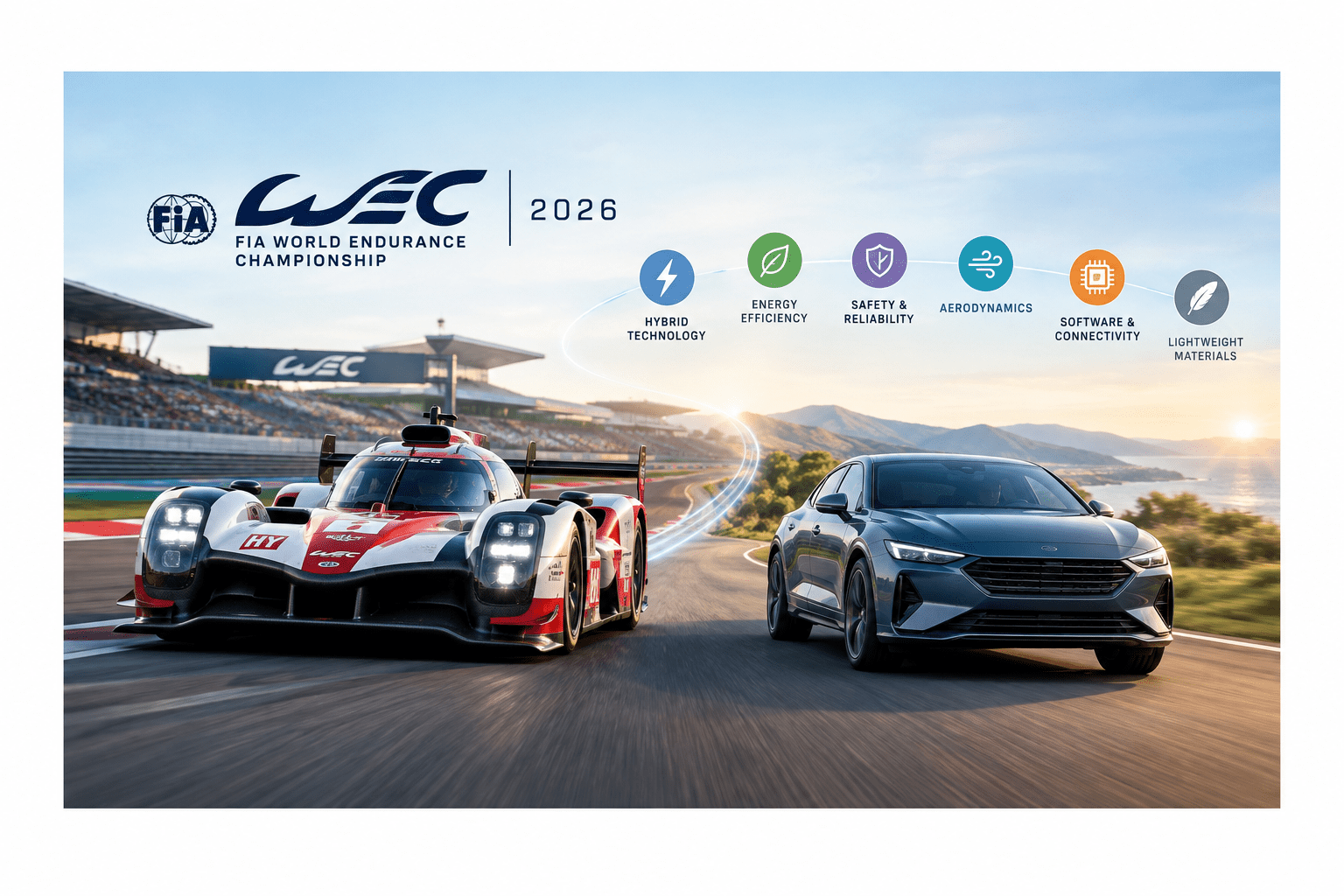
The FIA WEC 2026 (FIA World Endurance Championship 2026) is becoming much more than a showcase of fast racing cars. In 2026, the championship has brought together a record-equalling 14 major automotive manufacturers, including Toyota, Ferrari, BMW, Cadillac, Porsche, Aston Martin, Alpine, Peugeot and Genesis, with manufacturers using endurance racing to develop and demonstrate advanced automotive technology.
At the centre of this competition is the Hypercar category, where manufacturers push their engineering teams to improve efficiency, performance, reliability and technology over long-distance races.
But why should an ordinary car buyer care about a racing championship?
The answer is simple: many technologies tested under extreme racing conditions can eventually influence road cars.
From hybrid powertrains and energy recovery to lightweight construction, aerodynamics, software and thermal management, FIA WEC provides manufacturers with a demanding environment to test ideas that could become increasingly important in future production cars.
What Is FIA WEC Hypercar Racing?
FIA WEC is an international endurance racing championship built around races that test cars and drivers for several hours at a time. Its biggest event is the legendary 24 Hours of Le Mans, where reliability can be just as important as outright speed.
The Hypercar class is the championship’s headline category. It features technologically advanced racing cars developed under regulations designed to encourage manufacturer participation while controlling performance.
The 2026 Hypercar field includes cars from manufacturers such as Toyota, Ferrari, BMW, Cadillac, Alpine, Aston Martin, Peugeot and Genesis.
These cars are not simply built to be fast for a few laps. They have to survive long races, manage energy efficiently, maintain performance and operate under changing weather and track conditions.
That makes WEC particularly interesting from a road-car technology perspective.
Why Endurance Racing Matters to Road Cars
Traditional motorsport has often been described as a laboratory for automotive innovation. FIA WEC takes that idea even further because endurance racing puts enormous pressure on the entire vehicle.
A racing car may complete hundreds or thousands of kilometres during an event while its powertrain, brakes, tyres, battery systems, electronics and cooling systems operate under extreme conditions.
Manufacturers therefore have to answer an important question:
How can we extract more performance without simply using more energy?
That question is equally important for future road cars.
Modern buyers increasingly expect cars to deliver better performance, lower energy consumption, greater reliability and more technology at the same time. WEC gives manufacturers an opportunity to experiment with solutions under demanding conditions.
Hybrid Technology Could Become Even Smarter
One of the most important links between WEC and road cars is hybrid technology.
Hybrid systems combine an internal-combustion engine with electric assistance. In racing, however, the objective is not simply to improve fuel economy. Engineers also have to manage energy deployment, acceleration, braking and overall efficiency during long-distance competition.
The Toyota GR010 Hybrid is one prominent example of a WEC Hypercar built around hybrid technology.
The lessons learned from racing can potentially influence future production vehicles in several ways.
Engineers can study how energy is recovered during braking, how electric power can be deployed efficiently and how batteries and motors can operate under high loads.
For road cars, this could mean more efficient hybrid systems, smoother electric assistance and better energy management.
Regenerative Braking Could Improve
Regenerative braking is already common in hybrid and electric vehicles, but motorsport can help engineers explore more advanced ways of using it.
Instead of allowing braking energy to simply disappear as heat, a hybrid vehicle can recover some of that energy and store it for later use.
In endurance racing, where every unit of energy matters, efficient energy recovery can become a major performance advantage.
Future road cars could benefit from improvements in:
- Brake-energy recovery
- Battery charging efficiency
- Electric motor response
- Energy distribution
- Thermal management
- Software-controlled power delivery
The result could be road cars that feel more responsive while using energy more intelligently.
Lightweight Engineering Will Remain Important
Another major lesson from endurance racing is the importance of reducing weight.
A lighter car generally requires less energy to accelerate, brake and change direction. It can also improve handling and efficiency.
Hypercar manufacturers therefore pay close attention to materials, structural design and aerodynamic efficiency.
Road cars are becoming increasingly complex, with larger batteries, more electronics, advanced safety systems and additional comfort equipment. That makes weight reduction even more challenging.
Future production cars could increasingly use lightweight materials and smarter structural engineering to offset the weight added by batteries and technology.
The goal will not simply be to make cars lighter. It will be to achieve the best possible balance between weight, strength, safety, efficiency and performance.
Aerodynamics Could Influence Everyday Cars
Look at a WEC Hypercar and the importance of aerodynamics is immediately obvious.
Every surface has a purpose. Engineers need to generate sufficient downforce for cornering while keeping aerodynamic drag under control on long straights.
Road cars do not need the extreme aerodynamic solutions of racing cars, but some of the underlying principles are highly relevant.
Future road vehicles could use increasingly sophisticated aerodynamic design to improve:
- High-speed stability
- Highway efficiency
- Wind noise
- Cooling
- Range
- Driving dynamics
As electric vehicles become more common, aerodynamic efficiency becomes particularly important because reducing drag can help extend driving range.
This means that racing-inspired aerodynamic development could eventually influence the shape of everyday electric and performance cars.
Thermal Management Is Becoming Critical
A racing car generates enormous amounts of heat.
The engine, electric motors, battery, brakes and tyres all have to operate within controlled temperature ranges. If temperatures become excessive, performance can fall and components can suffer damage.
Road cars face similar challenges, particularly modern hybrids and EVs.
Battery temperature management is especially important for electric vehicles because extreme temperatures can affect charging performance, efficiency and battery life.
WEC gives manufacturers an environment in which cooling systems, thermal strategies and energy management can be tested under severe conditions.
The technology developed from such work could contribute to more reliable batteries, faster charging and better performance consistency in future road cars.
Software Will Become as Important as Hardware
Modern race cars are no longer just mechanical machines.
They depend heavily on software, sensors, data analysis and electronic control systems.
During an endurance race, teams constantly monitor vehicle performance and make decisions based on enormous amounts of data.
That approach is increasingly relevant to road cars.
Future vehicles will depend more heavily on software to manage:
- Battery energy
- Hybrid power delivery
- Regenerative braking
- Vehicle stability
- Thermal systems
- Driver assistance
- Performance modes
This could eventually make road cars more adaptable. A vehicle could automatically change its energy strategy depending on traffic, road conditions, temperature and driving style.
Reliability May Become a Bigger Selling Point
Speed attracts attention, but endurance racing is ultimately about finishing.
A car that is extremely fast but unreliable may lose to a slightly slower car that can maintain its performance for hours.
This philosophy is valuable for road cars too.
Consumers expect their vehicles to operate reliably for years, not just deliver impressive performance during a short test drive.
The demanding nature of WEC can therefore help manufacturers understand how components behave under sustained stress.
That knowledge can potentially contribute to more durable engines, motors, batteries, cooling systems and electronic components.
From Racing Track to Showroom
The relationship between motorsport and road cars is not new.
Manufacturers have historically used racing programmes to develop technologies, demonstrate engineering capabilities and strengthen their performance brands.
The modern WEC era takes this relationship in a slightly different direction.
The focus is increasingly on efficiency, electrification, energy management and sustainable performance, rather than simply chasing the highest possible engine output.
That is particularly relevant as the automotive industry moves toward electrification and more efficient powertrains.
The lessons learned on the race track may therefore become increasingly useful for ordinary road vehicles.
WEC Could Shape the Next Generation of Performance Cars
Performance cars of the future may not necessarily rely on bigger engines.
Instead, manufacturers could focus on achieving more performance through a combination of combustion engines, electric motors, sophisticated software, lightweight construction and advanced aerodynamics.
That is where the WEC Hypercar concept becomes particularly interesting.
Racing demonstrates how several technologies can work together as one system.
A future road-going performance car could use similar principles to deliver strong acceleration, efficient energy use and stable high-speed handling without relying solely on engine displacement.
The Future Could Be More Efficient, Not Just Faster
Perhaps the biggest lesson from FIA WEC is that performance and efficiency do not necessarily have to be opposites.
Endurance racing rewards manufacturers that can extract maximum performance while managing limited energy and maintaining reliability.
That philosophy fits perfectly with the direction of the modern automotive industry.
Whether the future belongs to hybrids, EVs or a combination of different technologies, manufacturers will need to find smarter ways to use energy.
WEC provides a high-pressure environment in which those ideas can be tested.
FIA WEC 2026 and the Road Ahead
The significance of FIA WEC in 2026 goes beyond the results of individual races.
With a record-equalling 14 manufacturers involved across the championship, competition is creating a strong platform for automotive technology development.
The series is also already looking further ahead. FIA WEC has announced that from 2030, the Hypercar category will move to a single two-wheel-drive technical platform, showing that the championship is continuing to evolve its technical framework.
For road-car enthusiasts, this makes WEC worth watching closely.
The next major breakthrough may not arrive in a showroom first. It could appear on a race track, be tested under extreme conditions and then gradually find its way into a production vehicle.
Final Verdict
FIA WEC Hypercar racing is more than a battle for trophies. It is a real-world engineering challenge that can help manufacturers explore the future of automotive technology.
Hybrid systems, regenerative braking, lightweight materials, aerodynamics, thermal management, software and energy efficiency are all areas where lessons from endurance racing can have relevance beyond motorsport.
Not every racing technology will make it into a family car, and a road car will never need the same extreme hardware as a Le Mans prototype. But the engineering philosophy is increasingly relevant.
As the automotive industry moves toward electrification, smarter software and greater efficiency, the technologies developed in FIA WEC could play an important role in shaping the performance and efficiency of tomorrow’s road cars.
For enthusiasts, that makes the 2026 FIA WEC season about more than watching manufacturers race. It