
CNG vs Hybrid vs EV vs Petrol is becoming an important question for Indian car buyers in 2026. Rising running costs, changing fuel preferences, improving electric-vehicle technology and a wider choice of alternative-powertrain cars are giving buyers more options than ever before.
The shift is visible in India’s latest passenger-vehicle retail data. In August 2026, CNG/LPG, hybrid and electric cars together accounted for 41.95% of passenger-vehicle retail sales, compared with 40.85% for petrol/ethanol vehicles. This was the first time the combined alternative-fuel category moved ahead of petrol/ethanol in India’s passenger-vehicle retail market. However, petrol/ethanol remained the largest individual powertrain category.
CNG/LPG accounted for 25.28%, hybrids for 9.04%, EVs for 7.63%, while diesel stood at 17.21%. Overall passenger-vehicle retail sales reached 4,02,398 units in August 2026, up 16.14% year on year.
So, does this mean petrol cars are losing their importance? Not necessarily. Instead, it shows that Indian buyers now have a much wider choice.
From affordable CNG hatchbacks and SUVs to strong hybrids and new-generation EVs, every powertrain has its own advantages and limitations.
CNG vs Hybrid vs EV vs Petrol: Quick Comparison
| Powertrain | Best suited for | Main advantage | Main limitation |
|---|---|---|---|
| Petrol | Low-to-medium usage and frequent travel | Easy refuelling and wide availability | Higher running cost |
| CNG | High daily running | Lower fuel cost | CNG availability and boot-space considerations |
| Hybrid | City + highway driving | Better efficiency without external charging | Higher purchase price |
| EV | City and predictable daily driving | Very low running cost | Charging time and infrastructure |
There is therefore no universal winner. The right choice depends on how much you drive, where you drive and what infrastructure is available to you.
Popular Petrol Cars in India 2026
Petrol remains the most straightforward choice for many Indian car buyers.
A petrol car can be refuelled quickly, petrol stations are widely available and buyers have a huge selection of hatchbacks, sedans and SUVs.
Some popular petrol-powered cars available in India include:
Hatchbacks
- Maruti Suzuki Swift
- Maruti Suzuki Baleno
- Hyundai Grand i10 Nios
- Hyundai i20
- Toyota Glanza
SUVs and Crossovers
- Maruti Suzuki Fronx
- Maruti Suzuki Brezza
- Hyundai Exter
- Hyundai Venue
- Hyundai Creta
- Kia Sonet
- Kia Seltos
- Tata Punch
- Tata Nexon
- Mahindra XUV 3XO
- Mahindra Scorpio-N
- Toyota Fortuner
Sedans
- Maruti Suzuki Dzire
- Hyundai Verna
- Honda City
- Honda Amaze
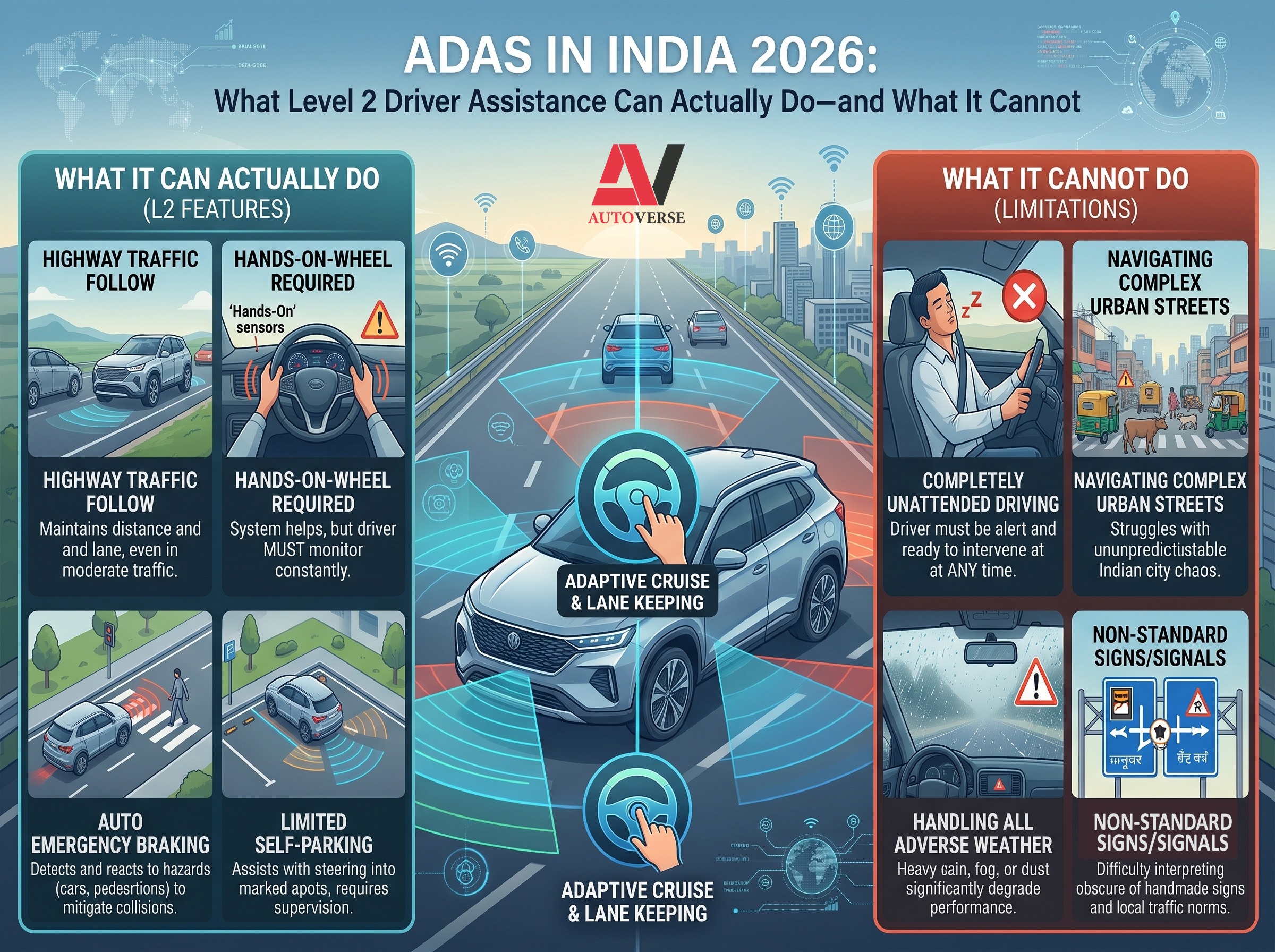
The updated 2026 Maruti Suzuki Baleno, for example, has received a major technology and feature update, including Level 2 ADAS, while continuing to be offered as a mainstream petrol/CNG hatchback.
Who should choose petrol?
A petrol car can make sense if:
- Your annual running is relatively low or moderate.
- You frequently travel between cities.
- You do not have convenient CNG access.
- You do not have home or workplace EV charging.
- You want quick and convenient refuelling.
- You want a wide choice of models.
The drawback
The biggest disadvantage is running cost. For someone driving a large number of kilometres every month, CNG, hybrid or EV options may offer better fuel or energy economics.
Popular CNG Cars in India 2026
CNG has become one of India’s most important alternative-fuel choices, particularly among high-mileage users.
In August 2026, CNG/LPG accounted for 25.28% of passenger-vehicle retail sales, making it the largest part of the alternative-fuel mix.
Popular CNG cars currently available
Maruti Suzuki
- Maruti Suzuki Alto K10 CNG
- Maruti Suzuki Celerio CNG
- Maruti Suzuki WagonR CNG
- Maruti Suzuki Swift CNG
- Maruti Suzuki Dzire CNG
- Maruti Suzuki Baleno CNG
- Maruti Suzuki Fronx CNG
- Maruti Suzuki Brezza CNG
- Maruti Suzuki Ertiga CNG
- Maruti Suzuki XL6 CNG
Hyundai
- Hyundai Grand i10 Nios CNG
- Hyundai Exter CNG
- Hyundai Aura CNG
Tata Motors
- Tata Tiago iCNG
- Tata Tigor iCNG
- Tata Altroz iCNG
- Tata Punch iCNG
- Tata Nexon iCNG
Toyota
- Toyota Glanza CNG
- Toyota Urban Cruiser Hyryder CNG
The current CNG market includes hatchbacks, sedans and SUVs, giving buyers more flexibility than before. Current Indian-market listings also show models such as the Tata Punch, Maruti Brezza and Maruti Fronx among the prominent CNG options.
New CNG models to watch
Kia has now opened pre-bookings for the Carens CNG and Carens Clavis CNG. These should be described as new/upcoming CNG options, rather than established models already selling in the market. Kia has not yet announced their final prices.
Who should choose CNG?
CNG is particularly suitable if:
- You drive a lot every day.
- Your monthly running is high.
- You have easy access to CNG stations.
- Running cost is a major priority.
- Most of your regular routes have CNG availability.
The drawback
CNG infrastructure is not equally convenient in every location. Buyers who frequently travel to areas without CNG stations may find petrol or hybrid vehicles more convenient.
Boot-space practicality can also vary by model depending on how the CNG system is packaged.
Popular Hybrid Cars in India 2026
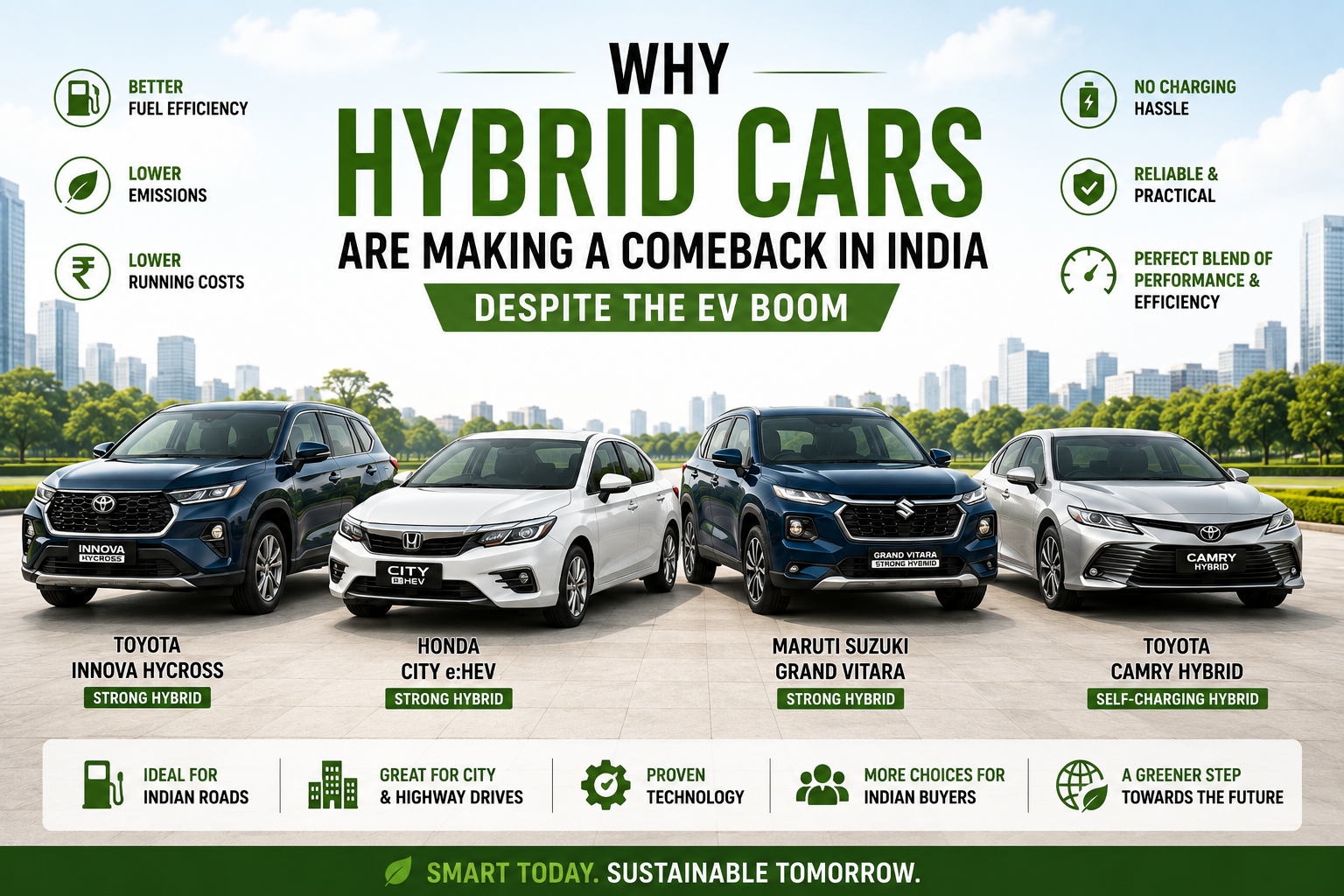
Hybrid cars offer an interesting middle ground between conventional petrol vehicles and full EVs.
A strong hybrid combines a petrol engine with an electric motor and battery. The system can use electric assistance in suitable conditions and recover energy during braking.
One of its biggest advantages is that you do not need to plug the car into a charger.
Hybrids accounted for 9.04% of passenger-vehicle retail sales in August 2026, according to FADA data.
Popular hybrid cars in India
- Maruti Suzuki Grand Vitara Strong Hybrid
- Maruti Suzuki Victoris Strong Hybrid
- Maruti Suzuki Invicto
- Toyota Urban Cruiser Hyryder Strong Hybrid
- Toyota Innova HyCross Hybrid
- Toyota Camry Hybrid
- Toyota Vellfire
- Honda City e:HEV
New hybrid model to watch
Kia has opened pre-bookings for the Carnival Limousine Hybrid in September 2026. Because it is a newly announced model, it is better classified as a new/upcoming hybrid option, rather than an established high-volume hybrid model.
Who should choose a hybrid?
A hybrid can be a strong choice if:
- You drive frequently in cities.
- You want better fuel efficiency.
- You also make regular highway trips.
- You do not want to depend on charging infrastructure.
- You want an easier transition from petrol to electrified driving.
The drawback
Hybrid cars can cost more upfront than comparable conventional petrol variants. Buyers should therefore consider their annual kilometres and ownership period before deciding whether the additional purchase price is worthwhile.
Popular Electric Cars in India 2026
Electric vehicles are now available across several price segments in India.
The market includes affordable city EVs, compact electric SUVs, larger family SUVs and premium models.
EVs accounted for 7.63% of passenger-vehicle retail sales in August 2026.
Popular electric cars in India
Tata Motors
- Tata Tiago EV
- Tata Punch EV
- Tata Nexon EV
- Tata Curvv EV
- Tata Harrier EV
Mahindra
- Mahindra XUV400
- Mahindra BE 6
- Mahindra XEV 9e
- Mahindra XEV 9S
Maruti Suzuki
- Maruti Suzuki e Vitara
Hyundai
- Hyundai Creta Electric
- Hyundai Ioniq 5
MG Motor
- MG Comet EV
- MG Windsor EV
- MG ZS EV
Kia
- Kia EV6
- Kia EV9
BYD
- BYD Atto 3
- BYD Seal
- BYD Sealion 7
VinFast
- VinFast VF 6
- VinFast VF 7
The expanding model range means EV buyers now have considerably more choice than they did a few years ago.
Who should choose an EV?
An EV can be particularly attractive if:
- Most of your driving is within a city.
- You can charge at home or work.
- Your daily driving distance is predictable.
- You want very low day-to-day energy costs.
- You are comfortable planning longer journeys around charging stops.
The drawback
Charging remains an important consideration.
Before buying an EV, check whether you can install home charging and whether public chargers are available along your regular long-distance routes.
CNG vs Hybrid vs EV vs Petrol: Which Has the Lowest Running Cost?
It is tempting to simply rank EV, CNG, hybrid and petrol from cheapest to most expensive, but that would not be accurate for every owner.
Actual running costs depend on:
- Fuel or electricity prices
- Vehicle efficiency
- Annual kilometres
- Driving conditions
- Home charging tariff
- CNG availability
- Highway usage
An EV charged primarily at home can offer very low energy costs. CNG can be highly economical for high-mileage drivers, while a strong hybrid can provide good fuel efficiency without requiring external charging.
A petrol car may still be the financially sensible option for someone who drives relatively little because the initial purchase price can be an important part of total ownership cost.
Therefore, total cost of ownership is more important than simply comparing fuel prices.
Which Is Best for City Driving?
For regular urban driving, EVs, hybrids and CNG cars can all make sense.
EV
Best suited to predictable city commuting when reliable home or workplace charging is available.
Hybrid
A strong option for city traffic because the electric motor can assist during low-speed and stop-start driving.
CNG
Useful for drivers covering high daily kilometres who have easy access to CNG stations.
Petrol
Still practical for low-mileage drivers who value convenience and quick refuelling.
Which Is Best for Highway Driving?
For frequent highway travel, petrol and hybrid cars continue to offer excellent convenience.
Petrol stations are widely available, while hybrids can be refuelled like conventional petrol cars.
CNG can also work well on long-distance routes where CNG stations are readily available.
EVs are increasingly practical for highway travel, but buyers should consider the vehicle’s real-world range, charging speed and charger availability before making a purchase.
CNG vs Hybrid vs EV vs Petrol: Which Should You Buy?
Choose Petrol if you want convenience
Petrol is suitable for buyers who drive relatively less, travel frequently and do not want to plan around charging or CNG stations.
Choose CNG if you drive a lot
CNG can make strong financial sense for high-mileage commuters and other users who have convenient access to CNG.
Choose Hybrid if you want efficiency without charging
A hybrid provides an attractive balance between fuel efficiency and the convenience of a conventional petrol car.
Choose EV if you mainly drive in the city
An EV can be particularly appealing when home charging is available and daily driving is predictable.
Why Are Indian Car Buyers Moving Beyond Petrol?
The latest market data shows that the Indian passenger-vehicle market is becoming increasingly diverse.
Several factors are contributing to the change.
Lower running costs
CNG and EVs can reduce everyday running expenses, while hybrids can improve fuel efficiency.
More model choices
Alternative-powertrain vehicles are no longer restricted to a handful of models. Buyers can now choose from hatchbacks, sedans, SUVs and MPVs.
Improving EV technology
Better range and a gradually expanding charging network are making EVs more practical for more buyers.
Growing hybrid availability
Hybrids offer fuel-efficiency benefits without requiring the owner to install a charger.
Changing buyer priorities
Running cost, technology and long-term ownership expenses are becoming increasingly important when people choose a new car.
FADA has also pointed to factors including the wider availability of alternative-fuel models and consumer concerns around the E20 transition. Reuters reported that these factors, alongside oil prices and improving EV range and charging infrastructure, are influencing the shift.
Final Verdict: CNG vs Hybrid vs EV vs Petrol
There is no single winner in the CNG vs Hybrid vs EV vs Petrol debate.
Petrol remains the simplest all-round choice for convenience and flexibility.
CNG can be an excellent option for high-mileage users looking to reduce running costs.
Hybrid offers a strong balance between efficiency, convenience and long-distance usability.
EV can provide very low running costs for buyers with reliable charging access.
The August 2026 market numbers show why this comparison matters. CNG/LPG, hybrid and EV cars together accounted for 41.95% of passenger-vehicle retail sales, slightly ahead of petrol/ethanol at 40.85%. But petrol/ethanol remained the largest individual category.
This is therefore not the end of petrol cars. Instead, it is evidence that Indian consumers now have more powertrain choices.
For a low-mileage owner, petrol may still be the smartest choice. For a high-mileage commuter, CNG can be more economical. For someone wanting better efficiency without charging, a hybrid can be an excellent compromise. And for a city driver with home charging, an EV may be the most economical option for daily use.
Before making a purchase, compare the on-road price, expected annual running, fuel or electricity cost, maintenance, charging/refuelling availability and expected ownership period.
The best powertrain is ultimately the one that matches the way you actually drive.
Frequently Asked Questions
Which is better in India in 2026, CNG or petrol?
CNG can be better for high-mileage users with easy access to CNG stations. Petrol remains more convenient for low-mileage users and people who frequently travel through areas without CNG infrastructure.
Is a hybrid better than an EV?
It depends on your usage. A hybrid offers better efficiency without external charging, while an EV can provide very low running costs if dependable charging is available.
Which has the lowest running cost: CNG, hybrid, EV or petrol?
There is no universal answer. An EV charged at home can have very low energy costs, while CNG can be highly economical for high-mileage users. Actual savings depend on local fuel and electricity prices and the vehicle’s efficiency.
Which is better for city driving: EV or hybrid?
Both can be excellent. An EV is particularly suitable when home charging is available and daily routes are predictable. A hybrid is useful for buyers who want efficiency without depending on charging.
Are CNG, hybrid and EV cars becoming more popular in India?
Yes. Their combined share reached 41.95% of passenger-vehicle retail sales in August 2026, compared with 40.85% for petrol/ethanol.
Should I buy a CNG, hybrid or EV car in 2026?
Consider your annual kilometres, typical driving routes, access to CNG or charging, purchase budget and how long you plan to keep the vehicle. There is no single powertrain that is best for every buyer.
For more automobile news, reviews, features and buying guides, visit AutoVerse and explore the auto universe.